Canada
Charlevoix
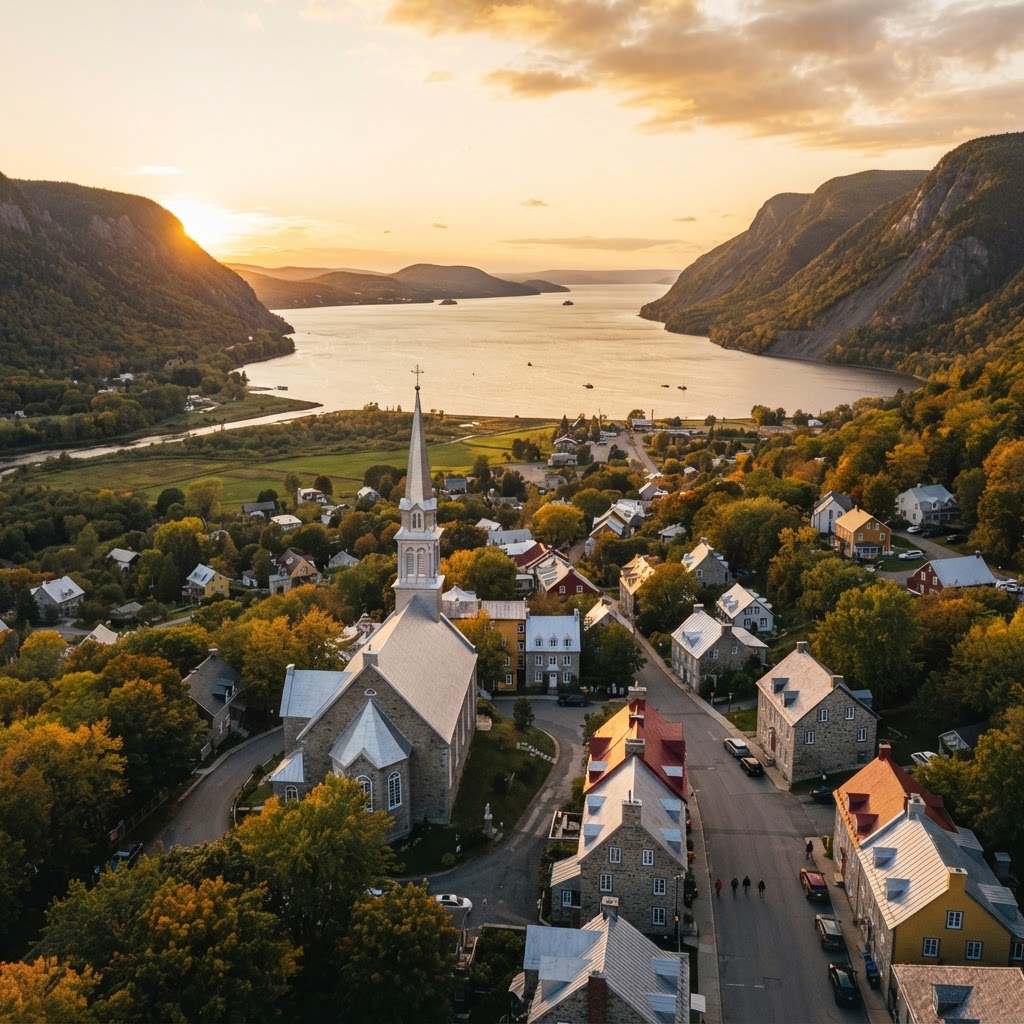
Ancient meteorite crater where Laurentian peaks plunge straight into the St. Lawrence.
Plan & book
Sort your Charlevoix trip in one place.
We point you to the booking tools we'd actually use — live prices, no markup. Or let us build the day-by-day plan around you first, then book.
Carved into the Canadian Shield by a colossal meteorite impact 400 million years ago, Charlevoix sits just over an hour northeast of Quebec City along Route 138. It is defined by dramatic topographical contrasts: towering granite cliffs and alpine ridges tumbling directly into the tidal estuary of the St. Lawrence River. Functioning primarily through two anchor hubs—the bohemian, art-dense valley village of Baie-Saint-Paul and the historic grand resort corridor of La Malbaie—Charlevoix blends serious outdoor topography with Quebec's most concentrated farm-to-table culinary corridor, Route des Saveurs.
4 days
Best time
Mid-July to mid-August for warm hiking and coastal patios, or late September to early October for peerless fall foliage.
Build your own trip with these prebuilt itineraries
Each one is a tested, day-by-day plan for Charlevoix — start here, then make it yours.
5 Days in Charlevoix: Terroir, Nordic Spas & Scenic Byways in Charlevoix
A slow-paced epicurean and romantic getaway focused on Route des Saveurs artisanal producers, cideries, thermal baths, and riverside estates
4 Days in Charlevoix: The Essential Crater & Coast in Charlevoix
First-time overview blending dramatic fjord-and-mountain hikes, coastal village drives, and the region's famous farm-to-table dining
3 Days in Charlevoix: Epic Trails & Wilderness in Charlevoix
High-intensity outdoor adventure tackling the iconic Acropole des Draveurs, canyon treks, and back-country exploration across the national parks
Go for the vertical drama of alpine-river landscapes matched with exceptional local gastronomy. Unlike rolling rural escapes, Charlevoix offers the highest vertical drop east of the Canadian Rockies at Le Massif, remote backcountry hiking in the river-gorges of Parc national des Hautes-Gorges-de-la-Rivière-Malbaie, and Michelin-caliber terroir dining powered by local duck, artisan cheese, and regional ciders.
Where to stay
Getting there
Getting around
Food & drink
What it costs
Things to do
Book tours & tickets in CharlevoixSkip it if
Skip Charlevoix if you do not plan to drive or rent a vehicle, as you will be stranded in a single village. Skip it if you are seeking high-octane city nightlife, late-night shopping, and extensive museum networks; head to Montreal or Old Quebec instead.
When to go
Summer brings open farm gates along the Route des Saveurs, full ferry service, and accessible alpine trails, but lodging books months in advance. Late September trades water recreation for staggering red-and-gold forest canopy across the meteorite crater, while late spring and late fall bring dreary mud, closed venues, and bone-chilling coastal dampness.
Peak (Mid-July–Labor Day & late Sept–mid-Oct)
Warmest weather, lively outdoor dining, and fiery autumn canopy; hotel rates hit peak levels and major trails in national parks require early arrivals.
Shoulder (June & January–March)
June delivers crisp, bug-light hiking before crowds surge; winter offers premier ski conditions, backcountry touring, and river-ice vistas, though side roads can be intensely icy.
Low (November–mid-Dec & April–early May)
Mud season, freezing rain, and lingering dirty snowdrifts; many seasonal farm stands, bistros, and coastal activities shut down completely.
Neighborhoods
Where you stay shapes the trip. Here's how to think about it.
Baie-Saint-Paul
Bohemian artistic valley hub packed with galleries, microbreweries, and heritage stone-and-clapboard architecture.
Best for:First-timers, foodies, and travelers who want walkable evenings without relying on a car for dinner.
Don't miss:Rue Saint-Jean-Baptiste for gallery hopping, followed by duck confit poutine and house ales on the patio at Microbrasserie Charlevoix.
La Malbaie (including Pointe-au-Pic)
Historic Gilded-Age grand resort cliffside corridor overlooking the wide St. Lawrence estuary.
Best for:Couples, luxury travelers, golfers, and those prioritizing river-view fine dining and historic estates.
Don't miss:A stroll along the cliffside chemin du Havre at Pointe-au-Pic, paired with dinner at the heritage Fairmont Le Manoir Richelieu.
Petite-Rivière-Saint-François
Sleepy, pine-scented coastal village anchored by the precipitous alpine terrain of Le Massif.
Best for:Skiers, snowboarders, downhill mountain bikers, and travelers seeking modern architectural cabins in the woods.
Don't miss:Riding the Le Massif gondola for an 800-meter vertical drop view that looks straight into the St. Lawrence River.
Isle-aux-Coudres
Slow-tempo island time with tidal mudflats, active windmills, orchards, and maritime salt breeze.
Best for:Cyclists, relaxed day-trippers, and families wanting flat, vehicle-light country exploration.
Don't miss:Renting a tandem bicycle or four-person quadricycle at Vélo-Coudres to loop the perimeter, stopping for fresh cider at Cidrerie et Vergers Pedneault.
Les Éboulements & Saint-Irénée
Rolling pastureland along panoramic Route 362 with sea breezes, artisan farms, and classical music venues.
Best for:Agritourism lovers, scenic road trippers, and travelers wanting quiet rural immersion between the main towns.
Don't miss:The sandy beach and heritage concert barn at Domaine Forget de Charlevoix in Saint-Irénée.
Destination intelligence
Updated 9/14/2026The structured record we plan every Charlevoix itinerary from.
Walkability
Low overall. Individual village centers (Rue Saint-Jean-Baptiste in Baie-Saint-Paul or the wharf area in La Malbaie) are walkable, but traveling between points of interest requires driving.
Transit quality
Poor. Intercar regional buses link primary highway towns, but internal transit to trailheads, ski hills, and rural producers is nonexistent.
Car needed
Yes, absolutely essential for exploring the region's nature parks, coastal drives, and farm circuit.
Ideal duration
4 days
Minimum useful
2 days
Peak season
Mid-July through Labor Day for summer hiking, river sports, and patio dining; late September to mid-October for explosive autumn foliage across the crater valley.
Shoulder season
June for early uncrowded hiking before the summer rush; January to March for winter sports, Le Massif powder days, and dog sledding.
Low season
November through mid-December and April to early May; freezing rain, lingering snowmelt, mud season, and broad commercial closures make travel bleak.
Best for
Common mistakes
- Assuming public transit or taxis can connect you between towns, parks, and farm producers; they cannot.
- Relying on the tourist train (Train de Charlevoix) for regular year-round transit; passenger services are seasonal and frequently modified.
- Underestimating winter driving conditions—Route 138 and Route 362 feature severe elevation pitches and rapid snow squalls off the river.
- Skipping dinner reservations during July, August, or leaf-peeping weekends in September and October, when dining rooms book solid weeks ahead.
- Attempting the Acropole des Draveurs hike without adequate water, hiking boots, and an early-morning start to beat park capacity limits.
Best nearby
How to plan it
- Base yourself in Baie-Saint-Paul if you prioritize evening walkability, art galleries, and craft breweries where you don't have to drive home after dinner.
- Choose La Malbaie if your priority is quiet luxury, historic manor properties, golf, and quick access to whale-watching boats further downriver.
- Take Route 362 (Route du Fleuve) between Baie-Saint-Paul and La Malbaie instead of Route 138; it adds 15 minutes of driving but hugs dramatic cliff edges and rolling coastal hamlets.
- Do not try to hike the Acropole des Draveurs in Parc National des Hautes-Gorges on the same day you visit Isle-aux-Coudres; the trail requires 4 to 6 hours of grueling elevation and deserves a dedicated day.
- Pair Charlevoix with a 2-day stay in Quebec City, using the 75-minute drive on Route 138 to stop at Canyon Sainte-Anne on the way in.
- Secure park trail day-use passes and vehicle entry through the SÉPAQ portal 48 hours in advance during July, August, and autumn peak weekends to avoid being turned away at full trailheads.
Questions
More in Canada

Cape Breton Island, Nova Scotia
Canada
Sea-sculpted highlands, living Celtic fiddling traditions, and wild Atlantic drama.
Kelowna
Canada
Sun-drenched vineyards, lakeside living, and pine-scented benchlands in British Columbia’s interior.
Whitehorse
Canada
The subarctic wilderness capital where boreal trails meet gold rush frontier culture
Yellowknife, Northwest Territories, Canada
Canada
The subarctic aurora capital perched on the ancient Canadian Shield.
Churchill, Manitoba
Canada
The subarctic frontier for wild polar bears, estuary belugas, and uninterrupted auroras.
Gaspé Peninsula (Gaspésie), Quebec
Canada
End-of-the-world sea cliffs, ancient Appalachian spines, and winding coastal highways.
Readymade itineraries
Start from a tested template — then make it yours.
Ready to book
Lock in your Charlevoix trip
Everything in one place. We may earn a small commission — it never costs you more.
Plan a trip to Charlevoix
Pick a length and we'll build a day-by-day plan around how you travel — neighborhoods clustered, budget-aware, and editable.
Get better at planning trips like this
Occasional notes on planning smarter — no spam, unsubscribe anytime.
Plan a trip to Charlevoix
Turn this guide into a day-by-day plan built around your pace, your group, and your budget.
Build my Charlevoix trip