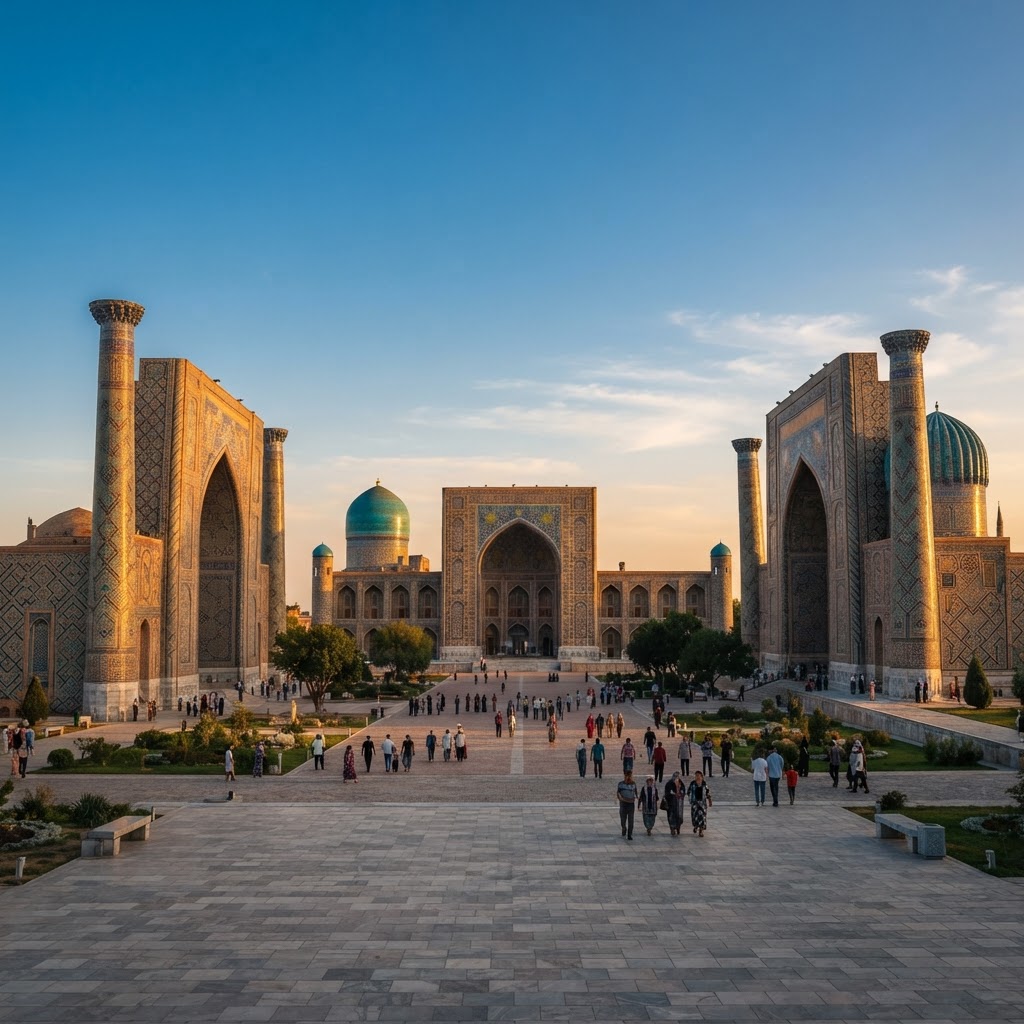
Uzbekistan
Samarkand, Uzbekistan
Monolithic Timurid majesty and electric blue tilework anchored along the Silk Road.
Plan & book
Sort your Samarkand, Uzbekistan trip in one place.
We point you to the booking tools we'd actually use — live prices, no markup. Or let us build the day-by-day plan around you first, then book.
Samarkand is the theatrical, grand-scale monument of Amir Timur's empire. Unlike Bukhara's preserved medieval mudbrick density or Khiva's open-air walled compound, Samarkand is a sprawling modern city punctuated by colossal madrasahs, soaring turquoise ribbed domes, and tiled necropolises that redefine Islamic architecture. It offers the most dramatic visual architecture on the Silk Road, supported by modern high-speed rail connections from Tashkent.
2 to 3 days
Build your own trip with these prebuilt itineraries
Each one is a tested, day-by-day plan for Samarkand, Uzbekistan — start here, then make it yours.
Go for monuments constructed at an imperial scale seen nowhere else in Central Asia. The sheer proportion of the Registan, the intricate majolica mosaics of Shah-i-Zinda, and the monumental scale of Bibi-Khanym Mosque justify the journey on their own. It also serves as the operational gateway to both the Zarafshan mountains and cross-border excursions into Tajikistan's Fann Mountains.
Where to stay
Getting there
Getting around
Food & drink
What it costs
Things to do
Book tours & tickets in Samarkand, UzbekistanSkip it if
Skip Samarkand if you are looking for an unbroken, mudbrick ancient-walled oasis where you can wander aimlessly through alleys without cars; Bukhara and Khiva fit that profile far better. Also skip if you cannot handle severe summer heat (above 40°C/104°F) while navigating large stone courtyards with little shade.
Destination intelligence
Updated 9/12/2026The structured record we plan every Samarkand, Uzbekistan itinerary from.
Walkability
Moderate. Individual monument clusters like the pedestrianized Islam Karimov corridor (Registan to Siab Bazaar) are very walkable, but reaching Gur-e-Amir, the Russian Quarter, or Shah-i-Zinda requires short taxi rides across wide Soviet-era avenues.
Transit quality
Moderate. There is a small tram system running toward the railway station, but visitors rely almost entirely on dirt-cheap, reliable app-based taxis (Yandex Go) and intercity high-speed rail.
Car needed
No. Driving in Samarkand is unnecessary and frustrating due to aggressive traffic patterns, unmarked lanes, and limited monument parking. Taxis and trains cover every tourist need.
Ideal duration
2 to 3 days
Minimum useful
2 days
Peak season
Spring (April to May) and Autumn (September to October), offering mild temperatures (20°C–28°C / 68°F–82°F) and clear skies, matching the peak demand for trains and boutique hotels.
Shoulder season
March and November. Chilly mornings and occasional rain, but significantly thinner crowds at the Registan and open availability on Afrosiyob trains.
Low season
Summer (June to August) brings dry, blistering heat consistently over 40°C (104°F) making daytime sightseeing draining. Winter (December to February) brings sub-freezing snaps, gray skies, and occasional snow.
Best for
Common mistakes
- Failing to book Afrosiyob train tickets the exact day they release (around 45 days prior), which forces a switch to slower 4-hour Soviet-era trains or long private car transfers.
- Visiting the Registan exclusively in the middle of the day when the sun bleaches out the tile colors and midday tour groups pack the courtyards; visit at 8:00 AM opening and return after dusk for the night illumination.
- Assuming historical sites are as tightly clustered as in Bukhara; Samarkand is a wide, 20th-century Soviet-planned city requiring taxis between disconnected historical pockets.
- Arriving for plov after 2:00 PM when traditional plov centers have already emptied their cauldrons and shut down service for the day.
- Ignoring modest dress expectations; shoulders and knees must be covered inside Gur-e-Amir, active mosques, and the holy shrine corridors of Shah-i-Zinda.
Best nearby
More in Uzbekistan
Readymade itineraries
Start from a tested template — then make it yours.
Ready to book
Lock in your Samarkand, Uzbekistan trip
Everything in one place. We may earn a small commission — it never costs you more.
Plan a trip to Samarkand, Uzbekistan
Pick a length and we'll build a day-by-day plan around how you travel — neighborhoods clustered, budget-aware, and editable.
Get better at planning trips like this
Occasional notes on planning smarter — no spam, unsubscribe anytime.
Plan a trip to Samarkand, Uzbekistan
Turn this guide into a day-by-day plan built around your pace, your group, and your budget.
Build my Samarkand, Uzbekistan trip