Chile
San Pedro de Atacama
Adobe alleys, lunar geology, and the planet's clearest night skies at 2,400 meters.
Plan & book
Sort your San Pedro de Atacama trip in one place.
We point you to the booking tools we'd actually use — live prices, no markup. Or let us build the day-by-day plan around you first, then book.
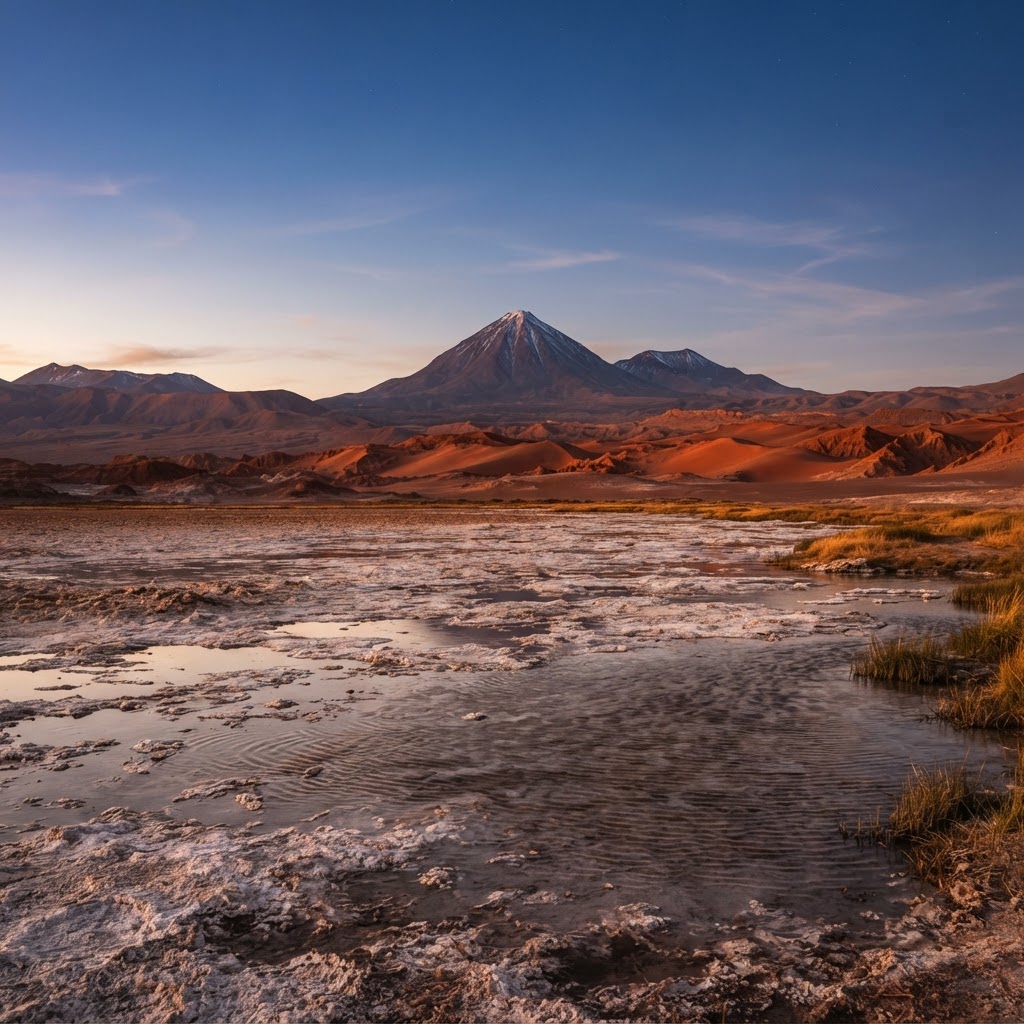
San Pedro de Atacama is an adobe-walled oasis perched at 2,400 meters (7,900 feet) in the world's driest non-polar desert. Framed by the smoking Licancabur volcano and surreal evaporite basins, the town acts as the operational basecamp for traversing multi-hued clay canyons, hypersaline lagoons, and steaming Andean geyser fields reaching 4,320 meters. Beyond extreme geology, the hyper-arid atmosphere and zero light pollution produce the most transparent stargazing conditions on Earth.
5 to 6 days
Build your own trip with these prebuilt itineraries
Each one is a tested, day-by-day plan for San Pedro de Atacama — start here, then make it yours.
5 Days in San Pedro de Atacama
In-Depth High Desert Exploration & Acclimatization Route
3 Days in San Pedro de Atacama
Classic Atacama: Geysers, High Andean Lagoons & Stargazing
2 Days in San Pedro de Atacama
Atacama Highlights: Valle de la Luna & Piedras Rojas
No other single base in the Americas lets you walk across salt crusts resembling cracked porcelain in the morning, watch geysers plume against minus-ten-degree dawn air at 4,320 meters, and study the southern night sky through high-powered research optics before midnight. The sheer density of otherworldly terrain—from the wind-sculpted clay ridges of Valle de la Luna to the turquoise altiplanic lagoons of Miscanti and Miñiques—makes it an essential pairing with Patagonia or the Bolivian Altiplano.
Where to stay
Getting there
Getting around
Food & drink
What it costs
Things to do
Book tours & tickets in San Pedro de AtacamaSkip it if
Skip San Pedro de Atacama if you cannot tolerate acute high-altitude exposure, as critical highlights require ascending above 4,000 meters (13,000 feet). It is also a poor fit if you dislike fine dust, intense ultraviolet sun, and long daily driving across unpaved washboard roads, or if you demand vibrant urban nightlife and lush green scenery.
Destination intelligence
Updated 9/12/2026The structured record we plan every San Pedro de Atacama itinerary from.
Walkability
Moderate within the town center, which is flat, compact, and unpaved; unfeasible outside of town without vehicle transport or guided excursions.
Transit quality
Poor; there is no municipal public transit. Movement relies solely on tour operators, pre-arranged shuttles, or personal rental vehicles.
Car needed
Optional for solo travelers using day tours, but strongly recommended (high-clearance SUV) for parties of two or more desiring flexibility.
Ideal duration
5 to 6 days
Minimum useful
4 days
Peak season
December to February (Southern Hemisphere summer; warm days, busy town, though subject to the unpredictable afternoon rains of the Altiplanic Winter / Invierno Boliviano).
Shoulder season
April to June (Autumn) and September to November (Spring; virtually zero rain, crisp transparent night skies, lower crowds, and comfortable hiking weather).
Low season
July to August (Southern Hemisphere winter; reliably clear skies and low rainfall, but night and early morning temperatures regularly plummet well below freezing).
Best for
Common mistakes
- Booking high-elevation excursions (like Geysers del Tatio at 4,320m or Piedras Rojas at 4,000m) on Day 1 or Day 2 instead of acclimatizing first at Valle de la Luna (2,500m) and Cejar (2,300m).
- Scheduling astronomy tours during a full moon; telescope tours lose visibility and deep-sky contrast for several days surrounding the bright lunar peak.
- Underestimating dramatic 25°C+ day-to-night temperature swings; packing light shorts for daytime while forgetting thermal base layers, gloves, and fleece for sub-zero dawns at El Tatio.
- Failing to drink sufficient water or electrolytes; hyper-arid air accelerates dehydration and amplifies altitude headaches well before you feel thirsty.
- Renting a compact city car in Calama instead of a high-clearance SUV or 4x4, causing tire punctures or beaching on washboard dirt tracks.
Best nearby
More in Chile
Readymade itineraries
Start from a tested template — then make it yours.
Ready to book
Lock in your San Pedro de Atacama trip
Everything in one place. We may earn a small commission — it never costs you more.
Plan a trip to San Pedro de Atacama
Pick a length and we'll build a day-by-day plan around how you travel — neighborhoods clustered, budget-aware, and editable.
Get better at planning trips like this
Occasional notes on planning smarter — no spam, unsubscribe anytime.
Plan a trip to San Pedro de Atacama
Turn this guide into a day-by-day plan built around your pace, your group, and your budget.
Build my San Pedro de Atacama trip