Argentina
Salta, Argentina
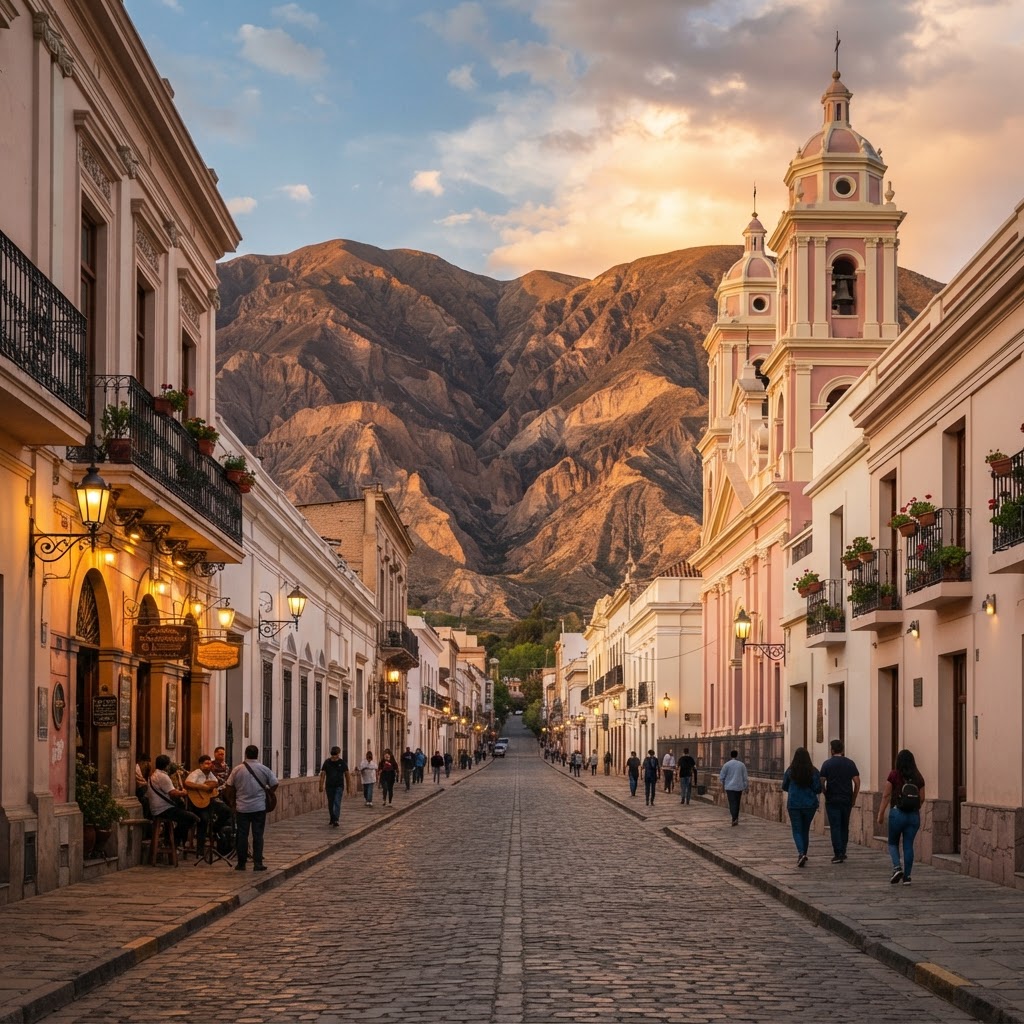
Colonial architecture, folk peñas, and the dramatic high-altitude gateway to the Calchaquí Valleys.
Plan & book
Sort your Salta, Argentina trip in one place.
We point you to the booking tools we'd actually use — live prices, no markup. Or let us build the day-by-day plan around you first, then book.
Nicknamed 'Salta la Linda' (Salta the Pretty), this colonial provincial capital sits in the Lerma Valley at 1,152 meters above sea level. It is the cultural and logistical anchor of Argentina's rugged northwest, balancing 18th-century arcades and world-class high-altitude archaeology with lively folk music halls known as peñas. While the compact urban core can be thoroughly explored on foot in 24 to 48 hours, Salta's primary appeal is serving as the launching pad for spectacular high-altitude road trips south into the red canyons of Cafayate and north into the salt flats and Andean quebradas of Jujuy.
How long
4 to 5 days (1 to 2 days in Salta city, paired with a multi-day road trip loop through Cafayate or Cachi)
Best time
April to June (autumn) and September to November (spring) offer the ideal balance of dry gravel passes, crisp mountain visibility, and temperate days.
Build your own trip with these prebuilt itineraries
Each one is a tested, day-by-day plan for Salta, Argentina — start here, then make it yours.
3 Days in Salta: Culture, Folklore & Andean Archaeology in Salta
Car-free cultural immersion focused on historic downtown architecture, world-class high-altitude archaeology, and traditional folk music nightlife
4 Days in Salta: The Classic City & Wine Loop in Salta
First-time overview balancing colonial history, lively peñas, and a road trip through Quebrada de las Conchas to Cafayate's high-altitude vineyards
Come for an authentic intersection of Spanish colonial history and Andean indigenous traditions that feels entirely distinct from European Buenos Aires or alpine Patagonia. In town, you will encounter the gripping Incan children of Llullaillaco at the MAAM museum, eat Argentina's crispest wood-fired empanadas salteñas, and spend late nights singing along at traditional peñas along Calle Balcarce. Outside town, Salta provides immediate access to some of South America's most dramatic geological driving routes, including the Quebrada de las Conchas and the historic dirt switchbacks of the Cuesta del Obispo.
Where to stay
Getting there
Getting around
Food & drink
What it costs
Things to do
Book tours & tickets in Salta, ArgentinaSkip it if
Skip staying in Salta city if your itinerary allows fewer than three days total and you have no intention of leaving the urban limits; the town itself has modest museum offerings and colonial landmarks that do not justify an arduous detour without exploring the surrounding quebradas, vineyards, and Andean landscapes.
When to go
Northwest Argentina's mountain passes and scenic unpaved stretches along Ruta 40 become treacherous during summer rains, while midwinter brings massive domestic holiday crowds that fill hotels and peñas.
Peak (July & Semana Santa)
Argentine winter school breaks and Holy Week bring heavy crowds, surging hotel rates, and fully booked peñas; reserve lodging and rental cars months ahead.
Shoulder (April–June & September–November)
Clear blue skies, dry roads across the high puna, comfortable daytime temperatures around 20°C (68°F), and manageable shoulder pricing.
Low (December–February)
Heavy summer rains cause sudden flash floods and mudslides (volcanes de barro) that frequently close high-elevation mountain roads like Cuesta del Obispo.
Neighborhoods
Where you stay shapes the trip. Here's how to think about it.
Centro Histórico (Plaza 9 de Julio)
Colonial pedestrian core anchored by arcaded squares, candy-pink cathedrals, and daytime bustle.
Best for:First-timers, short stays, and travelers without a rental car.
Don't miss:The Incan frozen-child exhibits at the Museo de Arqueología de Alta Montaña (MAAM) right on the west face of the plaza.
Balcarce (Estación de Tren)
Quiet daytime rail district that turns into the city's unapologetic folklore, peña, and late-night social corridor.
Best for:Night owls, live folk music enthusiasts, and traditional dinner gatherings.
Don't miss:A late-starting guitar and charango set paired with tamales at La Casona del Molino (just west) or Peña La Vieja Estación on Calle Balcarce.
Paseo Güemes & Monumento
Upmiddle-class residential enclave offering leafy sidewalks, relaxed craft cocktail spots, and boutique cafes away from downtown bus exhaust.
Best for:Couples, quiet evenings, and boutique hotel seekers.
Don't miss:Walking to the foot of the monumental stone staircase at Monumento a Güemes for an outdoor espresso under the jacarandas.
Portezuelo & Cerro San Bernardo
Scenic hillside zone at the eastern fringe providing wide Valley views and leafy park access.
Best for:Active travelers and families seeking green space and quiet nights.
Don't miss:Boarding the Teleférico San Bernardo inside Parque San Martín to reach the summit for sunset panoramic views over the Lerma Valley.
Villa San Lorenzo
Cool, forested foothills retreat 15 minutes west of downtown with sub-tropical microclimates and spacious fincas.
Best for:Summer travelers escaping valley heat, hikers, and extended stays with a vehicle.
Don't miss:Hiking the misty trails of the Reserva Natural Quebrada de San Lorenzo followed by tea and regional pastries at a local estancia.
Destination intelligence
Updated 9/14/2026The structured record we plan every Salta, Argentina itinerary from.
Walkability
High within the 6-block grid surrounding Plaza 9 de Julio; low once traveling outside the historic core or heading up Cerro San Bernardo.
Transit quality
Moderate. Urban SAETA buses require rechargeable cards and mainly serve residential routes; travelers rely on cheap radio taxis, private remises, or long-distance buses.
Car needed
Not needed for exploring downtown Salta, but strongly recommended to rent a car at the airport if you plan to visit Cafayate, Cachi, or the Quebrada de Humahuaca independently.
Ideal duration
4 to 5 days (1 to 2 days in Salta city, paired with a multi-day road trip loop through Cafayate or Cachi)
Minimum useful
2 days (1 day exploring downtown colonial sites and peñas, 1 day on an organized excursion to the Quebrada de las Conchas)
Peak season
July (Argentine winter school holidays) and Easter Holy Week (Semana Santa), bringing full hotels, packed peñas, and peak accommodation rates.
Shoulder season
April to June (autumn) and September to November (spring), offering crisp clear skies, dry gravel roads, pleasant daytime temperatures, and manageable crowds.
Low season
December through February (summer), characterized by heavy afternoon Andean rainfall, high heat, and occasional mudslides blocking unpaved mountain roads like Ruta 40.
Best for
Common mistakes
- Treating Salta only as a static city break rather than securing a rental car to drive the outer loops of Ruta 68 and Ruta 40.
- Booking the Tren a las Nubes without realizing it involves an 8-hour round-trip bus journey through San Antonio de los Cobres for just one hour on the actual train viaduct.
- Forgetting that downtown museums—including the essential MAAM—are closed on Mondays.
- Failing to respect afternoon siesta between 1:30 PM and 5:00 PM, when regional businesses, artisan shops, and many cafes shutter completely.
- Underestimating dramatic temperature shifts between blazing sunny afternoons and near-freezing mountain nights in the surrounding altitude.
Best nearby
See what a trip to Argentina actually costs. Travel Budget Co.
How to plan it
- Treat Salta city as your strategic buffer: spend your first afternoon adjusting and exploring downtown, but pick up your rental car on morning two for the loops.
- Never attempt the full Calchaquí Valley circle (Salta–Cachi–Cafayate–Salta) in one day; split it into an absolute minimum of two nights (one in Cachi, one in Cafayate).
- Check the opening schedule for the Museo de Arqueología de Alta Montaña (MAAM) immediately; it closes on Mondays, so plan your downtown day around Tuesday through Sunday.
- If choosing between a northern loop (Purmamarca/Humahuaca) and a southern loop (Cafayate/Cachi) on a tight 4-day trip, pick the southern loop for wine and canyon geology, or the north for indigenous Andean high-plateau culture.
Questions
More in Argentina
Readymade itineraries
Start from a tested template — then make it yours.
Ready to book
Lock in your Salta, Argentina trip
Everything in one place. We may earn a small commission — it never costs you more.
Plan a trip to Salta, Argentina
Pick a length and we'll build a day-by-day plan around how you travel — neighborhoods clustered, budget-aware, and editable.
Get better at planning trips like this
Occasional notes on planning smarter — no spam, unsubscribe anytime.
Plan a trip to Salta, Argentina
Turn this guide into a day-by-day plan built around your pace, your group, and your budget.
Build my Salta, Argentina trip