Bolivia
Salar de Uyuni, Bolivia
Surreal salt flats, volcanic lagoons, and raw high-altitude Altiplano adventure
Plan & book
Sort your Salar de Uyuni, Bolivia trip in one place.
We point you to the booking tools we'd actually use — live prices, no markup. Or let us build the day-by-day plan around you first, then book.
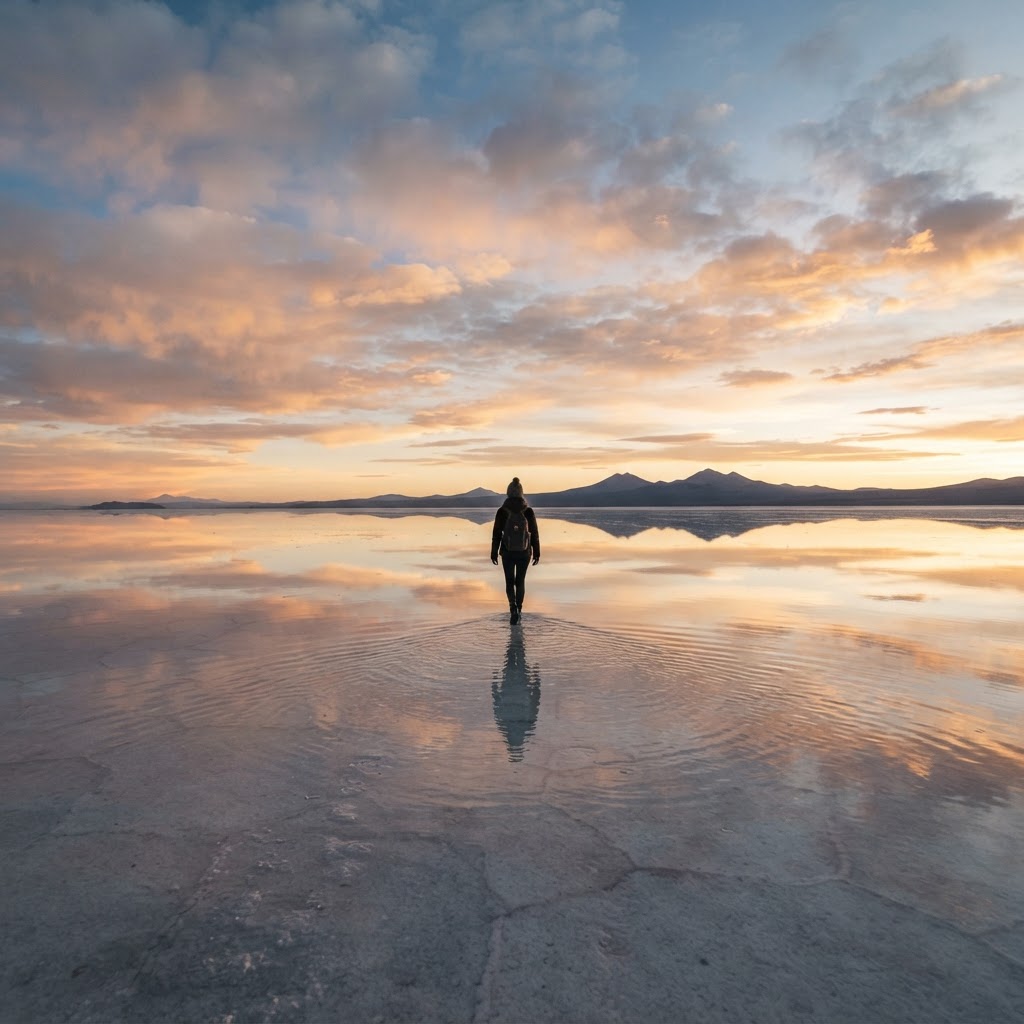
Covering over 10,000 square kilometers at an elevation of 3,656 meters, Salar de Uyuni is the world's largest salt flat. Depending on when you visit, it transforms from an endless, hexagonal-crusted white desert into the planet's most expansive natural mirror. Beyond the salt flats, standard multi-day expeditions venture deep into the remote southwest Altiplano, traversing geysers, thermal springs, and surreal mineral-tinted lagoons filled with Andean flamingos.
3 to 4 days
Build your own trip with these prebuilt itineraries
Each one is a tested, day-by-day plan for Salar de Uyuni, Bolivia — start here, then make it yours.
5 Days in Salar de Uyuni
Extended Altiplano Expedition from Uyuni to San Pedro de Atacama
3 Days in Salar de Uyuni
Classic 4x4 Circuit: White Desert, Colored Lagoons & Geysers
2 Days in Salar de Uyuni
Express Salt Flats & Isla Incahuasi Highlights
Salar de Uyuni offers a raw landscape unlike anywhere else on earth. The pure white expanse alters your depth perception and horizon, while the broader Eduardo Avaroa Reserve showcases high-altitude volcanic wonders—from bubbling mud calderas at Sol de Mañana to the blood-red waters of Laguna Colorada. It is one of the planet's premier overland 4x4 journeys.
Where to stay
Getting there
Getting around
Food & drink
What it costs
Things to do
Book tours & tickets in Salar de Uyuni, BoliviaSkip it if
Skip or reconsider if you suffer from severe altitude intolerance, as journeys cross passes exceeding 4,800 meters with scarce medical facilities. Travelers who require uninterrupted five-star luxury, reliable Wi-Fi, and plush private bathrooms should avoid standard 3-day circuit tours, as reserve refugios are notoriously spartan.
Destination intelligence
Updated 9/12/2026The structured record we plan every Salar de Uyuni, Bolivia itinerary from.
Walkability
Low. Uyuni town is fully walkable within a 15-minute radius, but the Salar and desert reserves require multi-hour 4x4 vehicle transits across hundreds of kilometers of roadless terrain.
Transit quality
Limited. There is no public transit across the flats. Travel is strictly reliant on organized 4WD operators, long-distance intercity buses, or flights connecting Uyuni's airport to La Paz.
Car needed
Not recommended for standard car rental. Self-driving is actively discouraged due to navigational hazards, lack of cellular coverage, and vehicle corrosion from salt; hire a professional 4x4 driver-guide instead.
Ideal duration
3 to 4 days
Minimum useful
1 full day (Salar only)
Peak season
July to August (dry winter with crystal-clear skies, stark white salt hexagons, and high tourist volume) and January to February (peak rainy season for the famous mirror effect).
Shoulder season
April to May and September to November (milder Altiplano temperatures, lower crowds, and reliable dry road conditions).
Low season
Late November to December (transitional weather before summer rains) and late March to early April (transitional water drying period).
Best for
Common mistakes
- Ascending directly to 3,656+ meters without prior acclimatization in La Paz, Sucre, or San Pedro de Atacama.
- Underestimating extreme nighttime Altiplano temperatures, which plunge well below freezing (down to -15°C/5°F) between June and August.
- Booking the cheapest rock-bottom street operator in Uyuni without verifying vehicle safety, seatbelts, working emergency radios, and driver licensing.
- Assuming the mirror reflection is visible year-round; the mirror requires standing water from January through March, whereas May to November is bone-dry.
Best nearby
See what a trip to Bolivia actually costs. Travel Budget Co.
More in Bolivia
Readymade itineraries
Start from a tested template — then make it yours.
Ready to book
Lock in your Salar de Uyuni, Bolivia trip
Everything in one place. We may earn a small commission — it never costs you more.
Plan a trip to Salar de Uyuni, Bolivia
Pick a length and we'll build a day-by-day plan around how you travel — neighborhoods clustered, budget-aware, and editable.
Get better at planning trips like this
Occasional notes on planning smarter — no spam, unsubscribe anytime.
Plan a trip to Salar de Uyuni, Bolivia
Turn this guide into a day-by-day plan built around your pace, your group, and your budget.
Build my Salar de Uyuni, Bolivia trip