Jordan
Petra & Wadi Musa
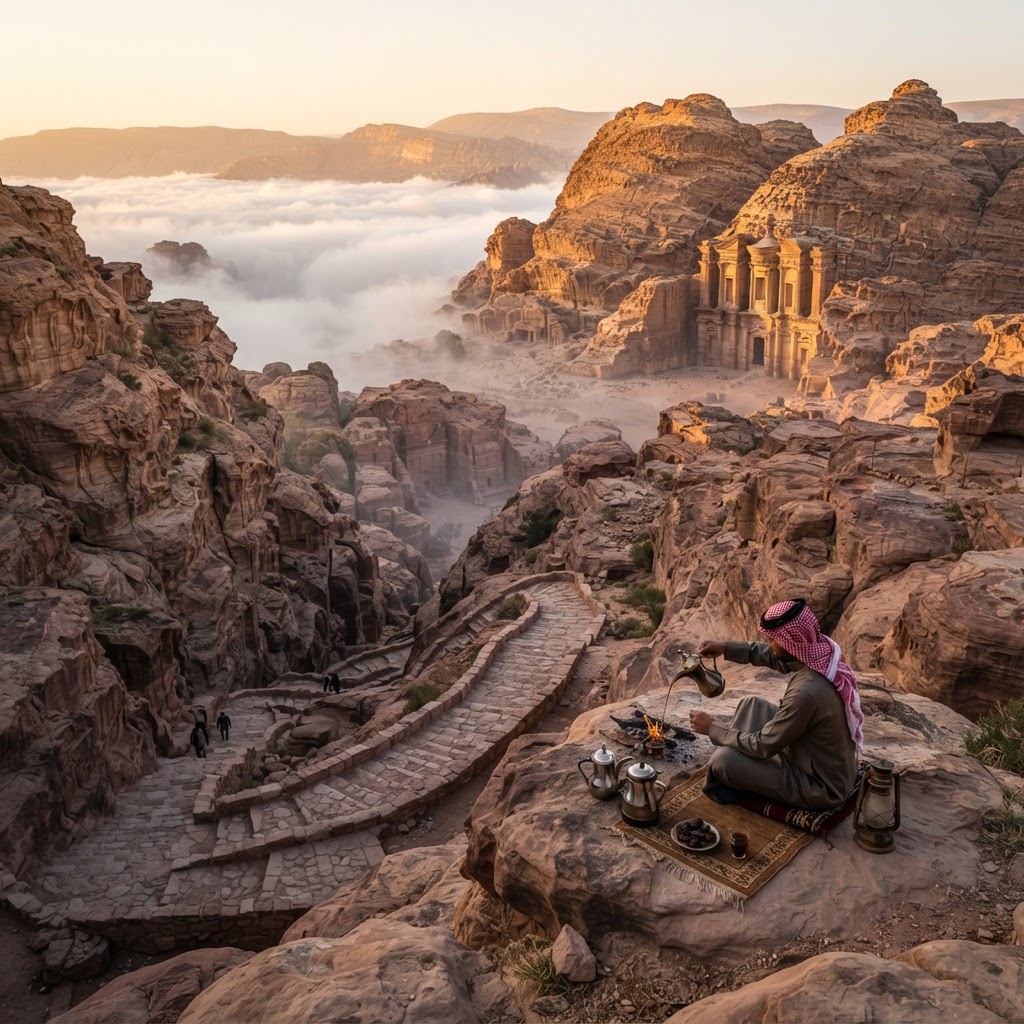
Carved rose sandstone, punishing canyon staircases, and Bedouin tea above the clouds
Plan & book
Sort your Petra & Wadi Musa trip in one place.
We point you to the booking tools we'd actually use — live prices, no markup. Or let us build the day-by-day plan around you first, then book.
Wadi Musa is the utilitarian valley town built to service Petra, the 2,000-year-old Nabataean capital sculpted straight into sheer desert sandstone. Most visitors treat it as a fleeting backdrop to snap the Treasury and vanish, which is a structural planning error. Petra covers over 260 square kilometers of rugged canyons, backcountry trails, and clifftop monuments like Ad Deir (The Monastery). Exploring it properly requires legwork, early alarms, and the logistical sanity of sleeping close to the main gate.
2 to 3 days
Build your own trip with these prebuilt itineraries
Each one is a tested, day-by-day plan for Petra & Wadi Musa — start here, then make it yours.
4 Days in Petra: In-Depth Archaeology & Road Trip in Petra/Wadi Musa
A slow-paced exploration for history enthusiasts pairing deep archaeological site immersion with self-drive excursions along the King's Highway and Shobak Castle
3 Days in Petra: The Backcountry Hiker in Petra/Wadi Musa
Strenuous wilderness trekking along the High Place of Sacrifice, the rugged Backdoor trail from Little Petra, and lesser-known Nabataean mountain routes
2 Days in Petra: The Classic Icons in Petra/Wadi Musa
First-time essential highlights covering the Siq, Treasury, Royal Tombs, and the iconic hike to the Monastery at dawn to beat the crowds and heat
To encounter ancient rock-cut architecture at monumental scale in genuine desert wilderness. The physical sensation of walking through the narrow, 1.2-kilometer gorge of the Siq as its towering 80-meter limestone cliffs suddenly frame Al-Khazneh (The Treasury) cannot be matched by photographs. Beyond the iconic facade lies a vast Nabataean and Roman metropolis of mountain alters, royal tombs, and backcountry trails where silence replaces tourist coaches.
Where to stay
Getting there
Getting around
Food & drink
What it costs
Things to do
Book tours & tickets in Petra & Wadi MusaSkip it if
Travelers with severe knee, mobility, or cardiovascular limitations who cannot manage long walking distances over uneven rock stairs and loose gravel, as the park offers very limited accessible transit. It is also worth skipping for whirlwind itinerary rushers who only have 3 hours to spare—the transit detour from Amman will yield only exhaustion and a crowded snapshot.
Destination intelligence
Updated 9/13/2026The structured record we plan every Petra & Wadi Musa itinerary from.
Walkability
Low in Wadi Musa due to extreme hills; high physical endurance required inside the Petra archaeological site (expect 15-25 km of hiking).
Transit quality
Low. There is no municipal public transit inside Wadi Musa; rely on rental cars, private transfers, JETT intercity coach, or local taxis.
Car needed
Not mandatory if using JETT buses and local taxis, but highly recommended for flexible travel along the King's Highway and south to Wadi Rum.
Ideal duration
2 to 3 days
Minimum useful
1 full day (2 nights)
Peak season
March to May and September to November (mild temperatures ideal for all-day hiking, blooming desert flora, high hotel demand).
Shoulder season
December to February (crisp, cold days with occasional snow or rain; very low crowds, though canyon flash flood closures can occur).
Low season
June to August (intense midday heat exceeding 38°C/100°F with limited shade in the canyons; necessitates dawn departures).
Best for
Common mistakes
- Booking a rushed day trip from Amman or a cruise excursion from Aqaba that only allows 3 hours on-site during midday heat
- Not buying the Jordan Pass online prior to landing, which waives the tourist visa fee and includes multi-day Petra entry
- Relying on donkey or camel rides to get up the Monastery steps instead of wearing sturdy trail shoes and pacing the hike
- Wearing slick sneakers; the sandstone stairs and canyon paths are polished smooth and become treacherous when dusty or wet
- Staying in high-altitude Upper Wadi Musa without factoring in the steep uphill walk back from the visitor gate after hiking
Best nearby
More in Middle East
Readymade itineraries
Start from a tested template — then make it yours.
Ready to book
Lock in your Petra & Wadi Musa trip
Everything in one place. We may earn a small commission — it never costs you more.
Plan a trip to Petra & Wadi Musa
Pick a length and we'll build a day-by-day plan around how you travel — neighborhoods clustered, budget-aware, and editable.
Get better at planning trips like this
Occasional notes on planning smarter — no spam, unsubscribe anytime.
Plan a trip to Petra & Wadi Musa
Turn this guide into a day-by-day plan built around your pace, your group, and your budget.
Build my Petra & Wadi Musa trip