Argentina
Iguazú Falls
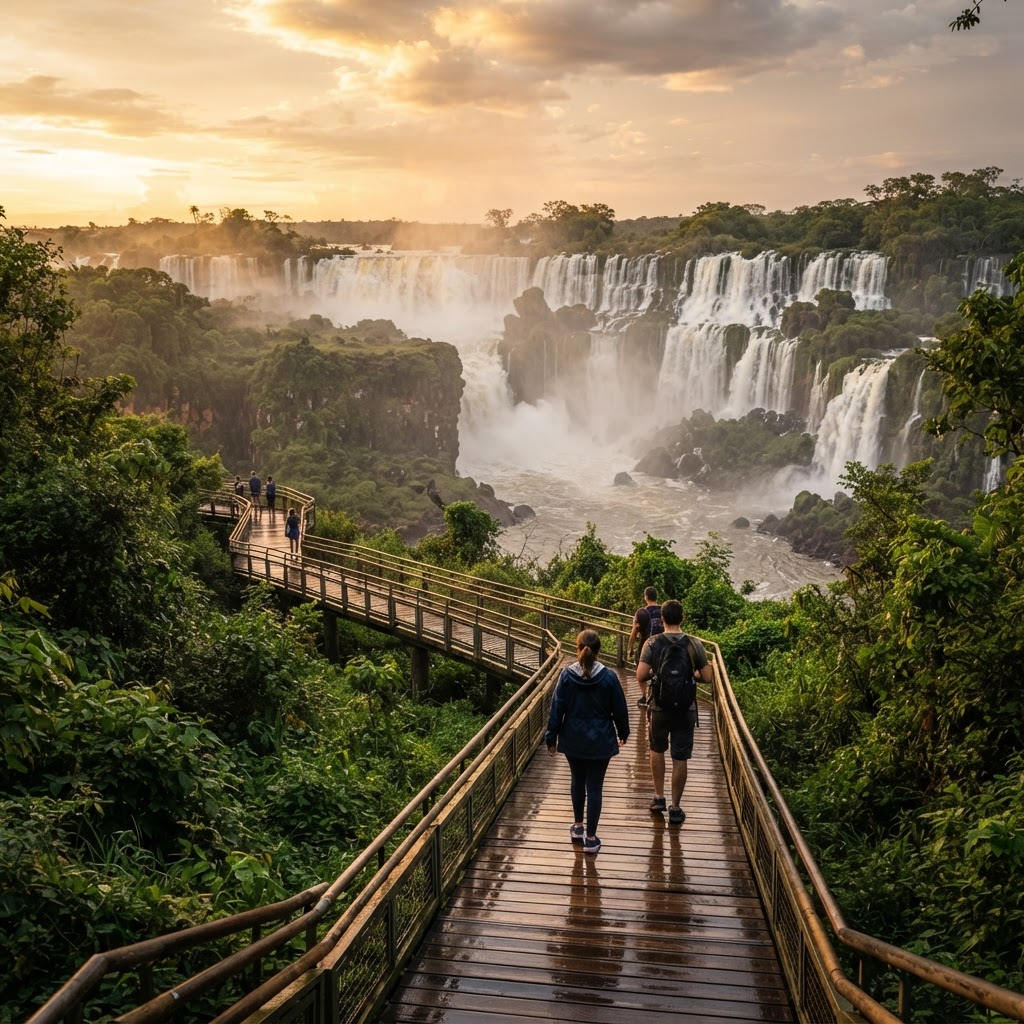
The world’s most cinematic cataract system, experienced from immersive rainforest catwalks.
Plan & book
Sort your Iguazú Falls trip in one place.
We point you to the booking tools we'd actually use — live prices, no markup. Or let us build the day-by-day plan around you first, then book.
Straddling the border between northeastern Argentina and southern Brazil, Iguazú Falls is a collection of 275 distinct cascades pouring through Atlantic rainforest. The Argentine side holds roughly 80% of the falls area, offering kilometers of elevated metal walkways that place travelers directly over roaring drops and inside thunderous mist plumes.
3 days
Best time
Late March to May and September to October offer the sweet spot of mild humidity, high water flow, and bearable crowd levels.
Build your own trip with these prebuilt itineraries
Each one is a tested, day-by-day plan for Iguazú Falls — start here, then make it yours.
3 Days: The Complete Wonder & Wildlife in Iguazú Falls
Classic immersive pace exploring all Argentine circuits, nautical safaris, and rainforest birding
4 Days: Active Jungle & Borderland Discovery in Iguazú Falls
Slower outdoor exploration featuring extended Misiones rainforest treks, indigenous Guaraní heritage, and night walks
2 Days: Essential Falls Express in Iguazú Falls
First-timer highlights prioritizing the full Argentine trail system and a quick Brazilian panoramic crossing
Unlike viewpoints that keep travelers at a distance, Iguazú’s Argentine circuit suspends you directly above the 80-meter chasm of Garganta del Diablo (Devil’s Throat). The combination of intricate trail networks, dense subtropical jungle populated by toucans and coatis, and water volume averaging 1,500 cubic meters per second creates an immersive scale unmatched by Niagara or Victoria Falls.
Where to stay
Getting there
Getting around
Food & drink
What it costs
Things to do
Book tours & tickets in Iguazú FallsSkip it if
Travelers with limited mobility who cannot manage several miles of walking on grated metal gangways or repeated flights of stairs, and those visiting South America strictly for arid mountain trekking or cultural city breaks.
When to go
Summer brings deafening torrents but suffocating heat above 32°C (90°F) and holiday swarms. Shoulder season balances comfortable walking temperatures on exposed metal boardwalks with dramatic river volumes and moderate hotel rates.
Peak (January–February & late July)
Brutal subtropical humidity and dense Argentine/Brazilian holiday crowds; book park entries and hotels months ahead, and start at gate opening (8:00 AM) sharp.
Shoulder (March–May & August–October)
The ideal compromise. High cataracts, daytime temperatures hovering around 25°C (77°F), manageable trails, and significantly shorter queues for the ecological train.
Low (June & early July)
Crisp, cooler mornings requiring a light jacket, lower humidity, fewer visitors, and occasionally reduced river flow exposing raw basalt cliff faces.
Neighborhoods
Where you stay shapes the trip. Here's how to think about it.
Centro & Terminal de Ómnibus (Puerto Iguazú)
Unpretentious, walkable frontier grid filled with parrillas, artisan stalls, and straightforward transit logistics.
Best for:independent travelers, budget conscious, short stays
Don't miss:Catching the Rio Uruguay shuttle directly from the terminal platform, followed by dinner on Avenida Brasil's Feirinha strip.
Selva Iryapú
Secluded, canopy-shaded reserve west of town hosting discreet eco-lodges along dirt roads.
Best for:couples, luxury seekers, nature immersion
Don't miss:Guided morning birding walks through the 600-hectare Atlantic forest preserve before the afternoon humidity peaks.
Costanera & Hito Tres Fronteras
Breezy riverside promenade where the Iguazú and Paraná rivers collide, overlooking Brazil and Paraguay.
Best for:sunset strolls, families, casual dining
Don't miss:The evening illuminated fountain show where the borders meet, paired with an artisanal pacú fish dinner overlooking the river junction.
Parque Nacional Iguazú Interior
Ultra-exclusive national park isolation surrounded by thundering water and protected jungle.
Best for:photographers, luxury splurges, crowd-beaters
Don't miss:Stepping onto the catwalks at 8:00 AM straight from the Gran Meliá terrace well before the first tourist train arrives.
Destination intelligence
Updated 9/14/2026The structured record we plan every Iguazú Falls itinerary from.
Walkability
Low in Puerto Iguazú town outside the immediate commercial grid; high inside Parque Nacional Iguazú along the dedicated catwalk trail system.
Transit quality
Moderate; regular, predictable shuttle buses link the central bus terminal directly to the park gates, complemented by widely available local taxis.
Car needed
No. Rental cars add unnecessary border-crossing red tape and parking friction when buses and remises efficiently service all key park access points.
Ideal duration
3 days
Minimum useful
2 days
Peak season
January to February (summer school holidays) and the last two weeks of July (winter break), bringing heavy regional crowds and hot jungle humidity.
Shoulder season
March to May and August to October, offering warm weather, reduced tourist congestion, and comfortable hiking conditions.
Low season
May to June, characterized by cooler temperatures, occasional rain, and significantly quieter park circuits.
Best for
Common mistakes
- Allocating only one day and trying to rush both the Argentine and Brazilian sides before sunset.
- Feeding or leaving bags unattended around brown-nosed coatis, which aggressively scavenge near picnic areas and food stands.
- Failing to check visa requirements before attempting the spontaneous half-day border crossing to the Brazilian side (Foz do Iguaçu).
- Skipping the Lower Circuit because of the stair climbs, which sacrifices the most dramatic spray angles and proximity to the waterfalls.
Best nearby
See what a trip to Argentina actually costs. Travel Budget Co.
How to plan it
- Dedicate your first full day strictly to Argentina: take the first 8:00 AM train to Garganta del Diablo before the tour bus crowds descend, then tackle the Upper and Lower circuits in the afternoon.
- Cross into Foz do Iguaçu, Brazil on morning two for the wide-angle, cinematic panorama; hire an official remis or take the international shuttle from the terminal rather than self-driving.
- Stay in Selva Iryapú if you want lush canopy isolation and quiet pools; stay in Puerto Iguazú Centro if you want to walk to dinner and catch public shuttles independently.
- If traveling during a full moon, reserve the park's official 'Paseos de Luna Llena' nocturnal catwalk tour weeks ahead through the national park concessionaire.
Questions
More in Argentina
Readymade itineraries
Start from a tested template — then make it yours.
Ready to book
Lock in your Iguazú Falls trip
Everything in one place. We may earn a small commission — it never costs you more.
Plan a trip to Iguazú Falls
Pick a length and we'll build a day-by-day plan around how you travel — neighborhoods clustered, budget-aware, and editable.
Get better at planning trips like this
Occasional notes on planning smarter — no spam, unsubscribe anytime.
Plan a trip to Iguazú Falls
Turn this guide into a day-by-day plan built around your pace, your group, and your budget.
Build my Iguazú Falls trip