Uganda
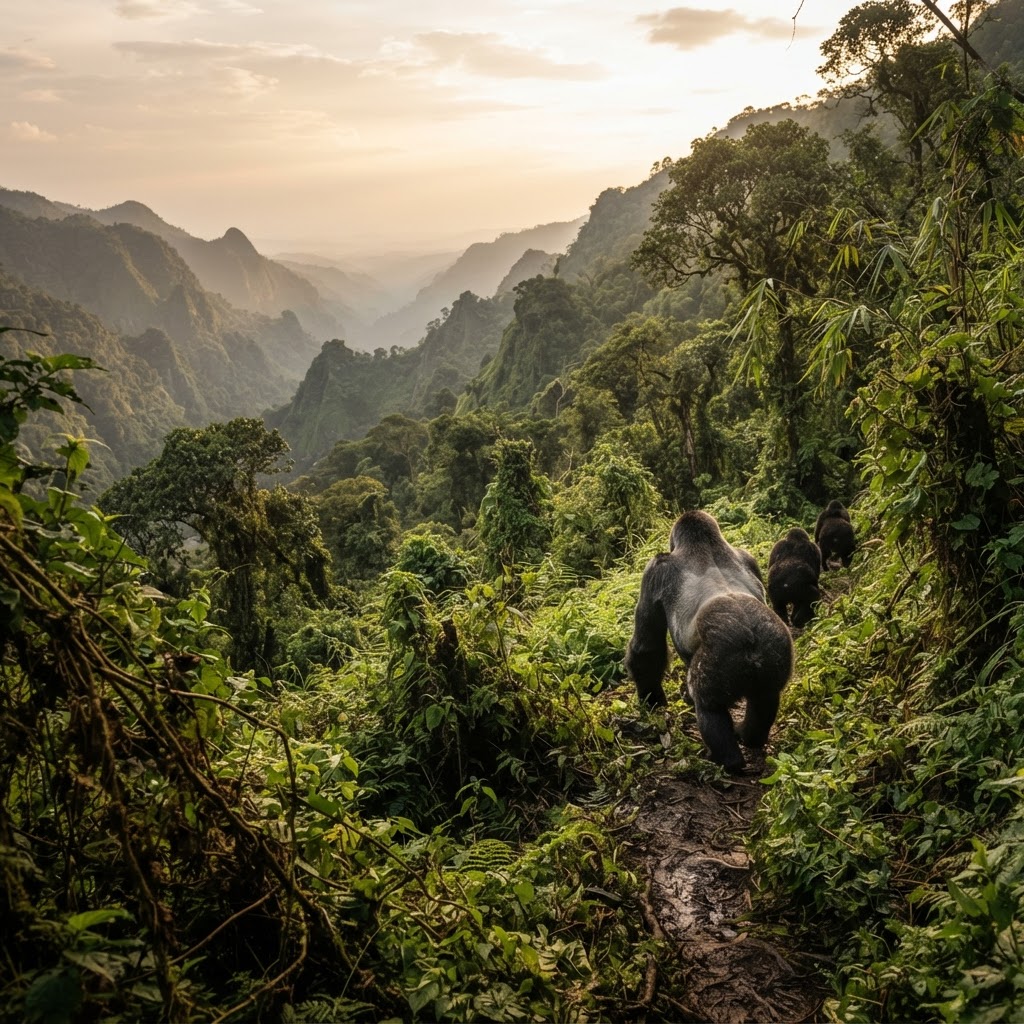
Bwindi Impenetrable Forest, Uganda
Steep primal jungle, razor ridges, and heart-stopping wild gorilla encounters.
Plan & book
Sort your Bwindi Impenetrable Forest, Uganda trip in one place.
We point you to the booking tools we'd actually use — live prices, no markup. Or let us build the day-by-day plan around you first, then book.
Perched across the Albertine Rift Valley ridges in southwestern Uganda, Bwindi Impenetrable National Park is a rugged UNESCO World Heritage sanctuary harboring nearly half of the planet's remaining wild mountain gorillas. Tracking through its dense tangles of bamboo, giant ferns, and tangled montane forest requires stamina and patience, but standing within paces of a wild silverback is an unmatched wildlife experience that warrants the arduous overland journey.
3 to 4 days
Best time
June to August or December to February for the driest footpaths and easiest tracking.
Build your own trip with these prebuilt itineraries
Each one is a tested, day-by-day plan for Bwindi Impenetrable Forest, Uganda — start here, then make it yours.
5 Days in Bwindi: Cross-Sector Trek & Albertine Birding in Bwindi Impenetrable Forest
Active multi-sector ridge-hiking and endemic birdwatching across Buhoma, Ruhija, and Nkuringo
4 Days in Bwindi: Habituation & Conservation in Bwindi Impenetrable Forest
In-depth primate tracking featuring an extended four-hour gorilla habituation experience
3 Days in Bwindi: Classic Gorilla Trek in Bwindi Impenetrable Forest
Fly-in gorilla tracking highlights with Batwa cultural immersion
Bwindi offers the most reliable, affordable, and ecologically intact mountain gorilla tracking on earth, sheltering over 450 wild gorillas across four dedicated trail sectors. Beyond the habituated primate groups, it is an ancient ecological refuge supporting 350 bird species and indigenous Batwa cultural heritage, set against misty ridgelines that rival any wilderness backdrop on the continent.
Where to stay
Getting there
Getting around
Food & drink
What it costs
Skip it if
Skip Bwindi if you have severe mobility limitations, knee or cardiac vulnerabilities, or cannot navigate 3 to 7 hours of steep, slippery, off-trail mountain hiking at 1,500–2,600 meters elevation. Travelers unwilling to spend $800 per person on a one-hour animal permit should opt for standard open-vehicle savanna game drives elsewhere.
When to go
Dry seasons offer manageable footing on steep, off-trail mud embankments, though equatorial showers remain possible year-round. The tradeoff is high demand: lodge rates peak and permits sell out 6 to 12 months in advance, whereas rainy low seasons offer discounted permits and quiet trails at the cost of deep knee-straining mud.
Peak (June–August & December–February)
Lowest rainfall, firmest trail conditions, and clear morning lighting for photography. Secure UWA permits 6 to 12 months ahead.
Shoulder (September–November & March)
Intermittent heavy downpours with vibrant green forest canopies; permits are substantially easier to secure on shorter notice.
Low (April–May)
The primary wet season yields torrential rains, slick clay roads, and grueling tracking conditions, but UWA promotional permit discounts ($600) and lower lodge rates take effect.
Neighborhoods
Where you stay shapes the trip. Here's how to think about it.
Buhoma Sector (North)
The classic, gentrified original gateway with paved access roads and upscale hillside eco-lodges.
Best for:First-time trekkers, older travelers, and those wanting softer elevation gains and luxury stays
Don't miss:The Munyaga River trail walk and visiting the Ride 4 a Woman community craft cooperative before your morning trek briefing.
Rushaga Sector (South)
High-density gorilla country with multiple habituated troops and direct overland links toward Rwanda.
Best for:Travelers entering via Kigali, late bookers needing permit availability, and Gorilla Habituation seekers
Don't miss:The Gorilla Habituation Experience (GHEX), offering four intensive hours alongside trackers and researchers rather than the standard single hour.
Nkuringo Sector (Southwest)
High-altitude drama featuring steep ridgeline panoramas facing the dramatic Virunga Volcano chain.
Best for:Athletic hikers seeking a rigorous physical workout and stunning photography angles
Don't miss:The grueling descent into the Kashasha River valley followed by the Batwa cultural trail along the border ridges.
Ruhija Sector (East)
Quiet, mist-wrapped montane highlands celebrated by serious naturalists and ornithologists.
Best for:Dedicated birdwatchers, off-grid quiet seekers, and travelers linking overland from Queen Elizabeth National Park
Don't miss:Birding the high-elevation Mubwindi Swamp trail in search of the endemic African green broadbill.
Destination intelligence
Updated 9/14/2026The structured record we plan every Bwindi Impenetrable Forest, Uganda itinerary from.
Walkability
Low. Inside the park, walking is confined to strenuous ranger-guided treks across slippery, steep untracked forest; outside park gates, dirt roads lack sidewalks and connect remote rural hillside villages.
Transit quality
None. There is no scheduled public transit within or between park sectors; transportation relies entirely on chartered bush flights, tour operator 4x4s, or local private hire.
Car needed
Crucial. An off-road 4x4 with a seasoned driver-guide is mandatory to negotiate the steep, unpaved volcanic gravel and clay roads between sectors and airstrips.
Ideal duration
3 to 4 days
Minimum useful
2 days (only feasible via Kigali cross-border transfer or scheduled domestic bush flight)
Peak season
June to August and December to February. The driest months with firmer footing, less slippery mud, and clearest mountain conditions. Permits sell out 6 to 12 months ahead.
Shoulder season
September to November and March. Transition periods featuring occasional heavy downpours, vibrant green scenery, and easier permit availability on short notice.
Low season
April and May. The long rains bring muddy, grueling trail conditions and swollen rivers, but lodges offer deep promotional discounts and the forest is quietest.
Best for
Common mistakes
- Booking a lodge in one sector (e.g., Buhoma) with a gorilla trekking permit issued for a different sector (e.g., Rushaga or Nkuringo), resulting in a 3:30 AM bone-jarring mountain transfer on unpaved tracks.
- Refusing to hire a local porter at the trailhead ($20 USD); porters not only carry your daypack and steady you on slick mud ridges, but hiring them directly provides vital livelihood to adjacent communities.
- Attempting a budget self-drive in a rental crossover SUV without off-road recovery gear or deep familiarity with southwestern Uganda clay tracks.
- Failing to pack sturdy, ankle-height waterproof boots, puncture-resistant gardening gloves for stinging nettles, and thick gaiters against biting safari ants.
Best nearby
How to plan it
- Book your UWA permit before reserving accommodations, and anchor your lodge in the exact sector printed on your permit.
- If your international flight lands in Kigali, target Rushaga or Nkuringo; the 4-to-5-hour drive via the Cyanika border cuts the grueling 10-hour drive from Entebbe in half.
- Pair Bwindi with Queen Elizabeth National Park's Ishasha sector (2 hours north of Buhoma) to spot tree-climbing lions on the drive back toward Kampala.
- Do not schedule your outbound flight on the same day as your trek; tracking can extend until mid-afternoon if gorilla families move deep into valley ravines.
- Pack US dollars printed in 2013 or later for tipping rangers and porters; older bills and torn currency are systematically rejected across rural Uganda.
Questions
More in East Africa
Readymade itineraries
Start from a tested template — then make it yours.
Ready to book
Lock in your Bwindi Impenetrable Forest, Uganda trip
Everything in one place. We may earn a small commission — it never costs you more.
Plan a trip to Bwindi Impenetrable Forest, Uganda
Pick a length and we'll build a day-by-day plan around how you travel — neighborhoods clustered, budget-aware, and editable.
Get better at planning trips like this
Occasional notes on planning smarter — no spam, unsubscribe anytime.
Plan a trip to Bwindi Impenetrable Forest, Uganda
Turn this guide into a day-by-day plan built around your pace, your group, and your budget.
Build my Bwindi Impenetrable Forest, Uganda trip