Armenia
Yerevan, Armenia
The pink tufa capital of open-air terraces, ancient monasteries, and deep volcanic wines.
Plan & book
Sort your Yerevan, Armenia trip in one place.
We point you to the booking tools we'd actually use — live prices, no markup. Or let us build the day-by-day plan around you first, then book.
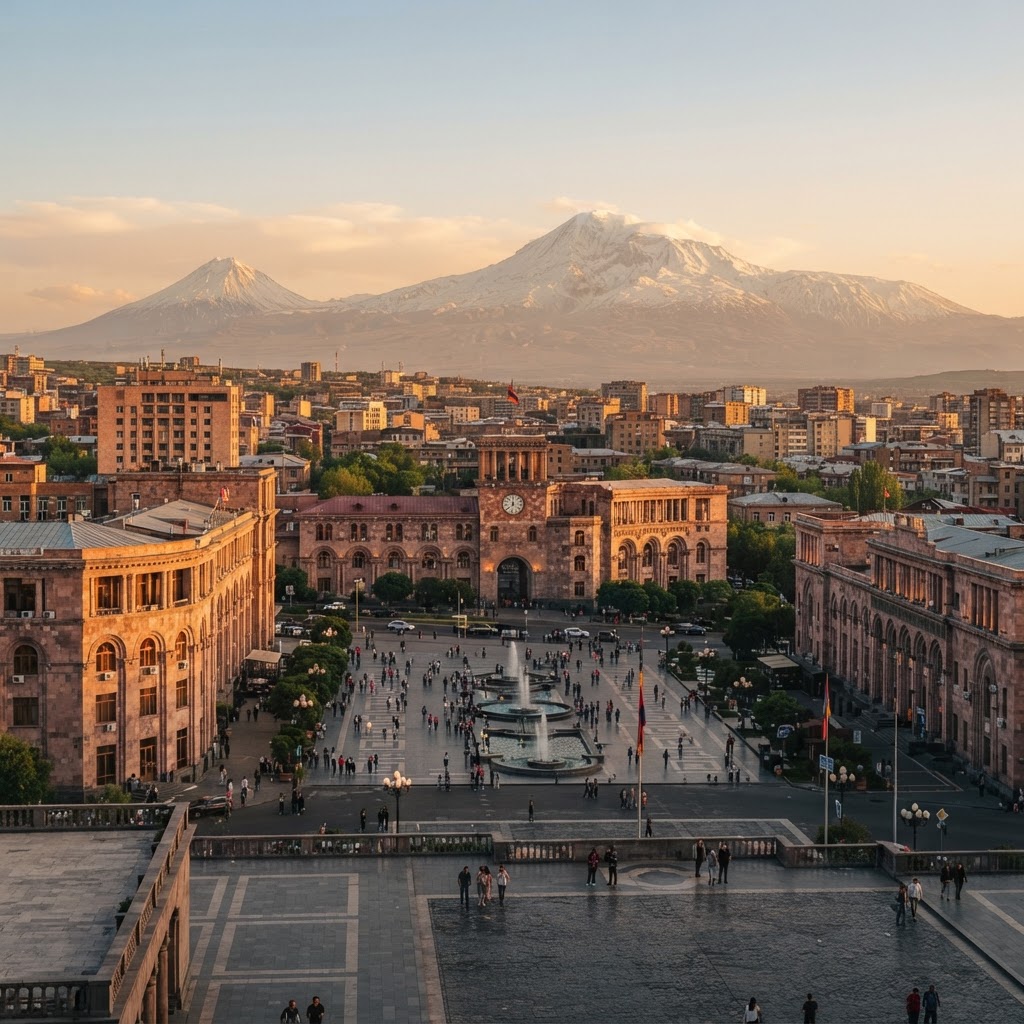
Carved from rosy volcanic tuff stone and laid out in Alexander Tamanian's concentric neoclassical grid, Yerevan is one of the world’s oldest continuously inhabited capitals, yet it operates with the late-night energy of a modern café culture hub. Set against the silhouette of Mount Ararat, the city balances Soviet monumentalism, intimate courtyard wine bars, and quiet stone alleys with unmatched logistical access to Armenia's medieval monastic landmarks.
How long
4 to 5 days (2 full days for urban neighborhoods and museums, plus 2-3 focused day trips into the Ararat plain and Kotayk)
Build your own trip with these prebuilt itineraries
Each one is a tested, day-by-day plan for Yerevan, Armenia — start here, then make it yours.
5 Days Yerevan & Monasteries in Yerevan
City highlights plus easy day trips to Garni Temple, Geghard, and Khor Virap
3 Days Culture & Wine in Yerevan
Cafesjian Art Center, Matenadaran manuscript museum, and local Areni wine tasting
2 Days Yerevan Essentials in Yerevan
Cascade complex, Republic Square, Vernissage market, and Armenian Genocide Memorial
Yerevan is both an atmospheric open-air metropolis and an exceptionally efficient regional base. Within a two-hour radius by road, you reach 4th-century cliffside monasteries, pagan Hellenistic temples, and the Areni wine region. Back inside Kentron, evenings revolve around walkable sidewalk cafés, natural volcanic wines, and open-air classical concerts around Republic Square.
Where to stay
Getting there
Getting around
Food & drink
What it costs
Things to do
Book tours & tickets in Yerevan, ArmeniaSkip it if
Skip if your idea of a European city break requires preserved medieval gothic architecture and car-free old quarters—Yerevan's center was systematically rebuilt in the 1920s in Soviet neoclassical tuff stone. Skip also if you are looking for beach resorts or manicured pedestrian plazas without traffic noise.
Destination intelligence
Updated 9/12/2026The structured record we plan every Yerevan, Armenia itinerary from.
Walkability
High inside the central Kentron amphitheater; steep and pedestrian-unfriendly once you climb outside the core into the Hrazdan canyon or northern heights.
Transit quality
Moderate; the single-line metro is efficient for north-south movement, but regional buses (marshrutkas) can be confusing for newcomers, making app-based rideshare (GG) the preferred option.
Car needed
Not for the city center. A rental car or hired private driver is only worthwhile when venturing independently into the Vayots Dzor or Syunik regions.
Ideal duration
4 to 5 days (2 full days for urban neighborhoods and museums, plus 2-3 focused day trips into the Ararat plain and Kotayk)
Minimum useful
3 days (enough for central Yerevan, the Armenian Genocide Memorial, and a combined day trip to Garni and Geghard)
Peak season
June through August: hot (often exceeding 35°C/95°F), bustling terrace culture, evening fountain shows, and packed mountain day-trip corridors.
Shoulder season
April to May and September to October: mild temperatures, crystal-clear skies framing Mount Ararat, grape harvests, and comfortable walking conditions.
Low season
November through March: cold winters with occasional snow, overcast skies, shorter museum hours, and dormant outdoor street dining.
Best for
Common mistakes
- Renting a car for central city days; traffic is congested and parking in Kentron is frustrating, whereas local rideshare apps cost barely a few dollars.
- Scheduling a trip to Khor Virap in the late afternoon haze when Mount Ararat is frequently obscured by cloud cover and heat wash; always go early in the morning.
- Hailing unmetered street cabs outside the airport or Republic Square without setting an agreed price; use the GG app instead for transparent fares.
- Skipping dinner reservations on weekends at top spots along Saryan Street and around Pushkin Street, which routinely book out.
Best nearby
Readymade itineraries
Start from a tested template — then make it yours.
Ready to book
Lock in your Yerevan, Armenia trip
Everything in one place. We may earn a small commission — it never costs you more.
Plan a trip to Yerevan, Armenia
Pick a length and we'll build a day-by-day plan around how you travel — neighborhoods clustered, budget-aware, and editable.
Get better at planning trips like this
Occasional notes on planning smarter — no spam, unsubscribe anytime.
Plan a trip to Yerevan, Armenia
Turn this guide into a day-by-day plan built around your pace, your group, and your budget.
Build my Yerevan, Armenia trip