Colombia
Tayrona National Natural Park, Colombia
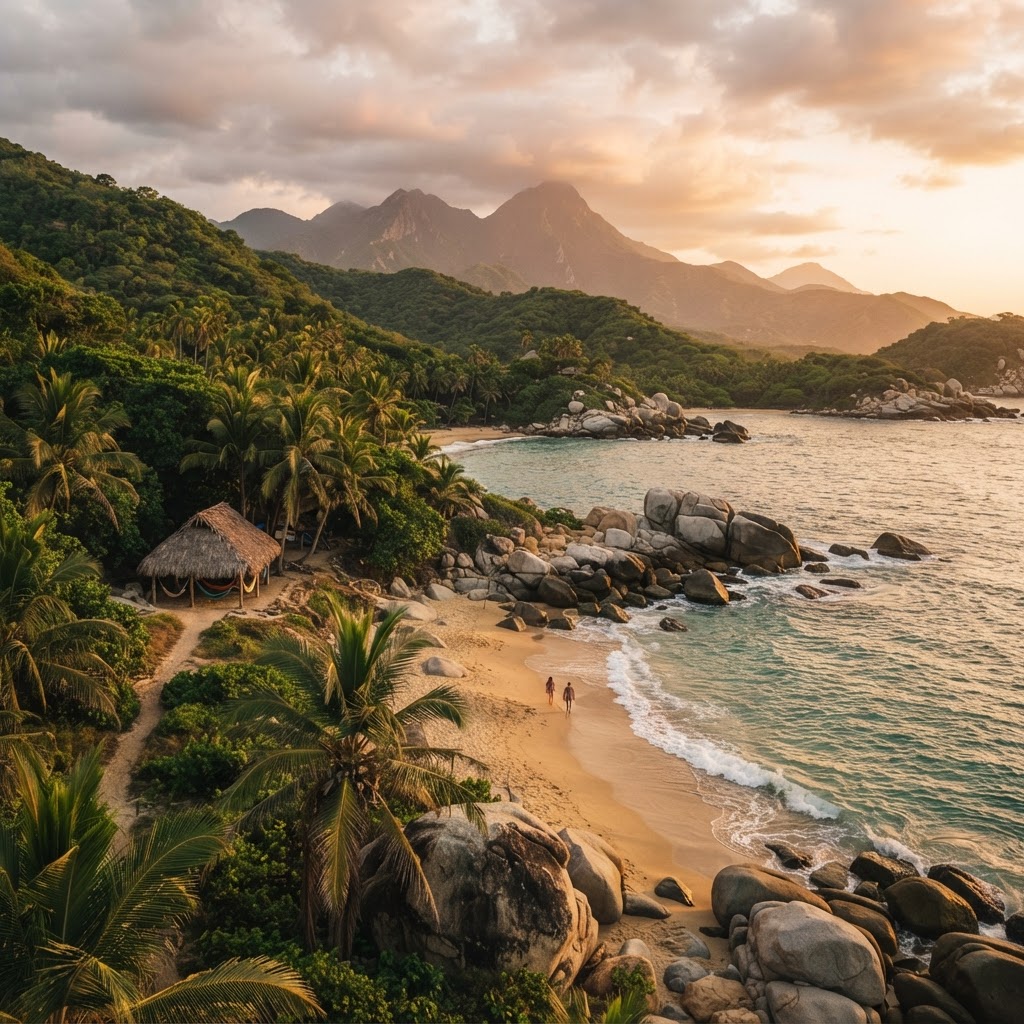
Dense coastal jungle meeting boulder-strewn Caribbean bays beneath sacred peaks
Plan & book
Sort your Tayrona National Natural Park, Colombia trip in one place.
We point you to the booking tools we'd actually use — live prices, no markup. Or let us build the day-by-day plan around you first, then book.
Tayrona National Natural Park covers 150 square kilometers of protected coastal rainforest where the Sierra Nevada de Santa Marta crashes into the Caribbean Sea. It is defined by coconut palms, giant granite monoliths, and sacred indigenous territory inhabited by the Kogui, Wiwa, Arhuaco, and Kankuamo peoples. Visiting is not a pampering beach resort experience; it demands hiking in fierce tropical humidity, coping with basic amenities, and paying heed to dangerous rip currents in return for pristine wild bays.
2 days / 1 night
Best time
Late January through March, and mid-July through August.
Build your own trip with these prebuilt itineraries
Each one is a tested, day-by-day plan for Tayrona National Natural Park, Colombia — start here, then make it yours.
3 Days Rugged Traverse: Calabazo to El Zaino Wilderness Trek in Tayrona National Park
An adventurous backcountry loop entering via the steep Calabazo trail to Playa Brava and continuing through the coastal trail network.
2 Days / 1 Night Classic Jungle & Coast Overnight in Tayrona National Park
The quintessential overnight stay sleeping in hammocks at Cabo San Juan, balancing daytime beach-hopping with quiet sunrise wildlife spotting.
1 Day Highlights Trek: El Zaino to Cabo San Juan in Tayrona National Park
An early-morning power hike along the eastern trail to swim at La Piscina and Cabo San Juan before exiting at sunset.
Tayrona delivers one of South America's most striking intersections of biodiversity and coastline. Unlike manicured Caribbean resort strips, the park preserves dense jungle trails where cotton-top tamarins and howler monkeys swing overhead while trails open onto dramatic golden bays framed by massive prehistoric boulders. Sleeping in an open-air hammock at Cabo San Juan or in an eco-lodge perched above Cañaveral puts you immersed in nature before the day-tripper boats and tour groups arrive.
Where to stay
Getting there
Getting around
Food & drink
What it costs
Skip it if
Skip Tayrona if you have limited mobility, heat intolerance, or require luxury resort amenities like air conditioning, room service, and dependable Wi-Fi. Those seeking a relaxed, step-free beach holiday with calm waters for small children will find the required multi-hour tropical trek and unswimmable beaches frustrating.
When to go
These windows dodge peak holiday crowds while avoiding the heaviest equatorial rains of May and September–October. Crucially, they avoid the recurring two-week ancestral park closures enforced by indigenous leaders in February, June, and late October.
Peak (Dec 15–mid-Jan, Easter Week, mid-Jun–mid-Jul)
Expect long entry queues at El Zaino, crowded trails, and packed campgrounds; reserve overnight hammocks and tents weeks in advance.
Shoulder (late Jan–Mar, Jul–Aug)
Lower trail traffic, mostly dry weather, and clearer seas for snorkeling at La Piscina, though midday heat remains fierce.
Low (Apr–May, Sep–Nov)
Frequent tropical deluges turn jungle pathways into knee-deep mud bogs, but beaches are blissfully empty outside mandatory Indigenous closure dates.
Neighborhoods
Where you stay shapes the trip. Here's how to think about it.
Cabo San Juan del Guía
Iconic, social beach hub set around dual boulder-flanked coves and an open-air mirador.
Best for:Social travelers, first-timers, and campers wanting immediate access to safe swimming waters.
Don't miss:The cliffside watchtower mirador for dawn views across the bay before the day-tripper boats arrive from Taganga.
Arrecifes
Rugged, windswept coastal clearing tucked between pounding surf and dense jungle.
Best for:Travelers prioritizing quiet, spacious eco-cabins and hammock camps who do not mind walking for a swim.
Don't miss:A sunset stroll along the shoreline dunes—swimming is forbidden due to lethal rip currents, but the wave drama is unmatched.
Cañaveral
Treetop luxury where the coastal vehicular road terminates into trailheads.
Best for:Upscale nature lovers and older travelers wanting high-end thatched EcoHabs without carrying heavy packs into deep trails.
Don't miss:The protected swimming lagoon at La Piscinita, reachable via a short walk from the EcoHabs complex.
Playa Brava
Isolated, off-grid eco-sanctuary reachable only via the demanding Calabazo mountain trail.
Best for:Serious trekkers and solitude seekers willing to hike 4–5 hours to escape the standard backpacker path.
Don't miss:The freshwater jungle waterfall hike hidden an hour behind the beach cabins.
Destination intelligence
Updated 9/14/2026The structured record we plan every Tayrona National Natural Park, Colombia itinerary from.
Walkability
Low overall for urban ease, but 100% foot-dependent on trails: once past the entry shuttle, movement is entirely pedestrian on rugged jungle paths and sand.
Transit quality
Limited: Cheap local buses serve park perimeter gates along the main coastal highway from Santa Marta, but interior transit is purely trail hiking or horse rental.
Car needed
Not required and strongly discouraged; personal cars cannot enter trail networks and must be left at exterior parking lots.
Ideal duration
2 days / 1 night
Minimum useful
1 full day (early morning to late afternoon)
Peak season
December through January, Holy Week (Semana Santa), and June 15 to July 15, when domestic holiday travel fills trails, hammocks, and entry queues.
Shoulder season
July to August and mid-January through March, offering manageable crowds and relatively dry coastal conditions.
Low season
April–May and September–November (heaviest rainfall months with muddy jungle trails), alongside mandatory closure weeks when entry is barred.
Best for
Common mistakes
- Attempting to swim at Playa Arrecifes or Playa Brava, where violent rip currents and heavy shorebreak have drowned numerous tourists; only swim in designated safe zones like La Piscina and Cabo San Juan
- Failing to check official park closure dates (known as #RespiraTayrona), when the park shuts entirely for ecological and indigenous spiritual rejuvenation (routinely during periods in February, June, and October/November)
- Wearing flimsy flip-flops on the hike; trails involve slippery clay, slick exposed tree roots, and steep granite boulders demanding sturdy trail runners or hiking sandals
- Arriving at the El Zaino entrance after 9:00 AM, resulting in brutal midday sun on the trail and long lines at the ticket and insurance verification booths
- Carrying full heavy rolling suitcases into the park instead of leaving bulk luggage in Santa Marta and hiking only with a light 25-35L overnight pack
Best nearby
See what a trip to Colombia actually costs. Travel Budget Co.
How to plan it
- Enter through the El Zaino gate right at the 7:00 AM opening to clear ticket processing and bag inspection before the midday tour buses arrive.
- Pay the 5,000 COP shuttle van at El Zaino to skip the dull 45-minute walk along paved road to the actual trailhead at Cañaveral.
- Book an overnight stay at Cabo San Juan or Arrecifes so you can experience the beaches before 10:00 AM and after 3:30 PM without the Santa Marta day crowds.
- If taking the rough motorboat (lancha) from Taganga straight into Cabo San Juan, prepare for an aggressive open-ocean ride with heavy swell; hikers avoid this by entering overland via El Zaino.
- Never attempt to trek out after 3:00 PM; jungle light fades rapidly under the canopy, and park rules strictly bar movement on trails after dark.
Questions
Readymade itineraries
Start from a tested template — then make it yours.
Ready to book
Lock in your Tayrona National Natural Park, Colombia trip
Everything in one place. We may earn a small commission — it never costs you more.
Plan a trip to Tayrona National Natural Park, Colombia
Pick a length and we'll build a day-by-day plan around how you travel — neighborhoods clustered, budget-aware, and editable.
Get better at planning trips like this
Occasional notes on planning smarter — no spam, unsubscribe anytime.
Plan a trip to Tayrona National Natural Park, Colombia
Turn this guide into a day-by-day plan built around your pace, your group, and your budget.
Build my Tayrona National Natural Park, Colombia trip