Thailand
Sukhothai, Thailand
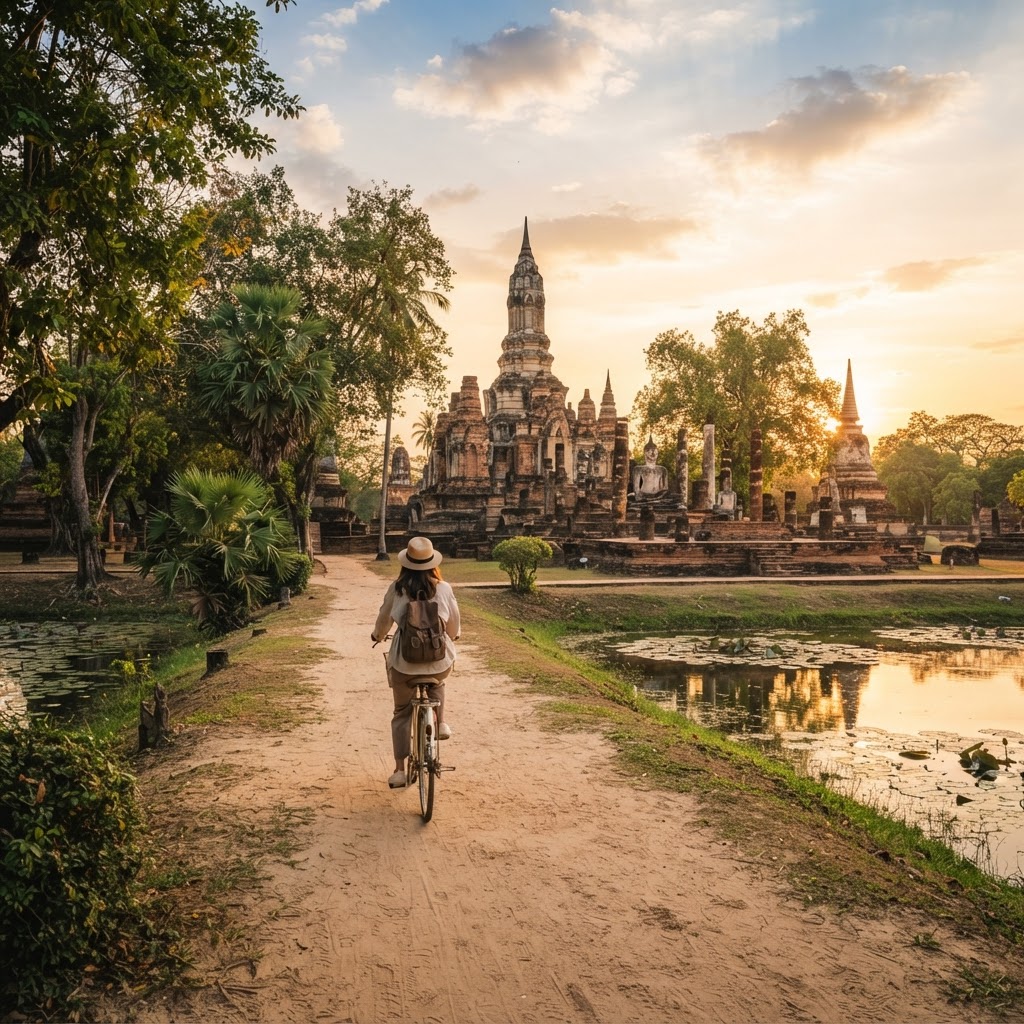
Cycle among the birthplace ruins of Siam, free from highway traffic and mass tour buses.
Plan & book
Sort your Sukhothai, Thailand trip in one place.
We point you to the booking tools we'd actually use — live prices, no markup. Or let us build the day-by-day plan around you first, then book.
Serving as the capital of the first unified Siamese kingdom in the 13th century, Sukhothai is divided into two distinct worlds: Old Sukhothai (Muang Kao), an open-air archaeological park bordered by lotus moats and rice paddies, and New Sukhothai, a utilitarian provincial hub 12 kilometers to the east. Unlike Ayutthaya, which is bisected by modern traffic and packed with Bangkok day-trippers, Sukhothai rewards travelers who make the deliberate journey north with flat, tree-lined cycling routes, peaceful morning ruins, and a rhythm centered on sunrise temple walks rather than nightlife.
2 to 3 days
Best time
November to February for mild morning temperatures and dry cycling conditions.
Build your own trip with these prebuilt itineraries
Each one is a tested, day-by-day plan for Sukhothai, Thailand — start here, then make it yours.
3 Days of Heritage and Photography in Sukhothai
Slow-paced exploration capturing dawn light, outer forest ruins, and regional art history
1 Day Temple Express in Sukhothai
Essential ruins stopover tailored for travelers journeying overland between Bangkok and Chiang Mai
2 Days Cycling the Ancient Kingdom in Sukhothai
First-time historical highlights exploring central, northern, and western temple zones by bicycle
Sukhothai offers Thailand's finest archaeological cycling experience. Its central and outer historical zones are preserved inside manicured parklands where motor traffic is restricted, letting you pedal between towering Buddha figures at Wat Mahathat and Wat Si Chum with space to breathe. It also gives travelers an unhurried look at classic Sukhothai-style bronze and stucco sculpture—defined by serene, sinuous walking Buddhas and lotus-bud chedis—without competing with tour bus congestion.
Where to stay
Getting there
Getting around
Food & drink
What it costs
Things to do
Book tours & tickets in Sukhothai, ThailandSkip it if
Travelers hunting for energetic nightlife, cocktail lounges, and late-night scenes should skip it—the town closes down shortly after dinner. It is also not recommended for travelers with severe heat or mobility limitations who cannot cycle or walk unpaved archaeological paths, or those short on time who can more conveniently visit Ayutthaya from Bangkok.
When to go
The tradeoff between November and February is higher lodging rates and the November Loy Krathong crowds in exchange for comfortable 20°C mornings that allow hours of cycling before tropical midday heat sets in.
Peak (November–February)
Cool, dry mornings and clear skies. November brings the spectacular Loy Krathong festival, filling hotels months ahead; December and January bring ideal cycling weather.
Shoulder (October & March)
October offers lush green rice paddies as monsoon rains taper off. March brings soaring heat and the beginning of regional crop burning before the rains return.
Low (April–September)
April to May is intensely hot with mid-30s temperatures making cycling punishing by 11:00 AM. June to September brings tropical rains, few tourists, and dramatic cloud-streaked temple photography.
Neighborhoods
Where you stay shapes the trip. Here's how to think about it.
Old Sukhothai (Mueang Kao)
A quiet rural sanctuary of lotus moats, dirt lanes, and guesthouses centered around the ancient city walls.
Best for:Cyclists, history travelers, early risers, and photographers.
Don't miss:Dawn bicycle ride to the island temple of Wat Sa Si before the bus tours arrive.
New Sukhothai (Mueang Thani)
A utilitarian, functional Thai provincial town centered around the Yom River with bustling evening food stalls.
Best for:Budget travelers, local night market dining, and overland transit connections.
Don't miss:The roadside Sukhothai noodle vendors setting up along the Yom River on Nikorn Kasem Road.
Si Satchanalai Outpost
A completely crowd-free sister archaeological park nestled in teak-forested hills 55 kilometers north.
Best for:Archaeology purists, off-the-beaten-track cyclists, and slow travelers.
Don't miss:Climbing the hill path to Wat Khao Phanom Phloeng for panoramic views over the forest canopy.
Mueang Kao Countryside (Rural Fringe)
Flat agricultural flatlands, irrigation canals, and organic farms just west and south of the ruins.
Best for:Resort stays, peaceful evenings, and cycling between rice paddies.
Don't miss:Pedaling the quiet agricultural paths south toward Wat Chetuphon at dusk.
Destination intelligence
Updated 9/14/2026The structured record we plan every Sukhothai, Thailand itinerary from.
Walkability
Moderate within individual ruin clusters, but low overall without a bicycle or scooter due to distances between zones.
Transit quality
Basic; reliable local songthaews run between Old and New towns, but local transit relies heavily on tuk-tuks and rental bicycles.
Car needed
No. A bicycle covers the core historical parks perfectly; taxis or hired songthaews easily cover airport and intercity transfers.
Ideal duration
2 to 3 days
Minimum useful
1 full day (2 nights)
Peak season
November to February: Cooler, dry mornings and lower humidity, coinciding with peak European travel and the Loy Krathong festival in November.
Shoulder season
October and March: October marks the tail end of monsoons with lush greenery; March brings surging temperatures before agricultural burning peaks.
Low season
April to September: High heat followed by the southwest monsoon rains, resulting in dramatic clouds, occasional afternoon downpours, and empty temples.
Best for
Common mistakes
- Booking lodging in New Sukhothai under the assumption that it is walking distance to the ruins; the two towns are separated by 12 kilometers.
- Visiting the Central Zone between 11:30 AM and 3:00 PM, when midday tropical heat and zero shade make cycling punishing.
- Skipping the Northern and Western outer zones, which feature Wat Si Chum and quieter jungle ruins that see a fraction of the central crowds.
- Treating Sukhothai as a hurried half-day transit stop between Bangkok and Chiang Mai rather than staying overnight to experience early mornings.
Best nearby
See what a trip to Thailand actually costs. Travel Budget Co.
How to plan it
- Stay inside Old Sukhothai to reach Wat Mahathat by bicycle right as gates open at 06:30, avoiding midday heat and tour groups.
- Do not try to combine Sukhothai and Si Satchanalai into a single day; each park deserves dedicated morning light and hours of cycling.
- Pair Sukhothai as a 2-night rail break between Bangkok and Chiang Mai via the Phitsanulok train station.
- Reserve your hotel 3 to 4 months in advance if visiting during November's multi-day Loy Krathong and Candle Festival.
- Take a midday break between 11:30 AM and 3:00 PM inside the air-conditioned Ramkhamhaeng National Museum to avoid the midday sun.
Questions
More in Thailand
Readymade itineraries
Start from a tested template — then make it yours.
Ready to book
Lock in your Sukhothai, Thailand trip
Everything in one place. We may earn a small commission — it never costs you more.
Plan a trip to Sukhothai, Thailand
Pick a length and we'll build a day-by-day plan around how you travel — neighborhoods clustered, budget-aware, and editable.
Get better at planning trips like this
Occasional notes on planning smarter — no spam, unsubscribe anytime.
Plan a trip to Sukhothai, Thailand
Turn this guide into a day-by-day plan built around your pace, your group, and your budget.
Build my Sukhothai, Thailand trip