Namibia
Sossusvlei, Namibia
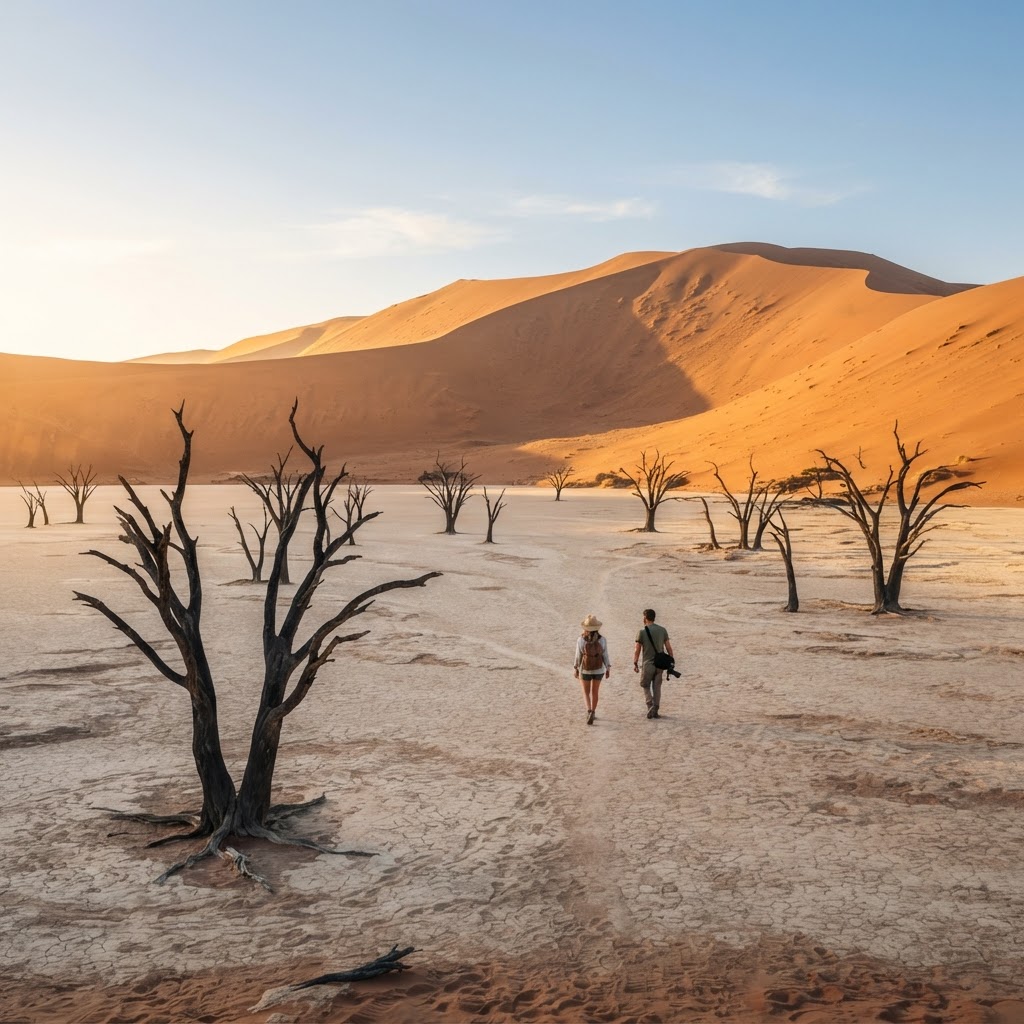
Colossal apricot dunes and skeletal camelthorn trees in the world's oldest desert.
Plan & book
Sort your Sossusvlei, Namibia trip in one place.
We point you to the booking tools we'd actually use — live prices, no markup. Or let us build the day-by-day plan around you first, then book.
Sossusvlei sits inside Namib-Naukluft National Park, centered around an ancient, clay-crusted salt pan framed by towering copper sand dunes. Its starkest signature is Deadvlei, where blackened, dead acacia trees stand preserved against blinding white pans and rust-red walls of sand. This is not a city break or a casual stop: reaching it demands a rugged gravel drive through remote desert, pre-dawn wake-ups, and deliberate trip choreography to beat searing midday heat.
2 full days (2 to 3 nights)
Best time
May to September for crisp mornings, mild climbing temperatures, and crystal-clear skies.
Build your own trip with these prebuilt itineraries
Each one is a tested, day-by-day plan for Sossusvlei, Namibia — start here, then make it yours.
3 Days: Photography, Night Skies & Solitude in Sossusvlei
A photography-first expedition capturing morning light on Big Mama, deep desert astrophotography, and hidden canyon geology
2 Days: The Essential Dunes & Salt Pans in Sossusvlei
First-time 4x4 self-drive highlights covering Deadvlei, Big Daddy, and Dune 45 at optimal golden hours
1 Day: The Fast Track Desert Sprint in Sossusvlei
An intense dawn-to-dusk highlights run tailored for road-trippers passing through the Namib desert
No other landscape on earth matches the stark scale of Deadvlei and the Tsauchab River valley. In the golden light just after dawn, star dunes like Big Daddy cast knife-edge shadows across porcelain-white clay pans, giving photographers and adventurers an environment that feels completely detached from modern civilization.
Where to stay
Getting there
Getting around
Food & drink
What it costs
Things to do
Book tours & tickets in Sossusvlei, NamibiaSkip it if
Skip Sossusvlei if you cannot handle long, bumpy gravel road driving (5+ hours from the nearest major airport), or if extreme dry heat, blowing dust, and physically demanding sand climbing sound punishing rather than rewarding.
When to go
Southern hemisphere winter brings predictable weather, comfortable mid-20s Celsius (70s Fahrenheit) dune hikes, and dark, cloudless night skies for stargazing. The tradeoff is bitter pre-dawn cold (dropping near freezing) and peak season lodge rates that sell out up to six to nine months in advance.
Peak (June to October)
Crisp desert winter with daytime highs around 20–25°C (68–77°F). Essential for intense physical dune climbs, but lodges in Sesriem book out months ahead and early morning gate queues are longest.
Shoulder (April to May & November)
Autumn (April–May) offers pleasant temperatures, soft desert greenery if late summer rains fell, and thinning crowds. November warms up fast and brings gusty winds before early storms.
Low (December to March)
Brutal summer heat often exceeding 40°C (104°F). Dune sand gets hot enough to burn through thin shoes by 10:00 AM, restricting all outdoor exploration strictly to dawn hours.
Destination intelligence
Updated 9/14/2026The structured record we plan every Sossusvlei, Namibia itinerary from.
Walkability
Zero. Attractions are spread along a 65 km corridor of road and sand tracks. Walking is strictly limited to rigorous dune ascents and footpaths across dried pans.
Transit quality
Non-existent. There is no public transit. Beyond private safari trucks and the local NWR sand shuttle, you must self-drive a rental 4x4.
Car needed
Yes, absolutely essential. A high-clearance 4WD vehicle with comprehensive tire insurance is the only realistic way to self-tour.
Ideal duration
2 full days (2 to 3 nights)
Minimum useful
1 full day (2 nights)
Peak season
June through October (dry winter months featuring crisp mornings, daytime temperatures in the 20s°C / 70s°F, and comfortable climbing weather).
Shoulder season
April to May and November (milder crowds, pleasant intermediate temperatures, and dramatic cloud formations during early or late rains).
Low season
December to March (scorching summer heat frequently exceeding 40°C / 104°F, making sand climbing punishing by mid-morning).
Best for
Common mistakes
- Staying outside the outer park gate and arriving late at Deadvlei, only to face blinding white overhead sunlight and searing sand temperatures.
- Attempting the final 5 km sand track without a proper 4x4 and without lowering tire pressures, getting bogged down and facing expensive recovery fees.
- Underestimating hydration in arid desert conditions; failing to carry at least 3-4 liters of water per person on dune hikes.
- Failing to purchase park permits at Sesriem office upon arrival, forcing unnecessary delays in lines at morning gate opening.
Best nearby
See what a trip to Namibia actually costs. Travel Budget Co.
How to plan it
- Book accommodations inside the park (Sesriem Campsite or Sossus Dune Lodge) if morning photography at Deadvlei is your absolute priority; it earns you inner-gate access an hour before sunrise.
- Do not tackle the final 5 km sand track past the 2WD parking lot unless your vehicle has true low-range 4WD and you have dropped tire pressure to 1.2–1.4 bar; otherwise, park and pay for the NWR open-air shuttle.
- Pair Sossusvlei directly with Swakopmund via the C14 across the Gaub and Kuiseb Canyons, but allow seven hours of driving rather than Google Maps' estimated five due to severe gravel corrugated surfaces.
- Tackle Big Daddy and Deadvlei during your first morning; by 10:00 AM, harsh desert sun flattens contrast for photos and turns the dune face into an exhausting thermal furnace.
- Carry a minimum of 5 liters of drinking water per person per day in your vehicle and ensure your rental contract includes full undercarriage and double-spare-tire insurance coverage.
Questions
Readymade itineraries
Start from a tested template — then make it yours.
Ready to book
Lock in your Sossusvlei, Namibia trip
Everything in one place. We may earn a small commission — it never costs you more.
Plan a trip to Sossusvlei, Namibia
Pick a length and we'll build a day-by-day plan around how you travel — neighborhoods clustered, budget-aware, and editable.
Get better at planning trips like this
Occasional notes on planning smarter — no spam, unsubscribe anytime.
Plan a trip to Sossusvlei, Namibia
Turn this guide into a day-by-day plan built around your pace, your group, and your budget.
Build my Sossusvlei, Namibia trip