Egypt
Siwa Oasis
Salt lakes, mud-brick ruins, and Berber quiet deep in the Western Desert
Plan & book
Sort your Siwa Oasis trip in one place.
We point you to the booking tools we'd actually use — live prices, no markup. Or let us build the day-by-day plan around you first, then book.
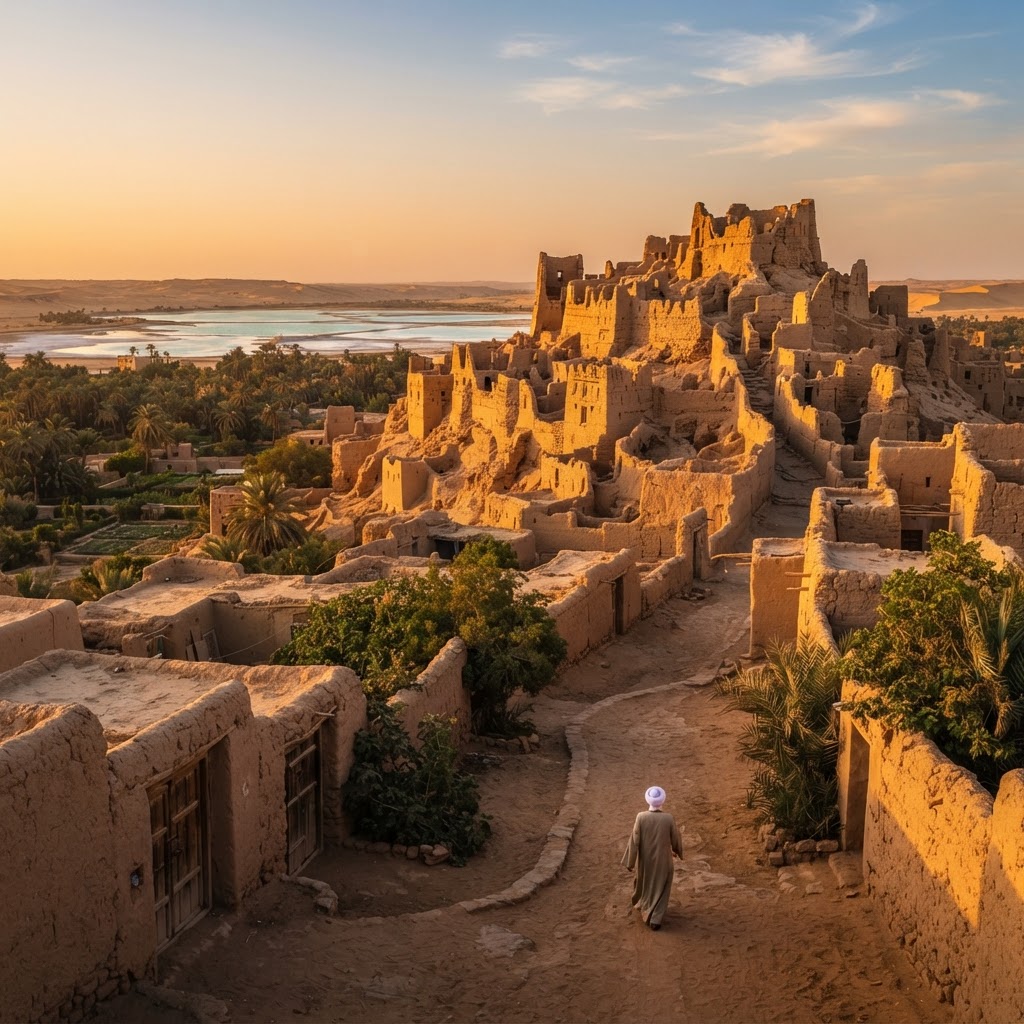
Perched on the edge of the Great Sand Sea roughly 50 kilometers from the Libyan border, Siwa Oasis feels completely untethered from the rest of Egypt. Dominated by hundreds of thousands of date palms and olive groves, its clay-and-salt kershef architecture, Indigenous Amazigh (Siwi) culture, and electric-blue salt pools offer an antidote to the aggressive touts and sensory overload of Cairo and Luxor.
4 days
Best time
October to March for crisp desert weather and tolerable daytime exploration.
Build your own trip with these prebuilt itineraries
Each one is a tested, day-by-day plan for Siwa Oasis — start here, then make it yours.
5 Days in Siwa: Slow Eco-Living & Amazigh Heritage in Siwa Oasis
Slow-paced cultural immersion and wellness retreat focusing on traditional kershef architecture, Berber craft workshops, natural springs, and quiet date palm groves
4 Days in Siwa: The Essential Oasis & Great Sand Sea in Siwa Oasis
First-timer highlights balancing Shali mudbrick ruins, buoyant salt lakes, Temple of the Oracle, and a thrilling 4WD dune safari
3 Days in Siwa: Active Adventure & Sand Sea Trek in Siwa Oasis
High-adrenaline outdoor focus featuring sandboarding the Great Sand Sea, desert 4x4 tracks, remote hot spring soaks, and cycling between palm groves
Go for an authentic, unhurried desert escape where hyper-saline turquoise basins let you float effortlessly amidst blinding white salt flats. Siwa combines the haunting, melt-in-the-rain ruins of the 13th-century Shali Fortress with secluded kershef eco-lodges, natural thermal hot springs, and monumental dunes without the high-pressure tourism common along the Nile.
Where to stay
Getting there
Getting around
Food & drink
What it costs
Things to do
Book tours & tickets in Siwa OasisSkip it if
Skip it if you are on a tight one-week Egypt itinerary; burning 2 full days in transit for a short stay will derail visits to Cairo, Luxor, or Aswan. Also avoid if you require chain luxury hotels, lively nightlife, or reliable high-speed fiber internet.
When to go
Desert winters offer mild midday highs in the low 20s Celsius and freezing starry nights, avoiding the debilitating 40°C heat that shuts the oasis down in midsummer. While December and January bring domestic holidaymakers, crowd density remains minuscule compared to Luxor or Cairo.
Peak (October to March)
Crisp sunny days and chilly desert nights; ideal for 4WD desert traversing and long bike rides through olive groves. Pack fleece layers for sundown.
Shoulder (April & September)
Temperatures consistently push into the mid-30s Celsius. Swimming in natural springs is comfortable, but midday climbs up Shali or Gebel Al-Mawta become grueling.
Low (May to August)
Extreme desert heat regularly surpasses 40°C (104°F). Midday travel is nearly impossible, desert safaris are restricted, and many eco-lodges close or limit operations.
Neighborhoods
Where you stay shapes the trip. Here's how to think about it.
Shali & El Souq
Earthy, walkable mud-brick market core buzzing with tricycles and date merchants beneath ruined ramparts.
Best for:First-timers wanting immediate walkability to cafes, bike rentals, and cash points.
Don't miss:Scrambling the kershef salt-clay stairs of the 13th-century Shali Fortress at dusk for a 360-degree panorama of the palm canopy.
Aghurmi
Quiet, ancient agricultural settlement surrounded by ancient olive groves and dramatic rocky bluffs.
Best for:History enthusiasts and travelers prioritizing contemplative stillness over village commerce.
Don't miss:The Temple of the Oracle of Amun, where Alexander the Great arrived in 331 BCE to confirm his divine parentage.
Fatnas (Fantasy Island)
Serene western lakeshore framed by reeds, hot-spring channels, and reflective salt water.
Best for:Sunset seekers, afternoon loungers, and travelers seeking rustic tranquility away from town center dust.
Don't miss:Sipping wood-fired Siwan lemongrass tea on cushioned palm-trunk mats at the edge of Lake Siwa while the sun drops behind the dunes.
Birket Siwa & Zeitoun
Surreal industrial-natural desert fringe dominated by hyper-saline turquoise mining pans and white crystal crusts.
Best for:Wellness floaters, photographers, and visitors seeking complete geological isolation.
Don't miss:Floating completely weightless in an electric-blue, cut-salt pit wearing hard-soled water shoes to withstand razor-sharp brine crystals.
Gebel Al-Mawta (Mountain of the Dead)
Conical limestone necropolis perforated by Greco-Roman tombs on the northern boundary of the main oasis.
Best for:Independent culture explorers who enjoy combining quiet desert panoramas with archaeological tomb visits.
Don't miss:The vibrant 26th-dynasty wall paintings inside the rock-cut Tomb of Si-Amun.
Destination intelligence
Updated 9/14/2026The structured record we plan every Siwa Oasis itinerary from.
Walkability
Moderate within Shali town center; negligible for visiting salt basins, springs, and desert tracks without a tuk-tuk or 4WD.
Transit quality
Limited. No metro or urban transit; local transport relies entirely on motorized tricycle tuk-tuks, rental bikes, and chartered 4x4s.
Car needed
Do not self-drive; hire a private driver with desert route experience from Cairo, then hire local tuk-tuks and authorized 4x4 safari guides in town.
Ideal duration
4 days
Minimum useful
3 days
Peak season
October through March (daytime temperatures are crisp and comfortable in the 20s Celsius, dropping to brisk desert nights).
Shoulder season
April and September (temperatures rise quickly into the 30s Celsius; warm for swimming in freshwater springs without suffocating heat).
Low season
May through August (blistering desert heat exceeding 40°C/104°F makes midday exploration nearly impossible).
Best for
Common mistakes
- Treating Siwa as an overnight trip from Cairo (a 10-hour drive each direction demands at least 3 full nights on the ground)
- Attempting to self-drive a rental car from Cairo through desert military checkpoints without knowing local transit permits
- Forgetting to pack gallons of tap water in the tuk-tuk when visiting the salt lakes, which leaves severe salt crust burning on your skin
- Wearing skimpy western resort swimwear inside the town or around sacred village freshwater springs; Siwa remains deeply culturally conservative
Best nearby
See what a trip to Egypt actually costs. Travel Budget Co.
How to plan it
- Stay within walking distance of El Souq if you want casual evening dining without pre-arranging tuk-tuks; choose an outlying kershef lodge near Aghurmi or the salt lakes only if you want off-grid silence.
- Do not attempt to cram the salt pools and a Great Sand Sea 4WD safari into the same morning; brine crust clings to skin and demands a shower before you strap into a dusty 4x4 for dune bashing and sandboarding.
- Pair your visit to Cleopatra's Spring with lunch along the shaded canal cafes rather than rushing through it as a photo stop, as midday heat is best passed sipping cold karkadeh in the shade.
- Secure your Great Sand Sea desert permit through your hotel or local guide at least 24 hours in advance to clear border military protocols without losing morning travel time.
- Do not visit Siwa as a weekend trip from Cairo; the 18+ hours of round-trip desert highway transit will leave you exhausted unless anchored by at least three full nights in the oasis.
Questions
Readymade itineraries
Start from a tested template — then make it yours.
Ready to book
Lock in your Siwa Oasis trip
Everything in one place. We may earn a small commission — it never costs you more.
Plan a trip to Siwa Oasis
Pick a length and we'll build a day-by-day plan around how you travel — neighborhoods clustered, budget-aware, and editable.
Get better at planning trips like this
Occasional notes on planning smarter — no spam, unsubscribe anytime.
Plan a trip to Siwa Oasis
Turn this guide into a day-by-day plan built around your pace, your group, and your budget.
Build my Siwa Oasis trip