Morocco
Sahara & Merzouga, Morocco
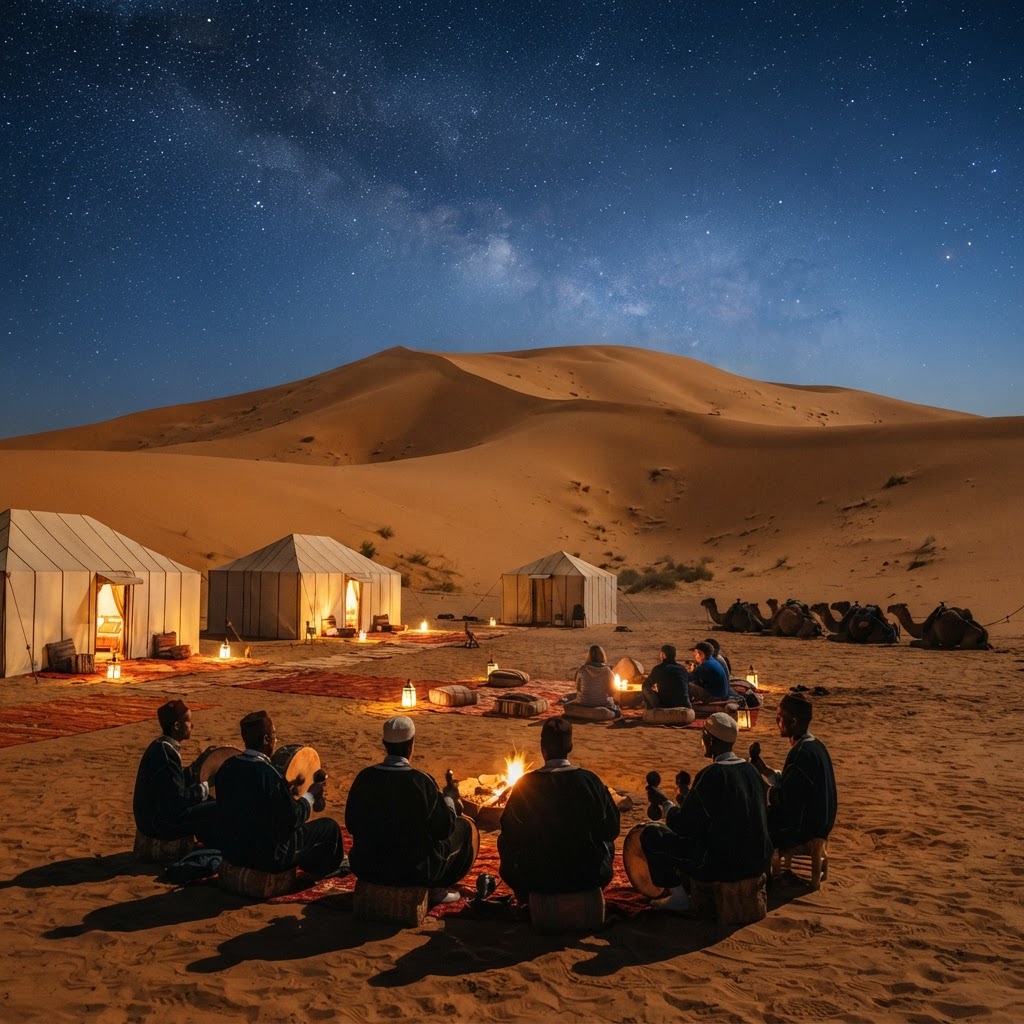
Towering Erg Chebbi dunes, Gnawa polyrhythms, and remote Berber glamping beneath dark-sky constellations.
Plan & book
Sort your Sahara & Merzouga, Morocco trip in one place.
We point you to the booking tools we'd actually use — live prices, no markup. Or let us build the day-by-day plan around you first, then book.
Perched on the edge of the Erg Chebbi dune field near the Algerian border, Merzouga is Morocco's primary gateway to deep Saharan landscapes. Unlike the rocky reg of Zagora or Agafay's barren stone plains outside Marrakech, Merzouga features classic wind-sculpted orange sand dunes that rear up to 150 meters high. The village itself functions as an outpost of mud-brick kasbahs and desert hotels, acting as the launching point for 4x4 tracks and dromedary treks into luxury desert bivouacs. Visiting requires enduring a long haul over the Atlas Mountains, but the reward is complete sensory isolation, silence, and brilliant stargazing.
2 nights
Best time
October to April for clear stargazing and tolerable daytime temperatures.
Build your own trip with these prebuilt itineraries
Each one is a tested, day-by-day plan for Sahara & Merzouga, Morocco — start here, then make it yours.
4 Days in Merzouga: Slow Desert Trek & Wilderness Retreat in Sahara/Merzouga
Slow-paced adventure combining remote oasis trekking, desert relaxation, sunrise dune climbs, and deep Saharan stargazing.
3 Days in Merzouga: Desert Culture & 4x4 Exploration in Sahara/Merzouga
In-depth desert immersion with Gnawa musical heritage in Khamlia, nomad encounters, fossil beds, and off-road pistes.
2 Days in Merzouga: The Classic Dune Camp Experience in Sahara/Merzouga
Essential highlights featuring sunset camel trekking, luxury bivouac glamping, and Erg Chebbi astrophotography.
Erg Chebbi provides the iconic Saharan visual: monumental, apricot-colored sand seas directly accessible without days of off-road expedition driving. Beyond dune trekking, the surrounding basin holds distinct cultural depth—from the historic trans-Saharan trading outpost of Rissani to the sub-Saharan Gnawa musical traditions preserved in Khamlia. Watching the setting sun cast long violet shadows across razor-sharp dune ridges before a fireside drum session under an unpolluted night sky is unmatched across North Africa.
Where to stay
Getting there
Getting around
Food & drink
What it costs
Skip it if
Skip Merzouga if your Morocco itinerary is under 7 days; the 18+ hours of round-trip driving will consume your vacation and leave you exhausted. Travelers with severe mobility issues will also struggle with loose dune sand and basic vehicle boarding.
When to go
Desert conditions shift dramatically from scorching summer heat to winter night chills. Visiting between late autumn and early spring guarantees comfortable daytime exploration, though you trade midday heat for nighttime desert temperatures that often dip below freezing.
Peak (October to April)
Crisp sunny days in the 20s°C (68–75°F) with freezing desert nights that can plunge to -5°C. Dune camps fill months ahead; heavy thermal layers are mandatory.
Shoulder (May & September)
Temperatures consistently push into the high 30s°C (upper 90s°F) with occasional sirocco sandstorms, requiring all dune activity to occur strictly at dawn or dusk.
Low (June through August)
Oppressive Saharan heat exceeding 45°C (113°F). Most glamping bivouacs shut completely, leaving only air-conditioned village kasbahs operational.
Neighborhoods
Where you stay shapes the trip. Here's how to think about it.
Merzouga Village
Dusty outpost hub lined with supply shops, tour depots, and traditional auberges
Best for:Budget road-trippers, last-minute supply runs, and bus travelers needing simple logistics
Don't miss:Stocking up on water and snacks along the main drag before coordinating your desert transfer, plus an early evening stroll to the foot of the dunes
Hassi Labied
Tranquil agricultural palm oasis right at the base of the western dune wall
Best for:Travelers who want a calmer, authentic Berber village setting with direct dune-walking access
Don't miss:Walking through the community-managed palmeraie to inspect the historic khattara irrigation system
Deep Erg Chebbi Dunes
Vast silence, shifting apricot sands, and zero light pollution under massive skies
Best for:Stargazers, romantics, and photographers booking high-end luxury bivouacs
Don't miss:Scrambling up a 100-meter slipface on foot before daybreak to catch the first sunbeams raking across the ridges
Khamlia Village
Soulful desert hamlet steeped in traditional sub-Saharan musical heritage
Best for:Culture seekers, music lovers, and day-trippers venturing south of the main strip
Don't miss:A live performance of hypnotic Gnawa drumming and qraqeb metal castanets at Dar Gnaoua Bambara
Destination intelligence
Updated 9/14/2026The structured record we plan every Sahara & Merzouga, Morocco itinerary from.
Walkability
Low. Village centers are compact, but moving between dunes, remote camps, and desert attractions requires 4x4s, camels, or private taxis.
Transit quality
Limited. Daily long-distance Supratours buses connect to major hubs, but local exploration relies entirely on private drivers and tour transfers.
Car needed
Recommended. A rental car gives complete schedule freedom along the paved highways, though driving directly into the dunes requires hiring a camp 4x4.
Ideal duration
2 nights
Minimum useful
1 night
Peak season
October to April, when daytime weather is pleasant and clear, ideal for trekking and outdoor dinners.
Shoulder season
May and September, bringing manageable crowds alongside midday heat spikes that require resting in the shade.
Low season
June through August, characterized by punishing Saharan heat over 40°C (104°F) and shuttered bivouacs.
Best for
Common mistakes
- Booking a rushed 2-day/1-night round-trip tour from Marrakech, which forces 18 to 20 total hours in a minivan for just 14 hours in the desert.
- Visiting in July or August, when ambient temperatures routinely surge past 45°C (113°F), rendering tents stifling and outdoor activity dangerous.
- Failing to confirm whether a luxury camp has a fully private ensuite bathroom inside the tent rather than a shared block or detached commode.
- Underpacking warm layers for winter trips; Saharan winter nights regularly drop close to freezing despite warm daytime sunshine.
- Attempting to self-drive standard two-wheel-drive hire cars onto unmarked sand pistes, leading to costly tow extractions.
Best nearby
See what a trip to Morocco actually costs. Travel Budget Co.
How to plan it
- Never attempt Marrakech to Merzouga as an unbroken day drive; split the route by staying in the Dades Gorge or Skoura on the way out and Ouarzazate or Ait Benhaddou on the return.
- If combining Merzouga with Fes, use the Midelt and Ziz Valley highway (N13), which is a direct 7- to 8-hour drive that functions well as a single-day transit day.
- Book an en-suite luxury camp tier if traveling between December and February; desert night temperatures regularly hit freezing, and high-end tents include heavy blankets and interior space heaters.
- Pack a compact weekend duffel specifically for your desert night; leave heavy rolling suitcases locked in your rental car trunk or your desert operator's base kasbah.
- Coordinate your exact arrival time and staging rendezvous with your desert camp at least 24 hours prior to prevent missing the pre-sunset camel caravan or 4x4 shuttle.
Questions
Readymade itineraries
Start from a tested template — then make it yours.
Ready to book
Lock in your Sahara & Merzouga, Morocco trip
Everything in one place. We may earn a small commission — it never costs you more.
Plan a trip to Sahara & Merzouga, Morocco
Pick a length and we'll build a day-by-day plan around how you travel — neighborhoods clustered, budget-aware, and editable.
Get better at planning trips like this
Occasional notes on planning smarter — no spam, unsubscribe anytime.
Plan a trip to Sahara & Merzouga, Morocco
Turn this guide into a day-by-day plan built around your pace, your group, and your budget.
Build my Sahara & Merzouga, Morocco trip