South Africa
Pilanesberg, South Africa
Big Five safari inside an ancient volcanic crater, malaria-free and three hours from Johannesburg.
Plan & book
Sort your Pilanesberg, South Africa trip in one place.
We point you to the booking tools we'd actually use — live prices, no markup. Or let us build the day-by-day plan around you first, then book.
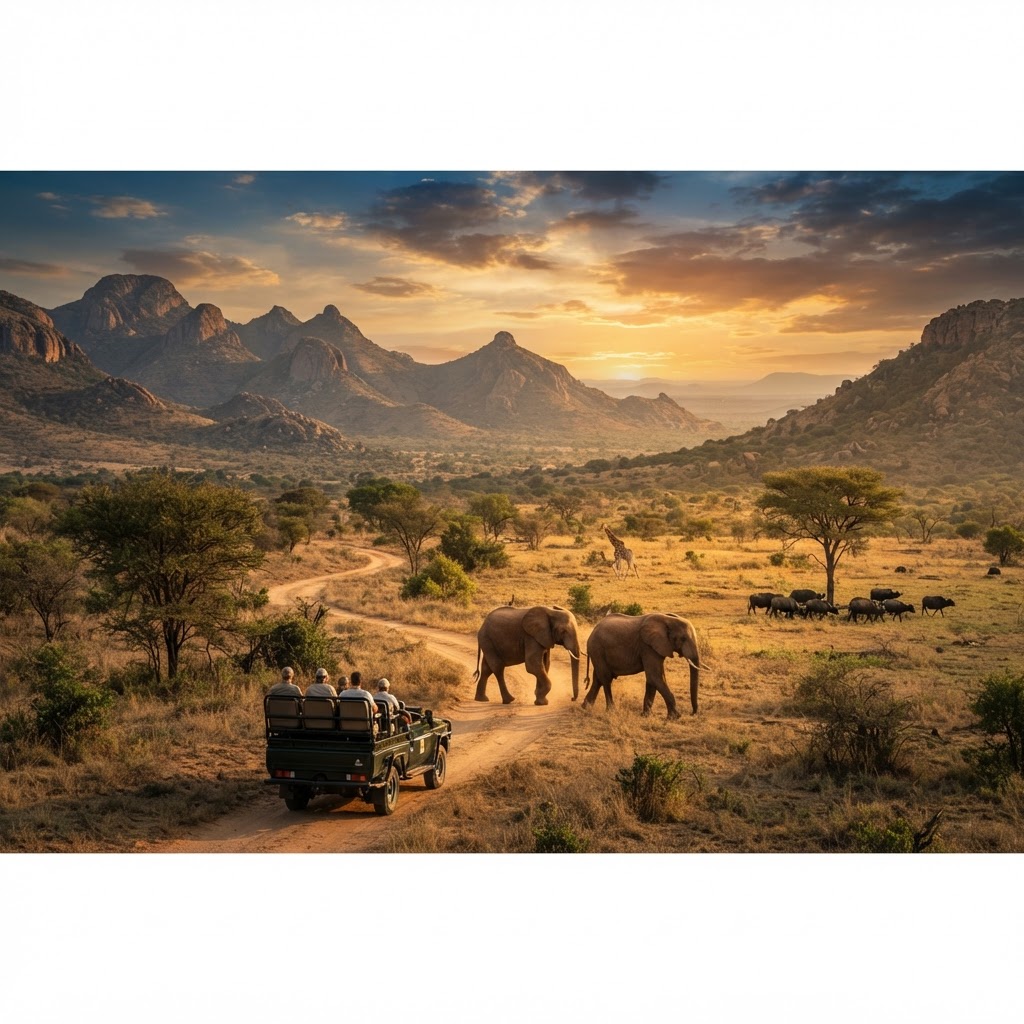
Set inside the concentric rings of an extinct alkaline volcanic complex that erupted 1.3 billion years ago, Pilanesberg National Park bridges the arid Kalahari thornveld and lush Lowveld bush. Because it is completely malaria-free and only a 2.5- to 3-hour highway drive from Johannesburg's O.R. Tambo International Airport, it delivers immediate, uncompromised Big Five game viewing without bush flights or antimalarial regimens. The reserve’s compact 550-square-kilometer footprint and 200 kilometers of well-maintained tar and gravel roads make self-driving exceptionally rewarding, pairing genuine wilderness encounters with top-tier convenience.
3 days (2 to 3 nights)
Best time
July through September (late dry winter)
Build your own trip with these prebuilt itineraries
Each one is a tested, day-by-day plan for Pilanesberg, South Africa — start here, then make it yours.
4 Days in Pilanesberg: Bush Photography & Walking Safari in Pilanesberg
Slow-paced photographic safari focusing on dawn hide sessions at Mankwe Dam and guided ranger-led walking trails
3 Days in Pilanesberg: Malaria-Free Family Safari in Pilanesberg
Family-focused wildlife exploration based inside park boundaries with guided open-vehicle drives and stationary hide vigils
2 Days in Pilanesberg: Quick Weekend Self-Drive in Pilanesberg
Self-drive safari highlights targeting Big Five game viewing and waterhole hides on an accessible weekend break from Johannesburg
Pilanesberg gives you the full Big Five roster—lion, leopard, elephant, rhino, and Cape buffalo—within an ancient caldera landscape that keeps animal density high and driving distances manageable. Unlike Greater Kruger or Madikwe, you do not need internal regional flights or antimalarial medication, making it the premier South African safari choice for multi-generational families, pregnant travelers, or anyone working with tight transit windows around Johannesburg. Its enclosed topography around Mankwe Dam guarantees dramatic sightings against dramatic geological amphitheaters.
Where to stay
Getting there
Getting around
Food & drink
What it costs
Skip it if
Skip Pilanesberg if you demand vast, unfenced landscapes where you can drive for hours without seeing another car, or if you expect the raw exclusivity of private Sabi Sand concessions. Because it sits within a 550-square-kilometer fenced perimeter close to Gauteng, popular sightings can attract crowds of private vehicles on weekends.
When to go
Vegetation dies back drastically and natural surface pans dry up, forcing animals to congregate around permanent dams like Mankwe. Mornings require heavy thermal layers, but midday temperatures sit comfortably around 22°C (72°F) with virtually zero rain or road mud.
Peak (October to April)
Lush, green bushveld with newborn antelope and superb birding, but thick foliage makes leopards hard to spot, afternoon thundershowers are common, and South African school holidays flood the main tar loops.
Shoulder (April to May & September)
Mild daytime conditions, low rain, and manageable gate traffic; late September specifically delivers dry-season visibility right before the summer rains break.
Low (May to August)
Freezing pre-dawn game drives dropping near 2°C (35°F), but uncrowded mid-week roads and the single most reliable game viewing around permanent hides and boreholes.
Neighborhoods
Where you stay shapes the trip. Here's how to think about it.
Black Rhino Game Reserve
Private, unfenced concession tucked against the park's northwestern slopes with open-vehicle off-roading.
Best for:luxury travelers and couples seeking uncrowded, high-end lodges
Don't miss:guided sunset traversing along private wilderness tracks forbidden to day visitors
Bakubung & Southern Sector
Family resort hub framed by granite hills, accessible directly through Bakubung Gate.
Best for:families with young kids and first-time safari travelers wanting creature comforts
Don't miss:watching elephants drink at the floodlit Bakubung waterhole right off the terrace
Kwa Maritane & Sun City Fringe
Polished, commercialized bush resort perched immediately adjacent to the Sun City complex.
Best for:travelers balancing golf, waterparks, and Big Five morning drives
Don't miss:walking through the 180-meter underground tunnel to the Kwa Maritane waterhole hide
Manyane & Eastern Wilderness
Self-catering bush camp and open grassy plains bordered by the main gate.
Best for:budget road-trippers, campers, and independent self-drivers
Don't miss:driving the Kgabo loop at first light to spot cheetahs across the open savannah
Mankwe Dam Central Basin
The watery core of the extinct caldera where park traffic and wildlife converge.
Best for:photographers, birdwatchers, and patient wildlife trackers
Don't miss:sitting silently in the Mankwe Bird Hide as hippos surface and fish eagles hunt
Destination intelligence
Updated 9/14/2026The structured record we plan every Pilanesberg, South Africa itinerary from.
Walkability
Car-only; walking inside the reserve is strictly prohibited outside fenced lodge grounds, bird hides, and ranger-led walking safaris.
Transit quality
No public transit exists inside the park; access requires a rental vehicle, booked safari tour, or private lodge transfer.
Car needed
Yes. A rental car is essential for self-drivers; visitors at all-inclusive lodges require transfers to and from Johannesburg.
Ideal duration
3 days (2 to 3 nights)
Minimum useful
2 days (1 night)
Peak season
October to April (High summer; hot weather, vibrant green bushveld, migratory birds, busy South African school holidays)
Shoulder season
April to May & September (Transition months; mild temperatures, clearing skies, comfortable game drives)
Low season
May to August (Dry winter; low tourist numbers outside weekends, cold mornings, but objectively the finest wildlife viewing)
Best for
Common mistakes
- Staying outside the park at Sun City when your primary goal is wildlife, which adds gate queues and rigid entry curfews to early drives.
- Driving too fast; park limits are 40 km/h, but the sweet spot for spotting game in the acacia scrub is 20–25 km/h.
- Skipping the hides during midday; stationary patience at Mankwe Dam often yields better sightings than driving in the heat.
- Failing to pack cold-weather layers for winter mornings (June–August), when open vehicle winds plunge temperatures near freezing.
- Relying solely on a tiny compact car; higher clearance pays significant dividends for seeing over embankment vegetation.
Best nearby
See what a trip to South Africa actually costs. Travel Budget Co.
How to plan it
- Base yourself in the Black Rhino Game Reserve concession if you want open safari vehicle off-roading and strict crowd caps, avoiding public park vehicle congestion.
- Do not drive during the dead hours of 11:30 to 14:30; park your vehicle at Mankwe Dam Hide or Rathogo Hide and let the animals come to the water while you wait out the heat.
- Pair Pilanesberg with a transfer directly from Johannesburg O.R. Tambo (JNB) for an efficient malaria-free safari before flying down to Cape Town or the Garden Route.
- If self-driving, pick up your rental car directly at O.R. Tambo Airport and take the R512 via Lanseria and Rustenburg for the smoothest 2.5-hour highway transit.
- Skip the Sun City day pass unless traveling with children who want the Valley of Waves waterpark; the mega-resort casino bustle directly clashes with the wilderness pace of the reserve.
Questions
Readymade itineraries
Start from a tested template — then make it yours.
Ready to book
Lock in your Pilanesberg, South Africa trip
Everything in one place. We may earn a small commission — it never costs you more.
Plan a trip to Pilanesberg, South Africa
Pick a length and we'll build a day-by-day plan around how you travel — neighborhoods clustered, budget-aware, and editable.
Get better at planning trips like this
Occasional notes on planning smarter — no spam, unsubscribe anytime.
Plan a trip to Pilanesberg, South Africa
Turn this guide into a day-by-day plan built around your pace, your group, and your budget.
Build my Pilanesberg, South Africa trip