Botswana
Okavango Delta
Untamed inland waterways, apex predator drama, and low-impact private safari concessions
Plan & book
Sort your Okavango Delta trip in one place.
We point you to the booking tools we'd actually use — live prices, no markup. Or let us build the day-by-day plan around you first, then book.
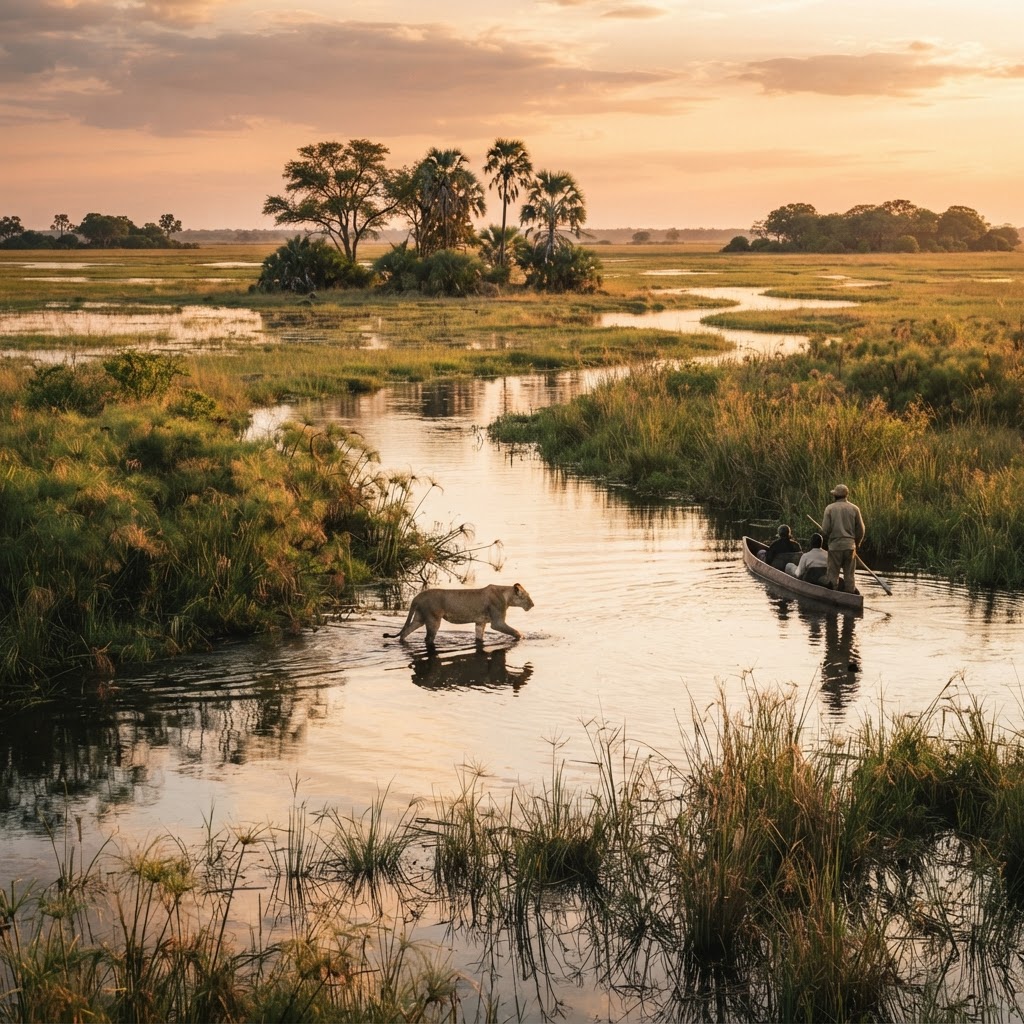
The Okavango Delta is an inland endorheic basin where the Okavango River drains into the sands of the Kalahari Desert, producing a vast oasis of floodplains, lagoons, and wooded islands. Unlike standard vehicle-bound safaris in Eastern or Southern Africa, the Delta balances classic off-road 4x4 game viewing with silent mokoro canoe glides, walking trails, and boat safaris. Because Botswana prioritizes high-value, low-density conservation, you encounter extraordinary wildlife concentrations—including wild dogs, lions, leopards, and large elephant herds—without encountering competing vehicle crowds.
How long
4 to 6 nights (split across 2 contrasting camps)
Best time
July to October for peak predator action and high water; late May to June for the best balance of rates, flood levels, and mild weather.
Build your own trip with these prebuilt itineraries
Each one is a tested, day-by-day plan for Okavango Delta — start here, then make it yours.
6 Days Deep Delta Birding & Walking Wilderness in Okavango Delta
Slow-paced safari veteran immersion emphasizing guided walking safaris, remote channels, and rare wetland bird species
5 Days Photographic & Predator Tracking in Okavango Delta
Focused game drive intensive across premier wildlife concessions designed for serious photographers and predator sightings
4 Days Classic Water & Land Safari in Okavango Delta
First-time balanced split between a permanent deep-water camp and a dry concession for mokoro glides and big cat tracking
The Okavango offers unmatched wildlife density with exceptional exclusivity. Rather than being confined to public park roads, private concessions allow off-road tracking of predators, night drives, and walking safaris. The dynamic combination of land and water ecosystems means you can track a pride of lions on dry ground at sunrise and glide through papyrus channels by mokoro alongside painted reed frogs by mid-afternoon.
Where to stay
Getting there
Getting around
Food & drink
What it costs
Things to do
Book tours & tickets in Okavango DeltaSkip it if
Skip the Okavango if you are traveling on a strict budget (under $300/day total) or prefer self-paced city hopping, nightlife, and dining autonomy. It is also poorly suited for families with children under 6 (most concession camps enforce strict age minimums due to unfenced wildlife) or travelers with severe mobility issues who cannot board light aircraft, step into unstable mokoro canoes, or navigate uneven bush pathways.
When to go
The paradox of the Delta is that floodwaters from Angolan summer rains arrive during Botswana's dry winter (June–August), attracting vast animal concentrations to shrinking islands while enabling water-based excursions. July through September commands steep peak rates and requires booking up to a year ahead, while May and June offer lower shoulder pricing with vibrant landscapes.
Peak (July to October)
Peak floodwater levels drop into late dry season; bush thins out, creating unmatched predator visibility and massive elephant gatherings around water. Rates are at their highest and temperatures spike dramatically in October.
Shoulder (May to June & November)
May to June sees cooler mornings, arriving floodwaters, and lower lodge rates. November brings high heat, the start of early summer rains, and newborn impala calving season, offering exceptional value.
Low / Green Season (December to April)
High heat and afternoon downpours make vegetation thick and game harder to spot, with some water camps forced to halt boat outings. However, migratory bird life peaks, camps drop rates by 30-45%, and concession traffic disappears.
Neighborhoods
Where you stay shapes the trip. Here's how to think about it.
Chief's Island & Moremi Heart
Apex predator theater surrounded by seasonal floodplains and mopane woodlands
Best for:Big-cat tracking, first-timers wanting high wildlife volume, luxury travelers
Don't miss:Tracking resident lion prides and African wild dog packs across the open savannahs of the Mombo concession
Vumbura & Northern Spillways
A dual-terrain wetland where dry woodland margins collide with deep perennial waterways
Best for:Year-round water and land combo safaris, diverse mammal viewing, avid birders
Don't miss:Gliding by mokoro along papyrus-fringed channels followed immediately by an off-road night drive
Jao & Western Permanent Delta
Tranquil, water-dominated lagoon system dotted with isolated palm islands
Best for:Water safari purists, honeymooners, rare wetland species tracking
Don't miss:Searching for the elusive semi-aquatic sitatunga antelope and Pel's fishing owl by motorized boat
Khwai Private Reserve & River Fringe
Action-packed wildlife corridor flanking the northeastern boundary of Moremi Game Reserve
Best for:Off-road tracking flexibility, night drives, serious wildlife photographers
Don't miss:Catching leopard activity along the riverine forest during late-afternoon and twilight spotlight drives
Sillero & Southern Floodplains (Kanana Area)
Classic low-density floodplains featuring vast heronries and open grasslands
Best for:Birdwatching enthusiasts, walking safaris, travelers seeking classic Delta variety at mid-luxury rates
Don't miss:Visiting the bustling Kanana heronry between August and November when thousands of storks and herons nest
Destination intelligence
Updated 9/14/2026The structured record we plan every Okavango Delta itinerary from.
Walkability
Non-walkable outside fenced lodge decks; all movements beyond camp perimeters are strictly guided due to dangerous game.
Transit quality
No public transit. Movement is entirely operated via bush charter flights, private safari 4x4s, and boats.
Car needed
Rental cars are unusable for lodge-based safaris. Only advanced self-drive 4x4 overlanders equipped with winches and snorkels access public tracks.
Ideal duration
4 to 6 nights (split across 2 contrasting camps)
Minimum useful
3 nights (single camp)
Peak season
July to October (floodwaters peak, vegetation thins out, dry conditions pull massive wildlife herds to open water).
Shoulder season
May to June (floodwaters arriving, pleasant temperatures, lower rates) and November (start of rain, calving season begins).
Low season
December to April (Green Season; heavy afternoon rain, thick bush, migratory birds arrive, significant lodge discounts).
Best for
Common mistakes
- Packing hard-shell suitcases: light charter aircraft enforce strict 15–20 kg soft-sided duffel bag limits with zero tolerance for rigid frames
- Booking only one camp type: staying solely at a permanent water lodge will limit big game sightings, while an exclusively dry camp eliminates the signature mokoro experience
- Failing to account for flood timing: assuming peak floods align with the rainy season; the Delta floods in winter (June–August) from distant Angolan rains, not local summer storms
- Skipping malaria prophylaxis: the Okavango is a known malaria risk zone requiring advance preparation and approved preventative medication
- Over-packing warm-weather clothing for winter: June and July mornings on open safari vehicles drop near freezing (0–5°C), requiring heavy layers, beanies, and windbreakers
Best nearby
See what a trip to Botswana actually costs. Travel Budget Co.
How to plan it
- Always pair one land-focused camp (e.g., Mombo or Khwai) with one water-focused camp (e.g., Jao or Kala) to experience both off-road predator tracking and silent mokoro safaris.
- Fly through Maun Airport (MUB) for seamless light-aircraft bush hops straight into camp concession airstrips rather than routing through Gaborone.
- Pair your 4-to-6-night Delta itinerary with 2 nights in the Makgadikgadi Salt Pans or Chobe River to contrast lush wetlands with desert adapted-wildlife.
- Avoid packing hard-shell spinner suitcases; bush charter flights will refuse rigid luggage at Maun airstrip, requiring you to repack into rented soft duffels.
- Book shoulder season (May, June, or November) if you want world-class guiding and game viewing while saving 30% to 40% off peak accommodation rates.
Questions
Readymade itineraries
Start from a tested template — then make it yours.
Ready to book
Lock in your Okavango Delta trip
Everything in one place. We may earn a small commission — it never costs you more.
Plan a trip to Okavango Delta
Pick a length and we'll build a day-by-day plan around how you travel — neighborhoods clustered, budget-aware, and editable.
Get better at planning trips like this
Occasional notes on planning smarter — no spam, unsubscribe anytime.
Plan a trip to Okavango Delta
Turn this guide into a day-by-day plan built around your pace, your group, and your budget.
Build my Okavango Delta trip