Bosnia and Herzegovina
Mostar, Bosnia and Herzegovina Itinerary: How Many Days + Sample Plans
Beyond the crowded bridge: Ottoman architecture, limestone canyons, and raw Balkan resilience.
Traveler rating
Loved by independent travelers exploring the Balkans by bus or car.
Plan & book
Sort your Mostar, Bosnia and Herzegovina trip in one place.
We point you to the booking tools we'd actually use — live prices, no markup. Or let us build the day-by-day plan around you first, then book.
Pick your trip length
How many days do you need in Mostar, Bosnia and Herzegovina?
Each of these opens a full day-by-day plan you can make your own.
- 2 days — Two days — the essentials, no rushing.
- 3 days — Three days — the icons plus one neighborhood.
- 4 days — Four days — a full city without sprinting.
- 5 days — Five days — room for a day trip.
- 7 days — A week — the city at a human pace.
- With Kids trip — Shorter days, earlier dinners, what to skip.
- For Couples trip — Two-person pacing with evenings built in.
- Solo trip — A plan that works well on your own.
- Food trip — Meals and markets as the anchors.
- Outdoors trip — Nature, walks and open air.
- Culture trip — History, museums and the streets around them.
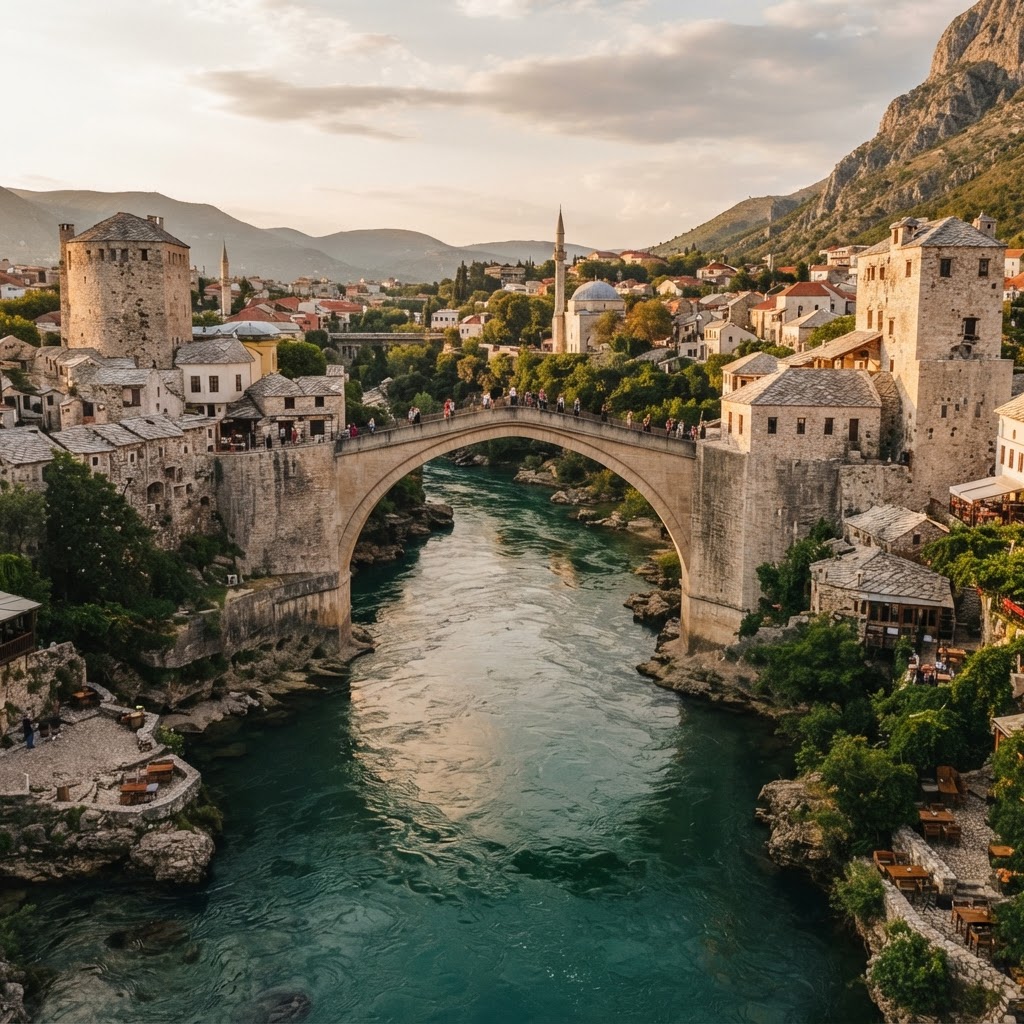
Mostar is frequently reduced to a hasty three-hour coach detour between Split and Dubrovnik, but treating it as a midday photo stop ruins the experience. When the tour buses leave by 5:00 PM, the polished limestone streets of the Kujundžiluk bazaar cool down, the call to prayer echoes over the turquoise Neretva, and the city reveals its complex soul. Base yourself here for two to three nights to explore the Old Town without tour groups and use it as your launchpad for the rugged Herzegovina karst region.
2 to 3 days
Best time
May to June and September to October offer the optimal balance of mild hiking temperatures and manageable crowd levels.
Build your own trip with these prebuilt itineraries
Each one is a tested, day-by-day plan for Mostar, Bosnia and Herzegovina — start here, then make it yours.
Weekend Mostar & Surrounds in Mostar
Evening charm after day-trippers depart, plus morning excursions to Blagaj Tekke and Počitelj
3 Days Herzegovina Road Trip Hub in Mostar
Full regional immersion covering Mostar old town, Kravice Waterfalls, and local Žilavka wine trails
One Day in Mostar in Mostar
Old Bridge divers, Ottoman quarters, Koski Mehmed Pasha Mosque, and traditional supper
Mostar sits at the cultural seam between Ottoman heritage and Mediterranean karst landscape. Stari Most is an engineering masterpiece, rebuilt stone by stone following its wartime destruction in 1993, but the real draw is Herzegovina itself. Staying overnight gives you quiet mornings on the bridge, cliff divers practicing in golden hour, and direct access to dramatic natural and historic sites like the Dervish monastery at Blagaj, the fortified hillside village of Počitelj, and the spring-fed pools of Kravice Waterfalls.
Where to stay
Getting there
Getting around
Food & drink
What it costs
Skip it if
Skip Mostar if you have mobility impairments that make steep steps and slippery cobblestones dangerous, or if your Balkan itinerary only permits a frantic four-hour round trip bus ride from Dubrovnik—the transit time and border queues will outweigh the short time you get on the ground.
When to go
Summer pushes the Neretva limestone valley past 40°C (104°F) and clogs the bridge with day-trippers from Dalmatia. The shoulder seasons deliver perfect light, warm swimming conditions at Kravice, and breathing room on the bazaar cobbles.
Peak (July–August)
Oppressive valley heat and shoulder-to-shoulder tour groups between 10:00 AM and 5:00 PM; book rooms with strong air conditioning and sightsee exclusively at dawn or night.
Shoulder (May–June & September–October)
Warm sunny days, comfortable walking temperatures, accessible outdoor dining along the river, and thinner tour bus volume.
Low (November–April)
Chilly, damp conditions with fast-moving, high river levels; many seasonal Old Town souvenir shops close, though hotel rates are rock-bottom and the alleys are serene.
Neighborhoods
Where you stay shapes the trip. Here's how to think about it.
Stari Grad & Kujundžiluk
Cobblestones, copper artisans, and direct sights of the Stari Most, packed by noon and wonderfully empty by dusk.
Best for:First-timers, architecture lovers, and travelers staying overnight to experience dawn and evening quiet.
Don't miss:Climbing the narrow minaret of the Koski Mehmed Pasha Mosque for the postcard panorama of the Old Bridge.
Bulevar (Former Frontline)
A gritty, thought-provoking dividing line between east and west marked by bullet-pocked facades and street art.
Best for:Modern history buffs and travelers wanting unfiltered context on the 1990s war.
Don't miss:The exterior of the derelict former Ljubljanska Banka building, historically dubbed the Sniper Tower, covered in vivid street art.
Rondo & Western Mostar
Tree-lined Austro-Hungarian boulevards, quiet residential avenues, student cafés, and modern retail.
Best for:Travelers seeking modern amenities, local-priced restaurants, easy car parking, and distance from tour-bus routes.
Don't miss:A stroll along Kralja Tvrtka avenue down to Park Zrinjevac for coffee among locals at shaded neighborhood bakeries.
Donja Mahala
Traditional riverside residential enclave south of the Old Town where leafy courtyards meet the churning Neretva.
Best for:Peaceful guesthouse stays, authentic family-run taverns, and escaping foot traffic.
Don't miss:The quiet cobblestone alleys leading down to Lučki Most bridge for an uncrowded vantage point looking back at Stari Most.
Destination intelligence
Updated 10/6/2026The structured record we plan every Mostar, Bosnia and Herzegovina itinerary from.
Walkability
High within the town center. The Old Town and western shopping districts are thoroughly walkable on foot, provided you wear grippy footwear.
Transit quality
Moderate. Excellent and picturesque train link north to Sarajevo, decent regional bus terminal, but patchy rural transit to outlying highlights like Kravice.
Car needed
Not for Mostar itself, but highly advantageous if you want to explore Blagaj, Počitelj, and Kravice at your own schedule without a guided van group.
Ideal duration
2 to 3 days
Minimum useful
1 night / 2 days
Peak season
July to August: Intense heat (frequently topping 40°C/104°F) and wall-to-wall day-tour crowds from the Adriatic coast.
Shoulder season
May to June and September to October: The sweet spot. Warm swimming weather, manageable crowds, and pleasant walking conditions.
Low season
November to March: Quiet, damp, and atmospheric with low hotel rates, though river levels run high and some tourism-oriented restaurants shut down.
Best for
Common mistakes
- Visiting purely as a midday coach stop from Dubrovnik, missing the peaceful early mornings and late evenings when the cruise day-trippers depart
- Wearing smooth-soled sandals or dress shoes across the slick, angled limestone cobblestones of Stari Most
- Expecting euro acceptance everywhere: tourist stalls near the bridge might take euros at poor exchange rates, but local bakeries, transit ticket windows, and smaller shops demand Bosnian Convertible Mark (BAM) in cash
- Underestimating border delays when driving between Croatia and Bosnia during July and August
- Attempting to reach Kravice Waterfalls by public transit, which is complex and requires multiple rural connection points compared to renting a car or booking a local day shuttle
Best nearby
See what a trip to Bosnia and Herzegovina actually costs. Travel Budget Co.
How to plan it
- Arrive by train from Sarajevo in the morning, check into your base, and rest or explore western Mostar during the midday heat when coastal tour buses congest the Old Town.
- Pair Blagaj Tekke, the medieval stone fortress of Počitelj, and Kravice Waterfalls into a single coherent day loop by rental car or hired driver.
- Do not climb Stari Most between 12:00 PM and 3:00 PM in July or August—the stones reflect intense heat and crowd density reaches its peak.
- Cross over to Lučki Most or the beach below Stari Most around dusk for clear bridge photography without dodging tour umbrellas.
Questions
Readymade itineraries
Start from a tested template — then make it yours.
Ready to book
Lock in your Mostar, Bosnia and Herzegovina trip
Everything in one place. We may earn a small commission — it never costs you more.
Plan a trip to Mostar, Bosnia and Herzegovina
Pick a length and we'll build a day-by-day plan around how you travel — neighborhoods clustered, budget-aware, and editable.
Get better at planning trips like this
Occasional notes on planning smarter — no spam, unsubscribe anytime.
Plan a trip to Mostar, Bosnia and Herzegovina
Turn this guide into a day-by-day plan built around your pace, your group, and your budget.
Build my Mostar, Bosnia and Herzegovina trip