Costa Rica
Monteverde
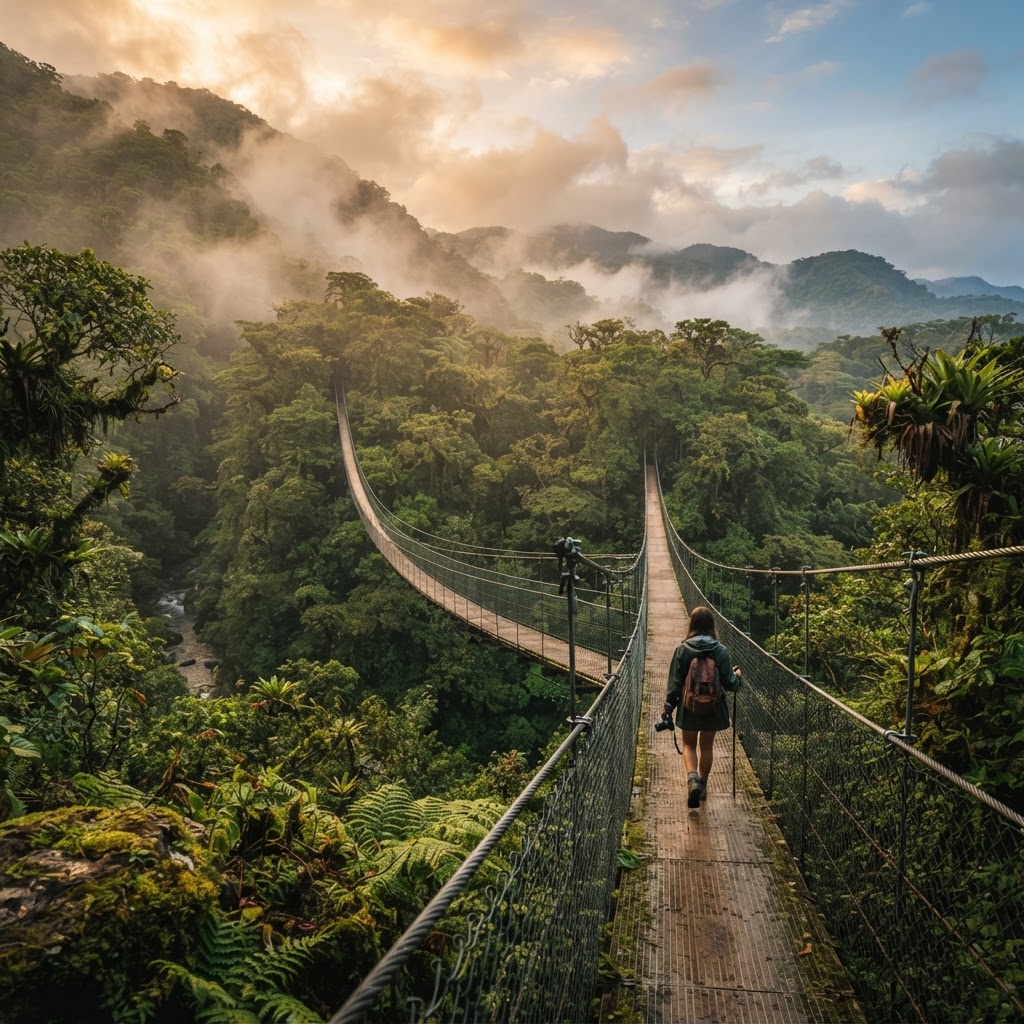
High-altitude cloud forests, suspension bridges, and cool misty mountain serenity.
Plan & book
Sort your Monteverde trip in one place.
We point you to the booking tools we'd actually use — live prices, no markup. Or let us build the day-by-day plan around you first, then book.
Perched at 1,400 meters along Costa Rica's continental divide, Monteverde trades coastal heat for cool mountain mists, hanging mosses, and high-altitude biodiversity. Founded largely by Quaker dairy farmers and local conservationists in the 1950s, the canton pairs rugged cloud forest ecosystems with active adventure parks and small mountain communities.
3 days
Best time
January through April for crisp, dry mornings and peak birding, or July for emerald trails without peak crowd volume.
Build your own trip with these prebuilt itineraries
Each one is a tested, day-by-day plan for Monteverde — start here, then make it yours.
5 Days in Monteverde: Deep Ecology & Birding Immersion in Monteverde
Slow-paced exploration for avid birders and nature photographers targeting rare species, off-the-beaten-path reserves, and eco-lodge tranquility
3 Days in Monteverde: The Classic Cloud Forest in Monteverde
Balanced introduction to primary cloud forest reserves with expert naturalist tracking, coffee culture, and Santa Elena dining
2 Days in Monteverde: Canopy & High Thrills in Monteverde
Adrenaline and aerial adventure focused on suspension bridges, extreme zipline circuits, and night-walk wildlife
Monteverde preserves one of the planet's rarest ecosystems—the tropical cloud forest—where continuous condensation wraps hanging bridges and primary canopy in low-drifting cloud. It offers world-class birdwatching for the Resplendent Quetzal, authentic night walks for nocturnal wildlife, and cooler, brisk temperatures that provide a refreshing break from Costa Rica's lowland heat.
Where to stay
Getting there
Getting around
Food & drink
What it costs
Things to do
Book tours & tickets in MonteverdeSkip it if
Skip Monteverde if your trip is under five days total and already includes coastal destinations, if you get severe motion sickness on winding mountain roads, or if you exclusively want hot tropical beach weather and poolside sunshine.
When to go
Dry season guarantees clearer roads and active resplendent quetzal mating displays, but brisk trade winds can drop temperatures sharply. The May to July shoulder season trades daily mid-afternoon rain for cheaper boutique lodge rates and mistier, cinematic canopy foliage.
December to April (Peak / Dry Season)
Dry trails and prime wildlife viewing, but hotel rates hit their peak and reserve entry slots must be booked days in advance.
May to July (Shoulder / Early Green Season)
Crisp, rain-free mornings give way to afternoon downpours; foliage is vibrant, crowds thin significantly, and pricing softens.
August to November (Low / Wet Season)
September and October bring torrential rains, persistent fog, and muddy unpaved roads; ideal for solitary hikers on tight budgets, but pack serious waterproof gear.
Neighborhoods
Where you stay shapes the trip. Here's how to think about it.
Santa Elena Downtown
Bustling highland crossroads packed with sodas, tour kiosks, bakeries, and banking services.
Best for:Budget travelers, non-drivers, and first-timers wanting walkable dining
Don't miss:Fresh empanadas and strong pour-overs at Orchid Coffee Shop, right off the central triangle
Cerro Plano
Paved, rolling corridor between town and the reserve, lined with boutique mountain hotels and casual eateries.
Best for:Independent travelers wanting a quiet stay within an easy taxi hop of town amenities
Don't miss:Dinner at Sabor Tico for elevated casado plates without the tour-bus crowds
Monteverde Reserve Road (Old Quaker Settlement)
Quiet, rural highland forest enclave defined by deep-green dairy pastures and design-led eco-lodges.
Best for:Couples, birdwatchers, and travelers seeking pure silence and direct trail proximity
Don't miss:Sampling artisanal gouda and homemade ice cream at the Monteverde Cheese Factory
San Luis Valley
Lush agricultural valley tumbling down from the divide, dominated by working coffee farms and canopy views.
Best for:Return visitors and agritourists willing to navigate steep, gravel backroads for complete seclusion
Don't miss:A bean-to-cup tour through the shade-grown coffee parcels at Finca Rosa Blanca's local highland plots or Café Monteverde
Destination intelligence
Updated 9/14/2026The structured record we plan every Monteverde itinerary from.
Walkability
Low. Central Santa Elena is walkable for restaurants and shops, but the reserves and lodges are scattered over steep, unlit mountain roads 3-6 km away.
Transit quality
Moderate. There are public buses connecting Santa Elena to San José and the reserves, but private shuttles, hotel transfers, and official red taxis are the practical choice.
Car needed
Optional. Helpful for total schedule flexibility across separate reserves, but high-clearance vehicles are needed for side trails, and many tourists manage well with shuttles and taxis.
Ideal duration
3 days
Minimum useful
2 days
Peak season
December through April. Dryer weather, clearer mornings, and peak Quetzal mating season, though mornings require advance reserve bookings.
Shoulder season
May through July. Green season starts; afternoon rain is frequent, but mornings are clear, trails are uncrowded, and forests are remarkably lush.
Low season
September through October. Heaviest downpours, potential mud on backroads, and dense fog, though prices drop and lodges are tranquil.
Best for
Common mistakes
- Packing only beach and warm-weather clothes; nighttime temperatures drop into the 50s°F (12-14°C) with persistent drizzle and brisk winds.
- Attempting a single-night whistle-stop stay, which forces you to rush long mountain transit on narrow winding roads.
- Hiking reserves without a certified naturalist guide and expecting to effortlessly spot camouflaged wildlife.
- Driving mountain access roads after dark in heavy fog and torrential afternoon downpours.
Best nearby
See what a trip to Costa Rica actually costs. Travel Budget Co.
How to plan it
- Stay in Santa Elena if you want unchaperoned dinner options on foot; book along the Monteverde Reserve Road if you prioritize morning birdsong over village conveniences.
- Do not book your cloud forest hike for the afternoon; cloud cover, wind, and rain roll in past 1:00 PM, making 7:00 AM the decisive slot for clear trails and wildlife.
- Pair Monteverde with La Fortuna by taking the three-hour Lake Arenal boat-taxi transfer instead of spending five bumpy hours in a van rounding the lake.
- Reserve your Monteverde Cloud Forest entrance tickets and naturalist guide at least two weeks out during the January-to-April dry rush.
- Do not overload your days with ticketed nature walks; pick one primary cloud forest reserve and one high-canopy suspension bridge park to prevent fee fatigue.
Questions
Readymade itineraries
Start from a tested template — then make it yours.
Ready to book
Lock in your Monteverde trip
Everything in one place. We may earn a small commission — it never costs you more.
Plan a trip to Monteverde
Pick a length and we'll build a day-by-day plan around how you travel — neighborhoods clustered, budget-aware, and editable.
Get better at planning trips like this
Occasional notes on planning smarter — no spam, unsubscribe anytime.
Plan a trip to Monteverde
Turn this guide into a day-by-day plan built around your pace, your group, and your budget.
Build my Monteverde trip