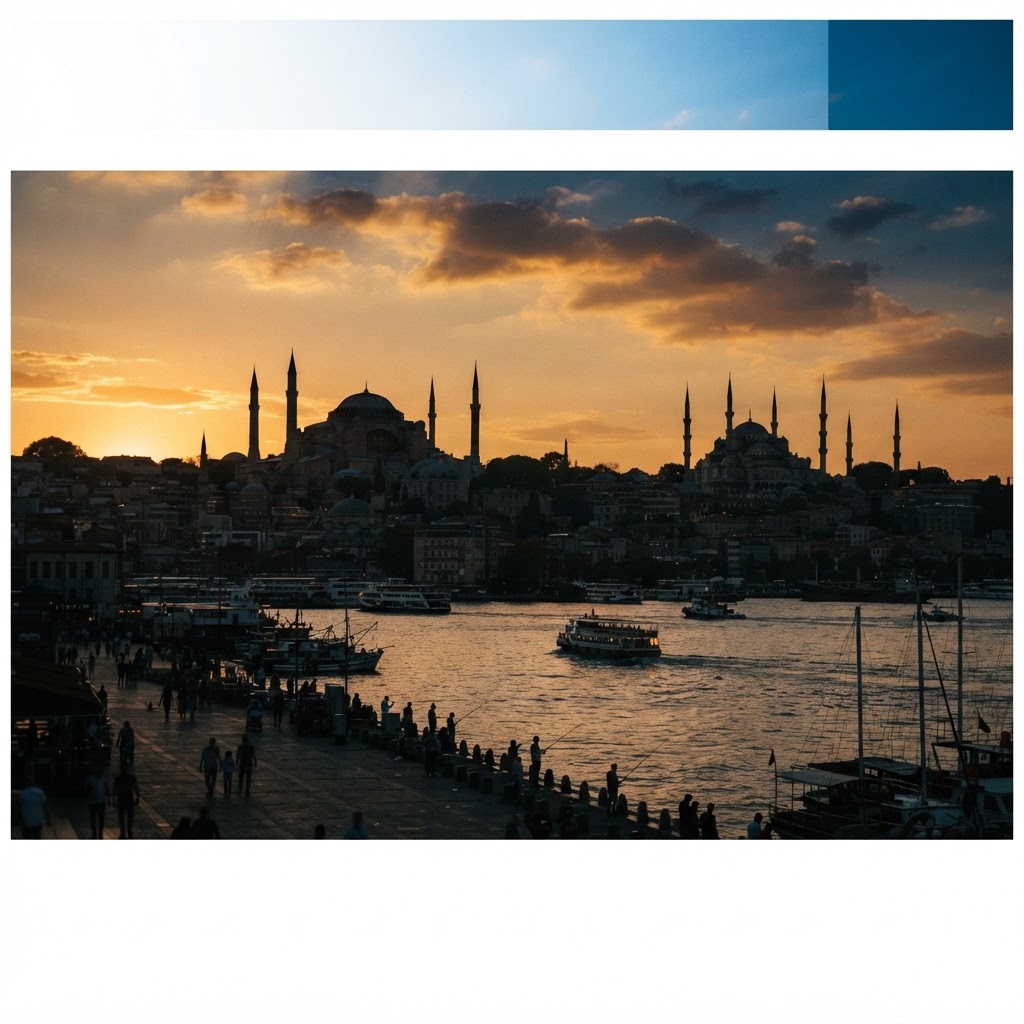
Turkey
Istanbul
Two continents colliding over salt air, layered empires, and late-night ferry wakes.
Plan & book
Sort your Istanbul trip in one place.
We point you to the booking tools we'd actually use — live prices, no markup. Or let us build the day-by-day plan around you first, then book.
Istanbul is a sensory powerhouse of 16 million people straddling Europe and Asia across the Bosphorus Strait. Built on layers of Roman, Byzantine, and Ottoman history, it is defined not just by domes and minarets, but by a vibrant maritime culture, unmatched hospitality, and distinct neighborhood micro-cultures. Moving through Istanbul means trading streetcars for commuter ferries, lingering over three-hour breakfasts, and navigating narrow, cat-guarded alleys.
5 to 6 days
Best time
May to early June or late September through October for mild weather and peak ferry life.
Build your own trip with these prebuilt itineraries
Each one is a tested, day-by-day plan for Istanbul — start here, then make it yours.
3 Days in Istanbul for First-Time Visitors
3 days in istanbul first time
4 Days in Istanbul Across Two Continents
istanbul two continents itinerary
5 Days in Istanbul for Street-Food Lovers
istanbul street food itinerary
4 Days in Istanbul: Hammams & the Bazaar
istanbul hammam bazaar itinerary
Few cities on earth offer this density of monumental architecture, culinary depth, and urban drama. Within a single day, you can stand beneath the 1,500-year-old domes of Hagia Sophia, cross a continental waterway on a public commuter ferry feeding seagulls with simit, and spend the evening eating meze and drinking raki in a buzzing Asian-side meyhane. It is immersive, dynamic, and genuinely unique in its dual-continent geography.
Where to stay
Getting there
Getting around
Food & drink
What it costs
Things to do
Book tours & tickets in IstanbulSkip it if
Skip or shorten your stay if you have severe mobility limitations and cannot handle steep hills, cobblestones, and heavy foot traffic, or if you get overwhelmed by dense, chaotic mega-cities of 16+ million people and prefer calm, manicured resort towns.
When to go
Spring and autumn strike the critical balance between walkable 20°C (68°F) temperatures and manageable daylight hours, dodging July's suffocating humidity and January's biting Bosphorus gales. You pay higher hotel rates than in winter, but you actually spend your days on open-air ferry decks rather than sheltering from sleet.
Peak (May–June & September–October)
Crisp light, comfortable walking temperatures, and buzzing outdoor meyhanes; expect heavy crowds at Topkapı and book boutique hotels 2–3 months ahead.
Shoulder (April & November)
April brings millions of blooming park tulips but unpredictable rain; November cools down rapidly with fewer visitors and sharper accommodation deals.
Low (December–March)
Cold, grey, and damp with occasional snow squalls off the Black Sea; museum queues evaporate and luxury Bosphorus hotels drop rates significantly.
Neighborhoods
Where you stay shapes the trip. Here's how to think about it.
Sultanahmet
Monumental and atmospheric by day, tourist-centric and sleepy after dark.
Best for:First-timers with limited days who prioritize walking to Byzantine and Ottoman landmarks.
Don't miss:The quiet courtyard and Iznik tiles of the Sokollu Mehmet Pasha Mosque, avoiding the mid-day Sultanahmet Square crush.
Galata & Karaköy
Steep cobblestones, third-wave espresso bars, contemporary art, and maritime bustle below the Genoese tower.
Best for:Design lovers, cafe crawlers, and travelers who want ferry and tram access right at the water.
Don't miss:Walking downhill past the luthier shops of Galip Dede Street to grab salt-crusted fish wraps (balık dürüm) at the Karaköy shoreline.
Cihangir & Çukurcuma
Leafy, bohemian residential streets packed with antique shops, street cats, and laid-back neighborhood bistros.
Best for:Couples, slower-paced urban wanderers, and travelers seeking an authentic local European-side base.
Don't miss:Browsing dusty Ottoman ephemera and mid-century glassware along Çukurcuma Caddesi, followed by a tea stop at a corner kahvehane.
Kadıköy & Moda
Youthful, energetic Asian-side enclave centered around buzzing market lanes, indie record stores, and sunset seafront parks.
Best for:Food-focused travelers, repeat visitors, and anyone who prefers vibrant local nightlife over tour buses.
Don't miss:Eating regional Anatolian stews at Çiya Sofrası before grabbing an outdoor tea along the Moda seaside promenade.
Fener & Balat
Multi-layered historical enclave with steep stairways, pastel wooden Ottoman facades, and Greek Orthodox heritage.
Best for:Photographers, architecture enthusiasts, and vintage hunters looking beyond the standard imperial track.
Don't miss:The towering red-brick facade of the Phanar Greek Orthodox College looming over the hilltops above the Golden Horn.
Destination intelligence
Updated 9/14/2026The structured record we plan every Istanbul itinerary from.
Walkability
High within individual historic districts (Sultanahmet, Galata, Kadıköy, Moda), though very steep hills, broken pavements, and sheer urban scale require linking walks with ferries, trams, and funiculars.
Transit quality
Excellent; a dense, integrated network of metro lines, light rail, modern trams, funiculars, and cross-continental public ferries run seamlessly on the rechargeable Istanbulkart.
Car needed
Never. Renting a car in Istanbul is a major logistical mistake due to notorious bumper-to-bumper gridlock, complex one-way alleys, and nonexistent parking.
Ideal duration
5 to 6 days
Minimum useful
3 days
Peak season
May to June and September to October: mild, sunny weather, vibrant outdoor dining along the Bosphorus, and heavy international and regional visitor numbers.
Shoulder season
April and November: blooming tulips in April, cooler autumn air in November, manageable monument lines, and lighter crowds.
Low season
December to March: chilly, damp, and occasionally snowy with grey skies, but hotel rates drop substantially and major historic sights have minimal queues.
Best for
Common mistakes
- Staying in Sultanahmet for a week and assuming it represents modern Istanbul; it empties out after dark and lacks good local dining.
- Relying on street-hailed yellow taxis during rush hour instead of boarding the T1 tram, M2 metro, or public commuter ferries.
- Rushing through the city treating it like an obstacle course of 10 sights a day instead of anchoring one morning landmark and spending the afternoon wandering a distinct neighborhood.
- Falling for unsolicited friendly invitations near Taksim or Sultanahmet to 'have a drink' at a nearby bar, which ends in an inflated extortionate bill.
- Visiting major active mosques like Hagia Sophia without checking daily prayer times, leading to long waits outside while services are conducted.
Best nearby
See what a trip to Turkey actually costs. Travel Budget Co.
How to plan it
- Buy an Istanbulkart for transit (tram, ferry, bus) and load it once.
- Take a Bosphorus ferry at sunset — the cheapest great view in travel.
- Eat a full Turkish breakfast (serpme kahvaltı) once — make it the morning's only plan.
- Get up early for Hagia Sophia and the Blue Mosque before tour buses.
- Cross to Kadıköy for a night out — the Asian side is where locals go.
Questions
Readymade itineraries
Start from a tested template — then make it yours.
Ready to book
Lock in your Istanbul trip
Everything in one place. We may earn a small commission — it never costs you more.
Plan a trip to Istanbul
Pick a length and we'll build a day-by-day plan around how you travel — neighborhoods clustered, budget-aware, and editable.
Get better at planning trips like this
Occasional notes on planning smarter — no spam, unsubscribe anytime.
Plan a trip to Istanbul
Turn this guide into a day-by-day plan built around your pace, your group, and your budget.
Build my Istanbul trip