Vietnam
Ha Long Bay
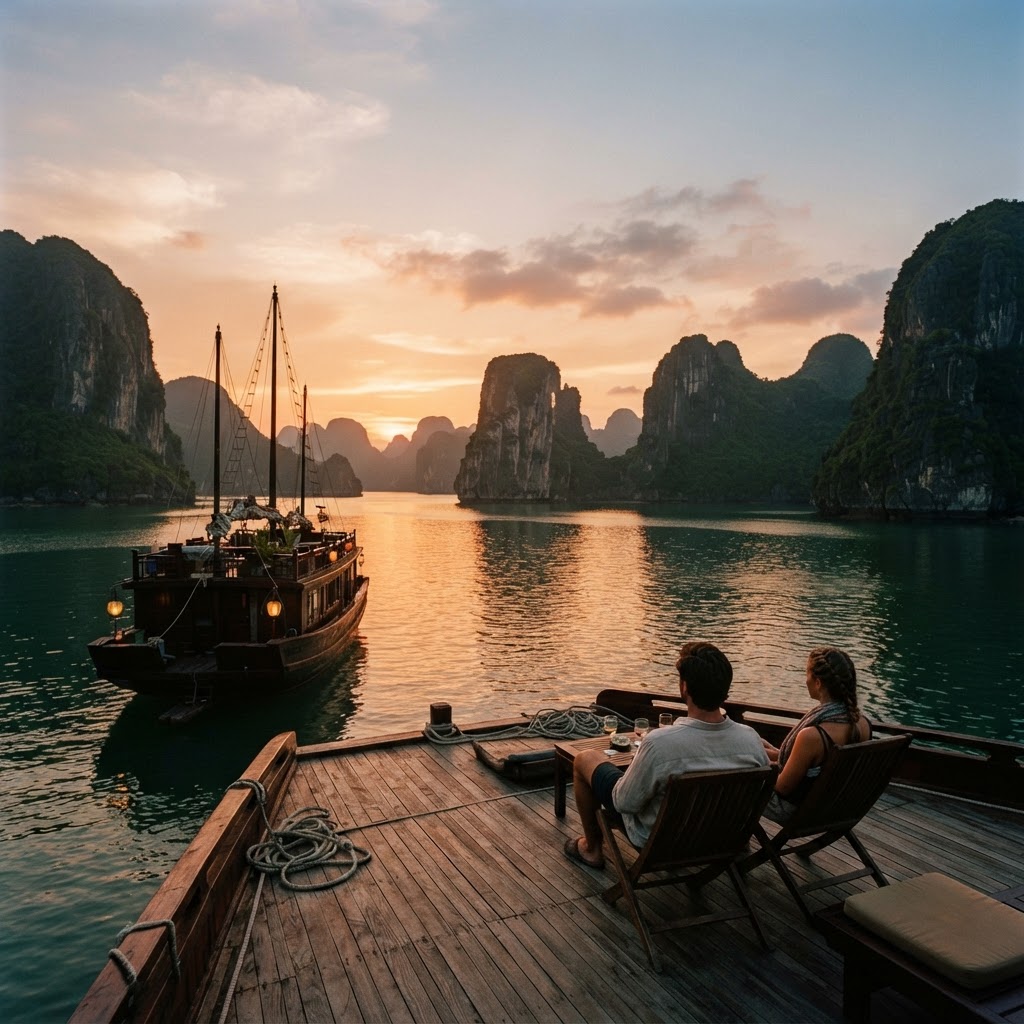
Dramatically sculpted karst waters best enjoyed overnight on deck away from the daytime fleet.
Plan & book
Sort your Ha Long Bay trip in one place.
We point you to the booking tools we'd actually use — live prices, no markup. Or let us build the day-by-day plan around you first, then book.
Rising from the Gulf of Tonkin, Ha Long Bay comprises nearly two thousand jagged limestone islets draped in tropical vegetation. While mainland Ha Long City has expanded rapidly into commercial high-rises and theme parks, the real allure remains on the water. Choosing the right route—whether classic Ha Long, serene Lan Ha Bay, or wild Bai Tu Long Bay—determines whether you experience maritime grandeur or a conveyor belt of crowded tenders.
3 days (2-night / 3-day cruise)
Best time
October to November and March to April.
Build your own trip with these prebuilt itineraries
Each one is a tested, day-by-day plan for Ha Long Bay — start here, then make it yours.
4 Days in Ha Long: Luxury Overwater & Island Retreat in Ha Long Bay
Slow-paced luxury combining a top-tier overnight cruise with an immersive wellness stay on Cat Ba Island
3 Days in Ha Long & Lan Ha: Deep Seclusion & Kayaking in Ha Long Bay
Active maritime adventure venturing into quiet Lan Ha Bay lagoons, secluded grottos, and tranquil island cycling routes
2 Days in Ha Long Bay: The Classic Overnight Cruise in Ha Long Bay
First-timer highlights featuring limestone cave exploration, iconic viewpoints, and sunset bay dining on a classic 1-night route
No photograph prepares you for the colossal verticality of thousands of ancient limestone towers emerging directly from calm jade water. Experiencing dawn over the misty karsts before engines start and excursion boats arrive is genuinely singular. Going beyond day tours lets you kayak through tidal arches, explore sea caves, and reach quiet anchorages unavailable to mass excursions.
Where to stay
Getting there
Getting around
Food & drink
What it costs
Things to do
Book tours & tickets in Ha Long BaySkip it if
Travelers who suffer from severe motion sickness, those who loathe scheduled group tours, and backpackers on sub-$25/day budgets who cannot afford an overnight cruise and would otherwise be stranded on an unsatisfying express bus.
When to go
These shoulder periods offer the ideal intersection of mild temperatures, lower humidity, and minimal rainfall. You avoid both the summer typhoon shutdown risks and the persistent, heavy winter sea mists that frequently choke panoramic visibility.
Peak (October to December & March to April)
Comfortable 20°C–26°C weather with crisp breezes and stable waters. Cruising demands booking high-tier cabins 2–3 months ahead; expect heavy boat traffic along central channel routes.
Shoulder (January to February)
Cool, overcast, and damp with temperatures dropping to 13°C–18°C. Swimming is unappealing and visibility can vanish in gray sea fog, though moody karst photos thrive.
Low (May to August)
Intensely hot, sweltering humidity with frequent tropical monsoon downpours. High domestic summer crowds dominate July, accompanied by genuine risk of maritime authority port bans during sudden tropical storms.
Neighborhoods
Where you stay shapes the trip. Here's how to think about it.
Bai Chay
Commercial mainland strip dominated by sprawling beachside resorts, seafood food halls, and the Sun World complex.
Best for:Mainland pre-cruise overnight stays, family logistics, and direct access to Ha Long International Cruise Port.
Don't miss:The seaside evening stroll along Bai Chay Beach promenade followed by fresh grilled squid cakes (Cha Muc) along Phan Boi Chau street.
Hon Gai
Working-class administrative district across the Bai Chay Bridge offering authentic residential street life away from resort tourism.
Best for:Local market photography, traditional northern noodle shops, and travelers seeking life untethered to tourism corridors.
Don't miss:Ha Long Market 1 (Cho Ha Long 1) for dried seafood and the foot of Bai Tho Mountain for traditional coffee stalls.
Tuan Chau Island
Purpose-built maritime hub filled with massive hotel blocks, yacht berths, and ferry terminals serving offshore departures.
Best for:Logistical staging directly next to Tuan Chau International Marina to eliminate morning road transfers before boarding.
Don't miss:An early morning coffee on the boardwalk overlooking the Tuan Chau Marina basin before hundreds of tour buses descend at 11:30 AM.
Cat Ba Island (Southern Rim)
Lush jungle topography fringed with dramatic karst walls, budget hostels, and fishing harbors opening straight into Lan Ha Bay.
Best for:Independent adventurers, active sea kayakers, and travelers wanting land-based hiking mixed with quieter boat tours.
Don't miss:Renting a bicycle to ride into Viet Hai Village through the Cat Ba National Park trail or via tender boat from the bay.
Destination intelligence
Updated 9/14/2026The structured record we plan every Ha Long Bay itinerary from.
Walkability
Low onshore; zero in the bay itself. Getting around involves tender transfers, dock ramps, and steep cave stairs.
Transit quality
Moderate. Mainland connections via expressway minivans and private transfers are seamless, but public municipal transit is negligible.
Car needed
No. Rental cars are unadvisable in northern Vietnam. Pre-booked cruise limousines, private drivers, and Grab rides easily handle all land transit.
Ideal duration
3 days (2-night / 3-day cruise)
Minimum useful
2 days (1-night / 2-day cruise)
Peak season
October to December and March to April (crisp air, dry skies, comfortable cruising temperatures, low storm risk)
Shoulder season
January to February (cool, misty, occasionally dramatic cloud cover with intermittent low visibility)
Low season
May to August (hot, humid domestic vacation rush, coupled with peak monsoon downpours and sudden tropical storm cancellations)
Best for
Common mistakes
- Booking a 1-day express trip from Hanoi, which requires 5-6 hours of highway transit for barely 3.5 rushed hours on the water.
- Selecting the cheapest boat available, which often results in noisy diesel fumes, substandard safety practices, and cramped shared dining rooms.
- Visiting strictly during July and August without monitoring typhoon warnings, which regularly lead maritime authorities to cancel sailings on short notice.
- Staying in a standard Bai Chay mainland hotel expecting bay views, rather than booking an overnight cabin out on the water.
Best nearby
See what a trip to Vietnam actually costs. Travel Budget Co.
How to plan it
- Book a 2-night/3-day cruise rather than a 1-night trip if you want to kayak through tranquil lagoons; 1-night cruises spend more than half their sailing time anchored alongside hundreds of idling vessels.
- Route toward Lan Ha Bay or Bai Tu Long Bay if your idea of relaxation does not include waiting in a queue of hundreds of passengers inside illuminated caves.
- Never organize separate transit; book the cruise operator's door-to-door expressway limousine shuttle from Hanoi to eliminate taxi scams at Tuan Chau Marina.
- Pair Ha Long Bay with land-based karsts in Ninh Binh (Trang An) via a direct 3-hour cross-province private transfer instead of backtracking through Hanoi.
- If traveling between June and August, keep your flight and onward hotel reservations flexible to cushion potential 24- to 48-hour port closures enforced by tropical depressions.
Questions
More in Vietnam

Mui Ne
Vietnam
Windswept Sahara-style coastal dunes meet Vietnam's premier kitesurfing swell

Ninh Binh
Vietnam
Karst limestone peaks, flat cycling routes, and traditional river sampans two hours south of Hanoi.
Readymade itineraries
Start from a tested template — then make it yours.
Ready to book
Lock in your Ha Long Bay trip
Everything in one place. We may earn a small commission — it never costs you more.
Plan a trip to Ha Long Bay
Pick a length and we'll build a day-by-day plan around how you travel — neighborhoods clustered, budget-aware, and editable.
Get better at planning trips like this
Occasional notes on planning smarter — no spam, unsubscribe anytime.
Plan a trip to Ha Long Bay
Turn this guide into a day-by-day plan built around your pace, your group, and your budget.
Build my Ha Long Bay trip