New Zealand
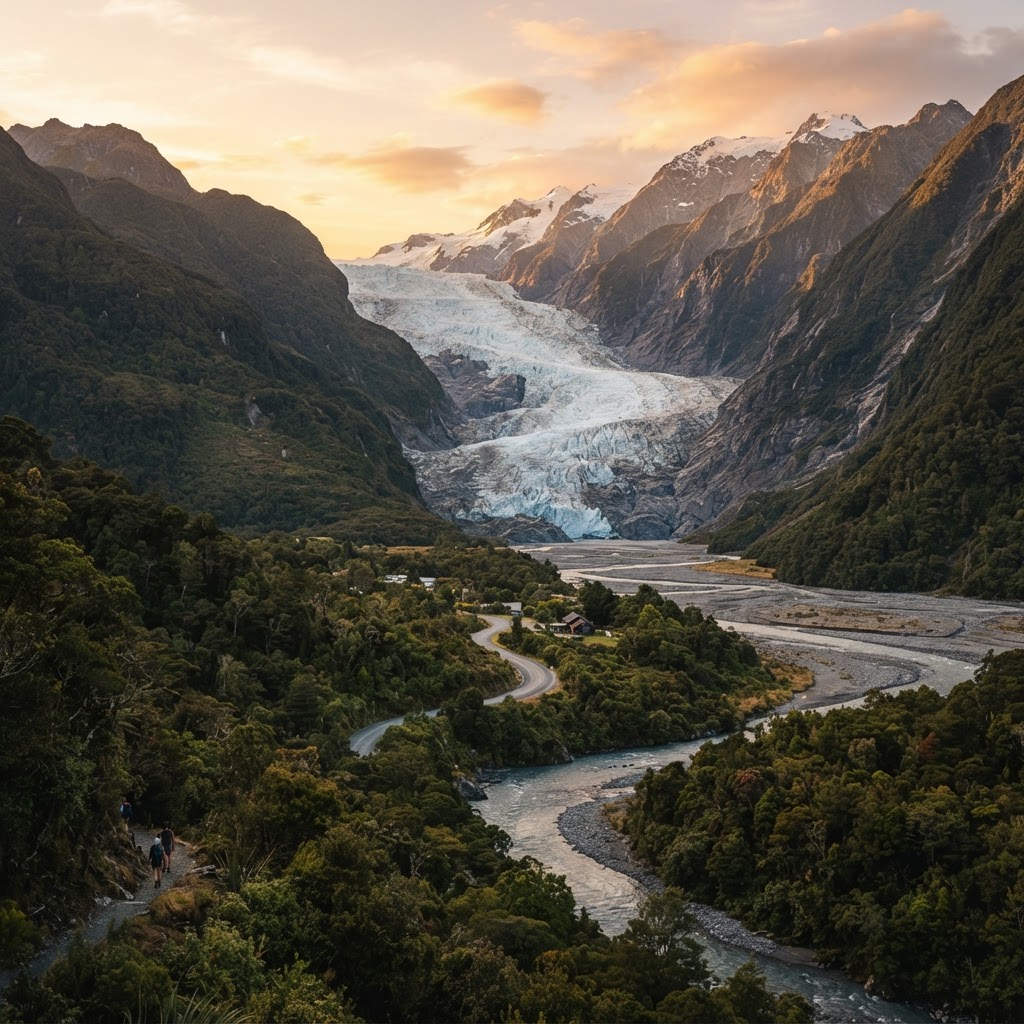
Franz Josef & Fox Glaciers, New Zealand
Temperate rainforest valleys meeting ancient, retreating rivers of maritime ice.
Plan & book
Sort your Franz Josef & Fox Glaciers, New Zealand trip in one place.
We point you to the booking tools we'd actually use — live prices, no markup. Or let us build the day-by-day plan around you first, then book.
Set along the rugged spine of the South Island's West Coast within Westland Tai Poutini National Park, Franz Josef and Fox Glaciers represent one of the planet's rare maritime glacial environments. Here, steep alpine ice plunges down toward sea level, terminating amid dense, temperate podocarp rainforest. Once reachable on foot from highway-adjacent gravel paths, the retreating terminal faces now require helicopter ascents to touch blue ice, while the valley floors offer moody riverbed walks, dark reflection lakes, and the raw elemental power of New Zealand's wettest, most untamed corridor.
2 nights
Best time
March to April (crisp autumn days, settled weather fronts, and thinning trail traffic).
Build your own trip with these prebuilt itineraries
Each one is a tested, day-by-day plan for Franz Josef & Fox Glaciers, New Zealand — start here, then make it yours.
3 Days of Ice & Rainforest Immersion in Franz Josef/Fox Glaciers
Deep backcountry trails, photography at dawn, and thermal rainforest relaxation
2 Days in Glacier Country in Franz Josef/Fox Glaciers
First-time alpine highlights and essential heli-hike weather window
1 Day Highway 6 Road-Trip Express in Franz Josef/Fox Glaciers
Quick viewpoints, valley walks, and Lake Matheson on a coastal transit drive
To witness the jarring collision of subtropical-looking rainforest tree ferns directly adjacent to hanging icefalls and rugged braided riverbeds. It is also the premier staging ground for heli-hiking onto active crevasses and seracs without needing multi-day technical mountaineering logistics.
Where to stay
Getting there
Getting around
Food & drink
What it costs
Skip it if
Skip it if your budget cannot accommodate a helicopter tour and you exclusively want to touch blue ice, as ground-level trails only see the glacier from a distance; or if you despise persistent rain, as the West Coast receives up to 5 meters of annual precipitation.
When to go
Summer brings maximum warmth but torrential tropical rain fronts that ground helicopters for days at peak prices. Autumn delivers more stable high-pressure systems, extraordinary photography light, and fewer tour buses competing for heli-hike slots.
Peak (December to February)
Long daylight hours and warmer temperatures, but hotels sell out months ahead, and heavy rain spikes can cancel flights abruptly.
Shoulder (March to May & October to November)
Autumn (Mar–May) offers the most reliable flying conditions and stable light; spring (Oct–Nov) brings roaring waterfalls and bird breeding season alongside unpredictable alpine squalls.
Low (June to August)
Crisp, cold winter air frequently produces the highest rate of clear blue-sky days for glacier flights, though days are short and nights drop below freezing.
Neighborhoods
Where you stay shapes the trip. Here's how to think about it.
Franz Josef Township (Waiau)
Buzzing alpine outpost centered on Main Road / SH6, packed with helicopter bases, supply stores, and rain-friendly pubs.
Best for:First-timers, families needing amenities, and travelers wanting wet-weather backup plans.
Don't miss:The Franz Josef Glacier Valley Walk along the Waiho riverbed, and soaking at the Franz Josef Glacier Hot Pools afterward.
Fox Glacier Village (Weheka)
Laid-back, rural settlement with a farming-frontier feel, slower pace, and dramatic unhindered views toward Mount Tasman.
Best for:Landscape photographers, early risers, and travelers seeking quiet seclusion over pub crawls.
Don't miss:The 90-minute dawn loop track around Lake Matheson for mirror-glass reflections of Aoraki / Mount Cook.
Ōkārito
Remote, windswept coastal sanctuary 25 minutes north of Franz Josef, set between a giant shallow lagoon and crashing Tasman surf.
Best for:Kayakers, birders searching for the kōtuku (white heron), and travelers wanting to escape tour buses.
Don't miss:Renting a sea kayak at dawn on the Ōkārito Lagoon or walking the Ōkārito Trig Track for sweeping views across the Southern Alps.
Gillespies Beach
Wild, moody West Coast shoreline 21 km west of Fox Glacier, strewn with driftwood, old gold dredge tailings, and sea spray.
Best for:Campervan wild campers, coastal hikers, and rugged nature enthusiasts.
Don't miss:Walking the Miners Tunnel Track past historic gold-mining relics to the seal colony view point.
Destination intelligence
Updated 9/14/2026The structured record we plan every Franz Josef & Fox Glaciers, New Zealand itinerary from.
Walkability
Low overall. Villages themselves are compact and walkable, but glacier tracks, lakes, and trailheads require vehicle transport.
Transit quality
Poor. There is no suburban transit system; only occasional regional long-haul buses connect the towns along SH6.
Car needed
Yes. A rental car or campervan is essential to access trailheads, neighboring valleys, and scenic viewpoints safely.
Ideal duration
2 nights
Minimum useful
1 night
Peak season
December to February (warmest temperatures, busy trails, maximum demand for scenic flights and lodgings).
Shoulder season
March to May and October to November (crisper air, fewer crowds, though autumn brings shifting rain fronts).
Low season
June to August (coldest temperatures, shorter days, but frequently the clearest, crispest blue-sky flying weather).
Best for
Common mistakes
- Booking only a single night when planning a heli-hike; flights are routinely cancelled due to West Coast cloud and rain, making a 2-night buffer essential.
- Expecting to walk up and touch the ice on foot; rapid glacial retreat means valley-floor trails stop hundreds of meters short of the unstable terminal faces for safety.
- Visiting Lake Matheson in the windy midday rather than dead calm at dawn, missing the glassy mirror reflection.
- Underestimating driving times along winding State Highway 6, especially over Haast Pass or through the Otira Gorge.
Best nearby
See what a trip to New Zealand actually costs. Travel Budget Co.
How to plan it
- Book your heli-hike for the morning of your first full day; if low cloud cancels the flight, operators can roll your seat to the afternoon or next morning.
- Stay in Franz Josef for rainy-day insurance and dining options, but drive 25 minutes south to Fox Glacier for dawn photography at Lake Matheson.
- Do not attempt to drive from Queenstown to Franz Josef in a single rush; budget a full day along SH6 to stop at Haast Pass, Blue Pools, and Knight's Point.
- Pack a high-grade Gore-Tex waterproof jacket and insect repellent containing DEET or Picaridin—West Coast sandflies are ruthless near water and beaches.
- Combine the glacier country with an overnight or morning detour to Ōkārito Lagoon to paddle through undisturbed kahikatea swamp forest.
Questions
Readymade itineraries
Start from a tested template — then make it yours.
Ready to book
Lock in your Franz Josef & Fox Glaciers, New Zealand trip
Everything in one place. We may earn a small commission — it never costs you more.
Plan a trip to Franz Josef & Fox Glaciers, New Zealand
Pick a length and we'll build a day-by-day plan around how you travel — neighborhoods clustered, budget-aware, and editable.
Get better at planning trips like this
Occasional notes on planning smarter — no spam, unsubscribe anytime.
Plan a trip to Franz Josef & Fox Glaciers, New Zealand
Turn this guide into a day-by-day plan built around your pace, your group, and your budget.
Build my Franz Josef & Fox Glaciers, New Zealand trip