Namibia
Etosha National Park
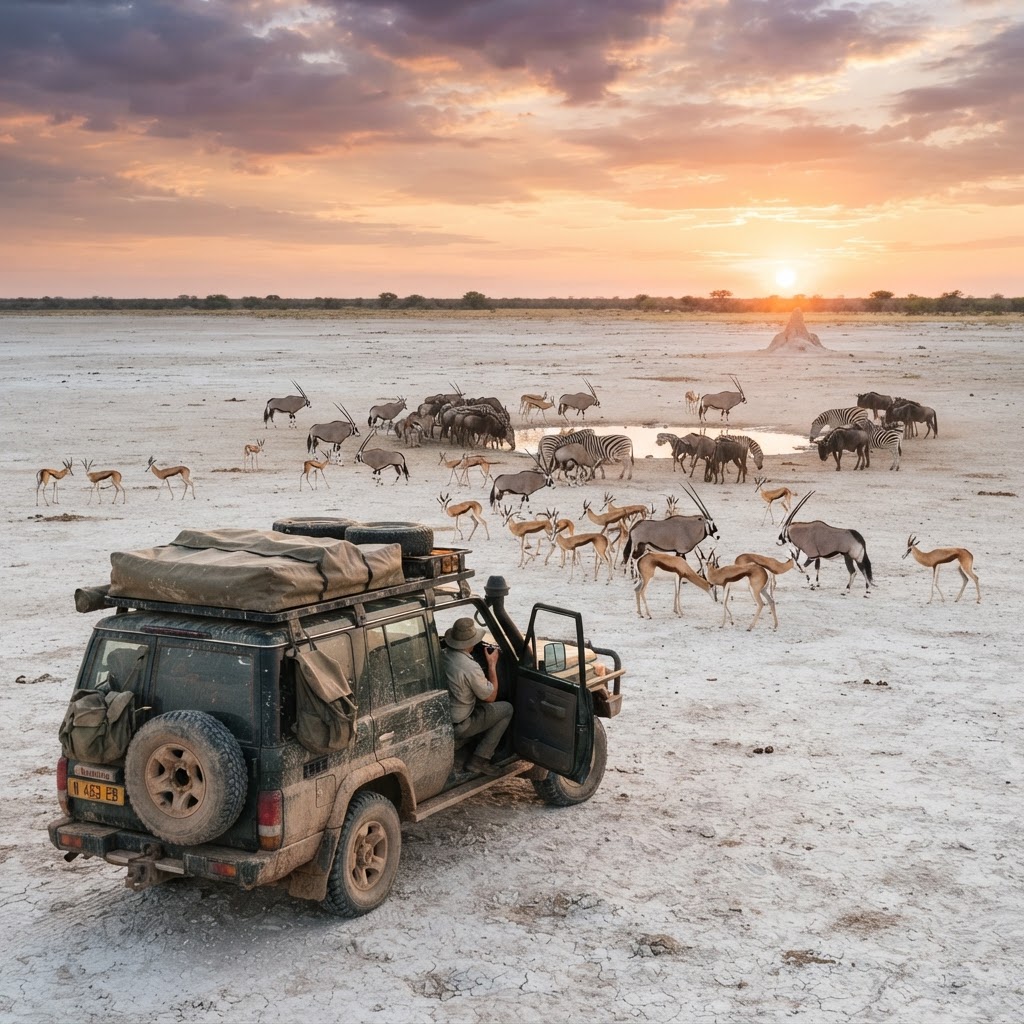
A stark white salt pan where wildlife congregates right before your parked car
Plan & book
Sort your Etosha National Park trip in one place.
We point you to the booking tools we'd actually use — live prices, no markup. Or let us build the day-by-day plan around you first, then book.
Covering more than 22,000 square kilometers of northern Namibia, Etosha National Park is defined by an enormous mineral salt pan so vast it is visible from space. Unlike East Africa's sprawling savannahs where tracking wildlife requires bouncing across endless tracks with a spotter, Etosha during the dry months operates on patience and geography: animals must drink, and water is sparse. You park your car at natural springs or camp waterholes and let the spectacle—endangered black rhinos, ghost-white dust-caked elephants, and prides of lions—come directly to you.
4 days
Best time
July through October for dramatic, dense wildlife congregations at shrinking waterholes.
Build your own trip with these prebuilt itineraries
Each one is a tested, day-by-day plan for Etosha National Park — start here, then make it yours.
5 Days in Etosha: Wildlife Photography & Floodlit Nights in Etosha National Park
Slow-paced photographic safari dedicated to golden hour light, chalk-white pan contrasts, and overnight floodlit waterhole vigils
4 Days in Etosha: The East-to-West Traverse in Etosha National Park
Complete cross-park migration tracking contrasting landscapes from Namutoni to Okaukuejo and the western plains
3 Days in Etosha: The Central Waterhole Circuit in Etosha National Park
First-time self-drive highlights focused on patient stakeouts at high-density central waterholes
Etosha is Africa's premier self-drive safari destination. Its hard-packed gravel roads are navigable without specialized off-road guiding, and the dry-season concentration around permanent waterholes yields some of the most reliable predator and megafauna viewing on the continent. The floodlit waterholes at the government rest camps offer an unmatched nighttime front-row seat to wildlife drama without needing to leave your lodging.
Where to stay
Getting there
Getting around
Food & drink
What it costs
Things to do
Book tours & tickets in Etosha National ParkSkip it if
Skip Etosha if you require off-road vehicle tracking to get within arm's reach of big cats, if you despise long driving stretches across dusty gravel, or if you demand ultra-luxurious, five-star pampering inside the core national park boundaries.
When to go
Dry winter air strips all surface water across the park, compelling elephants, rhinos, and predators to drink openly at accessible springs. You trade cold desert night temperatures and peak accommodation rates for near-effortless game viewing.
Peak (July to October)
Severe drought forces every species into tight waterhole rotations. Freezing dawn temperatures give way to warm afternoons; lodging inside park gates books out up to 11 months ahead.
Shoulder (May to June & November)
May and June offer clean air, thinner crowds, and comfortable daytime driving before extreme dry congregation begins. November brings dramatic skies, rising heat, and the very first drop of summer rains.
Low (December to April)
Rains turn the salt pan green and ephemeral ponds fill everywhere, scattering big game away from park tracks. Superb for newborn antelopes and migratory flamingos, but difficult for tracking cats.
Neighborhoods
Where you stay shapes the trip. Here's how to think about it.
Okaukuejo Sector (South-Central)
Bustling, predator-heavy savanna with the world's premier floodlit waterhole amphitheater.
Best for:First-timers, black rhino seekers, and photographers wanting 24-hour action without driving.
Don't miss:The floodlit Okaukuejo camp waterhole bench between 8:00 PM and midnight for sparring black rhinos.
Halali Sector (Central)
Mopane woodland ridges anchored by a quiet, steep-seated natural rock waterhole.
Best for:Mid-park transits, leopard trackers, and travelers seeking shade and fewer tourist vehicle jams.
Don't miss:Sitting silently at the Moringa waterhole at dusk to catch elusive leopard and honey badger sightings.
Namutoni Sector (East)
Lush reed-fringed artesian springs around an old German whitewashed fort.
Best for:Birders, cheetah spotting along Fischer's Pan, and visitors arriving via the Von Lindequist Gate.
Don't miss:Driving the scenic loop around Klein Namutoni and Chudop waterholes in the early morning for spotted hyenas and giraffe herds.
Western Etosha (Galton Gate & Dolomite)
Rugged, rolling dolomite hills, reddish earth, and vast solitude far from tour buses.
Best for:Second-time safari travelers, mountain zebra tracking, and self-drivers craving raw isolation.
Don't miss:The dramatic panoramic viewpoint over the western plains from the perched chalets of Dolomite Camp.
Ongava Private Game Reserve (Southern Border)
High-end, fenced private wilderness concession offering off-road tracking and night safaris.
Best for:Luxury travelers, walking safari enthusiasts, and honeymooners wanting plush service outside government rest camps.
Don't miss:A guided on-foot white rhino tracking excursion with an armed specialist guide.
Destination intelligence
Updated 9/14/2026The structured record we plan every Etosha National Park itinerary from.
Walkability
Zero outside of fenced camp perimeters. Leaving your vehicle outside designated enclosed rest camps and fenced picnic spots is strictly prohibited due to predator hazards.
Transit quality
None. There is no public transit to or within the park; visitors must rent a vehicle or arrive via fully guided commercial overland tours.
Car needed
Essential. You cannot experience the park independently without a private rental car or a contracted private safari guide and vehicle.
Ideal duration
4 days
Minimum useful
2 days
Peak season
July to October (deep dry season: sparse foliage, dry bush, extreme wildlife concentrations around shrinking waterholes, cool clear mornings).
Shoulder season
May to June (drier air begins, cooler temperatures, fewer crowds) and November (arrival of initial rains, greening bush, plains game giving birth).
Low season
January to March (summer rains: lush vegetation, muddy tracks, animals disperse away from waterholes, prime migratory birding).
Best for
Common mistakes
- Rushing from waterhole to waterhole instead of parking under an acacia tree and waiting 45 minutes for animals to rotate in.
- Failing to carry a spare tire and a tire pressure gauge; Etosha's sharp calcrete gravel eats under-inflated road tires.
- Underestimating travel times inside the park; the speed limit is 60 km/h, gate closures are strictly enforced at sundown, and heavy fines apply for late arrivals.
Best nearby
See what a trip to Namibia actually costs. Travel Budget Co.
How to plan it
- Traverse the park longitudinally from south to east: enter through Andersson Gate near Okaukuejo, spend 2 nights centrally, and exit through Von Lindequist Gate in the east to eliminate backtracking.
- Do not spend your entire day driving: pick an active perennial waterhole like Okaukuejo, Goas, or Chudop between 10:00 AM and 3:00 PM, cut the engine, and let thirsty wildlife rotate in front of you.
- Split your stay between an NWR camp inside the park for night waterhole access and a private reserve lodge outside (such as Ongava or Onguma) for culinary comfort and guided night drives.
- Pack a high-powered red-light headlamp and 8x42 or 10x42 binoculars; night action at the camp floodlit waterholes happens at variable distances where phones cannot focus.
- Never schedule a drive between Okaukuejo and Namutoni on your arrival or departure day; the 135-kilometer dirt traverse takes over 4 hours when accounting for 60 km/h limits and mandatory wildlife stops.
Questions
Readymade itineraries
Start from a tested template — then make it yours.
Ready to book
Lock in your Etosha National Park trip
Everything in one place. We may earn a small commission — it never costs you more.
Plan a trip to Etosha National Park
Pick a length and we'll build a day-by-day plan around how you travel — neighborhoods clustered, budget-aware, and editable.
Get better at planning trips like this
Occasional notes on planning smarter — no spam, unsubscribe anytime.
Plan a trip to Etosha National Park
Turn this guide into a day-by-day plan built around your pace, your group, and your budget.
Build my Etosha National Park trip