Turkey
Ephesus / Selçuk
A working Aegean market town anchoring the greatest Greco-Roman ruins in the Mediterranean
Plan & book
Sort your Ephesus / Selçuk trip in one place.
We point you to the booking tools we'd actually use — live prices, no markup. Or let us build the day-by-day plan around you first, then book.
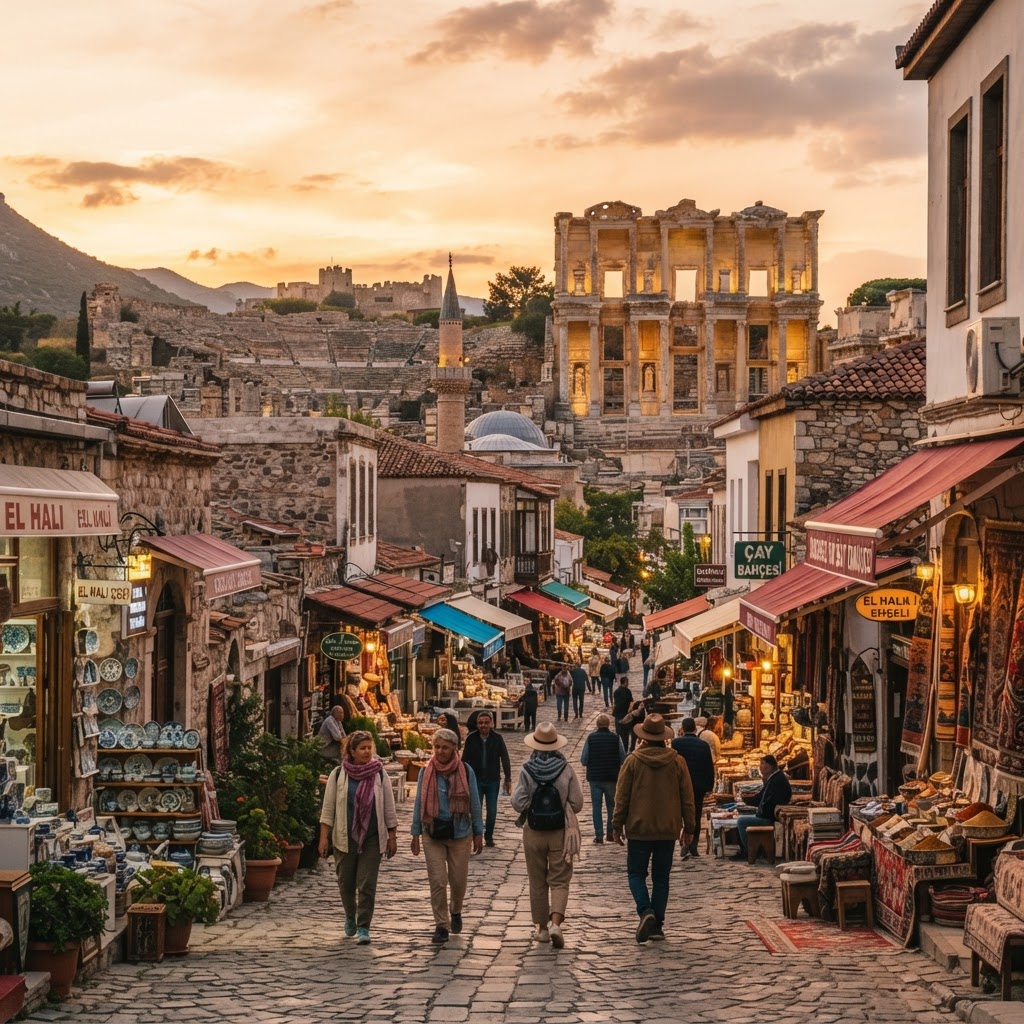
Selçuk is a grounded, citrus-and-olive-surrounded Aegean market town anchored by storks nesting atop Roman aqueducts and Byzantine fortifications. It also happens to share borders with Ephesus, the best-preserved classical metropolis in the Mediterranean. While most tourists experience the site as a rushed, sun-bleached cruise excursion from Kuşadası, sleeping in Selçuk flips the entire dynamic: you can enter the ancient ruins at 08:00 before tour bus fleets arrive, hike up Ayasuluk Hill in the late afternoon, and spend evenings lingering over grilled lamb and Aegean meze without the resort-town markup.
2 days
Best time
Mid-April through May and late September through October
Build your own trip with these prebuilt itineraries
Each one is a tested, day-by-day plan for Ephesus / Selçuk — start here, then make it yours.
3 Days in Ephesus & Beyond in Ephesus/Selçuk
Biblical heritage, early Christian sites, and the Ionian countryside
2 Days in Ephesus & Selçuk in Ephesus/Selçuk
Deep classical history, Terrace Houses, and hillside village culture
1 Day in Ephesus & Selçuk in Ephesus/Selçuk
Essential ancient ruins and classical highlights via public transit
Ephesus preserves classical scale like nowhere else: Curetes Street, the reconstructed two-story facade of the Library of Celsus, and the 25,000-seat Great Theatre give an authentic sense of walking through an operational imperial Roman capital. Staying in Selçuk puts you 3 kilometers away, giving you dawn access before bus tours clog the marble avenues, plus access to the exceptional Roman domestic mosaics at the Terrace Houses, the 6th-century Basilica of St. John, and the mountain village of Şirince.
Where to stay
Getting there
Getting around
Food & drink
What it costs
Things to do
Book tours & tickets in Ephesus / SelçukSkip it if
Skip staying overnight if you are indifferent to antiquity and only want sandy beach resorts or high-energy Aegean nightlife (head to Bodrum or Çeşme instead). Also skip if members of your party have severe mobility limitations and cannot handle steep, uneven ancient stone stairs and ramps.
When to go
Spring and autumn provide comfortable temperatures between 18°C and 26°C (64°F-79°F), avoiding both the blistering heat reflected off ancient marble and the suffocating midday cruise-tourist surges common in July and August.
Peak (June to August)
Expect intense daytime heat surpassing 38°C (100°F) with virtually zero shade inside the ruins, plus dense crowds disembarking from Kuşadası cruise docks between 10:00 and 15:00.
Shoulder (April-May & September-October)
The prime window. Mild walking temperatures, lush wildflowers across the archaeological zones in spring, grape harvesting in Şirince in autumn, and manageable visitor volume.
Low (November to March)
Crisp air with periodic winter rain, but you will often have the Library of Celsus and the Great Theatre entirely to yourself at a fraction of summer lodging rates.
Neighborhoods
Where you stay shapes the trip. Here's how to think about it.
Ayasuluk Hill & Citadel Quarter
Cobbled, sloping residential alleys crowned by Byzantine ramparts and nesting storks
Best for:History buffs and boutique guesthouse lovers wanting quiet evenings
Don't miss:The panoramic view of the Aegean plain from inside the Saint John Basilica grounds at sunset
Selçuk Town Center (Çarşı)
Unpretentious, lively market hub structured around Roman aqueduct pillars and pedestrian squares
Best for:Budget travelers, transit connectors, and street-food lovers
Don't miss:A plate of wood-grilled çöp şiş with ice-cold ayran along the pedestrian stretch of Anton Kallinger Caddesi
İsabey Quarter
Sleepy, rural edge of town blending agricultural plots with monumental ruins
Best for:Travelers seeking tranquil mornings within walking distance of central sights
Don't miss:The soaring 14th-century carved marble portal and quiet courtyard of İsa Bey Mosque
Şirince Village
Hillside former Ottoman-Greek enclave of whitewashed stone houses surrounded by peach orchards and vineyards
Best for:Couples and romantic overnights wanting wine cellars and crisp mountain air
Don't miss:Local dry Narince wine paired with regional Aegean wild herbs on an orchard terrace away from the main tourist alley
Destination intelligence
Updated 9/14/2026The structured record we plan every Ephesus / Selçuk itinerary from.
Walkability
High in Selçuk town; site exploration at Ephesus requires 3-5 km of sustained walking on uneven classical stonework and marble.
Transit quality
High: frequent TCDD regional rail connects Selçuk directly with İzmir Airport, while central dolmuş minibuses serve Ephesus and Şirince seamlessly.
Car needed
Not required. Regional trains, taxis, and public dolmuş shuttles easily cover Selçuk, Ephesus, and Şirince. A rental car is only beneficial for exploring remote ruins like Priene or Didyma.
Ideal duration
2 days
Minimum useful
1 day
Peak season
June through August: maximum crowds from Aegean cruises, severe heat exceeding 35°C (95°F), and completely unshaded ancient streets.
Shoulder season
April to May and September to October: optimal walking weather (18°C-26°C), clear skies, lower cruise volume, and blooming countryside.
Low season
November through March: cool, rainy days and shorter museum hours, but you will often experience the grandest Roman monuments completely alone.
Best for
Common mistakes
- Entering Ephesus from the lower gate: entering the upper gate lets you walk downhill the entire length of Curetes Street rather than hiking uphill on slick marble.
- Skipping the Terrace Houses inside Ephesus to save time or ticket money: it is the single best-preserved domestic Roman archaeological site outside Herculaneum.
- Visiting between 11:00 and 15:00: mid-day brings hundreds of cruise ship tour groups from Kuşadası and oppressive, unshaded heat reflecting off white marble.
- Booking a hotel in resort-heavy Kuşadası when your primary goal is Ephesus: Kuşadası adds unnecessary transfer traffic, high prices, and cruise port chaos.
- Wearing slick leather-soled dress shoes: two-thousand-year-old polished marble streets are exceptionally slippery, requiring grippy sneakers or hiking shoes.
Best nearby
See what a trip to Turkey actually costs. Travel Budget Co.
How to plan it
- Base yourself in Selçuk or Şirince rather than resort-heavy Kuşadası to eliminate long transfer times and cruise port markups.
- Pair your morning ruins walk with an afternoon visit to the Ephesus Archaeological Museum in Selçuk town—it houses the delicate artifacts, including the famous Artemis statues, removed from the site.
- Do not visit the ruins between 11:30 and 15:30 in summer; the white marble acts like an oven and tour groups bottle-neck the Curetes Street corridor.
- Take a taxi up to the Upper Gate and walk downhill through Ephesus, finishing at the Lower Gate where minibuses wait to take you back into town.
- Spend Friday evening or Saturday morning in Selçuk to catch the authentic weekly Saturday open-air produce and spice market near the bus terminal.
Questions
Readymade itineraries
Start from a tested template — then make it yours.
Ready to book
Lock in your Ephesus / Selçuk trip
Everything in one place. We may earn a small commission — it never costs you more.
Plan a trip to Ephesus / Selçuk
Pick a length and we'll build a day-by-day plan around how you travel — neighborhoods clustered, budget-aware, and editable.
Get better at planning trips like this
Occasional notes on planning smarter — no spam, unsubscribe anytime.
Plan a trip to Ephesus / Selçuk
Turn this guide into a day-by-day plan built around your pace, your group, and your budget.
Build my Ephesus / Selçuk trip