Australia
Darwin & Kakadu
Ancient sandstone floodplains, saltie territory, and balmy tropical open-air nights.
Plan & book
Sort your Darwin & Kakadu trip in one place.
We point you to the booking tools we'd actually use — live prices, no markup. Or let us build the day-by-day plan around you first, then book.
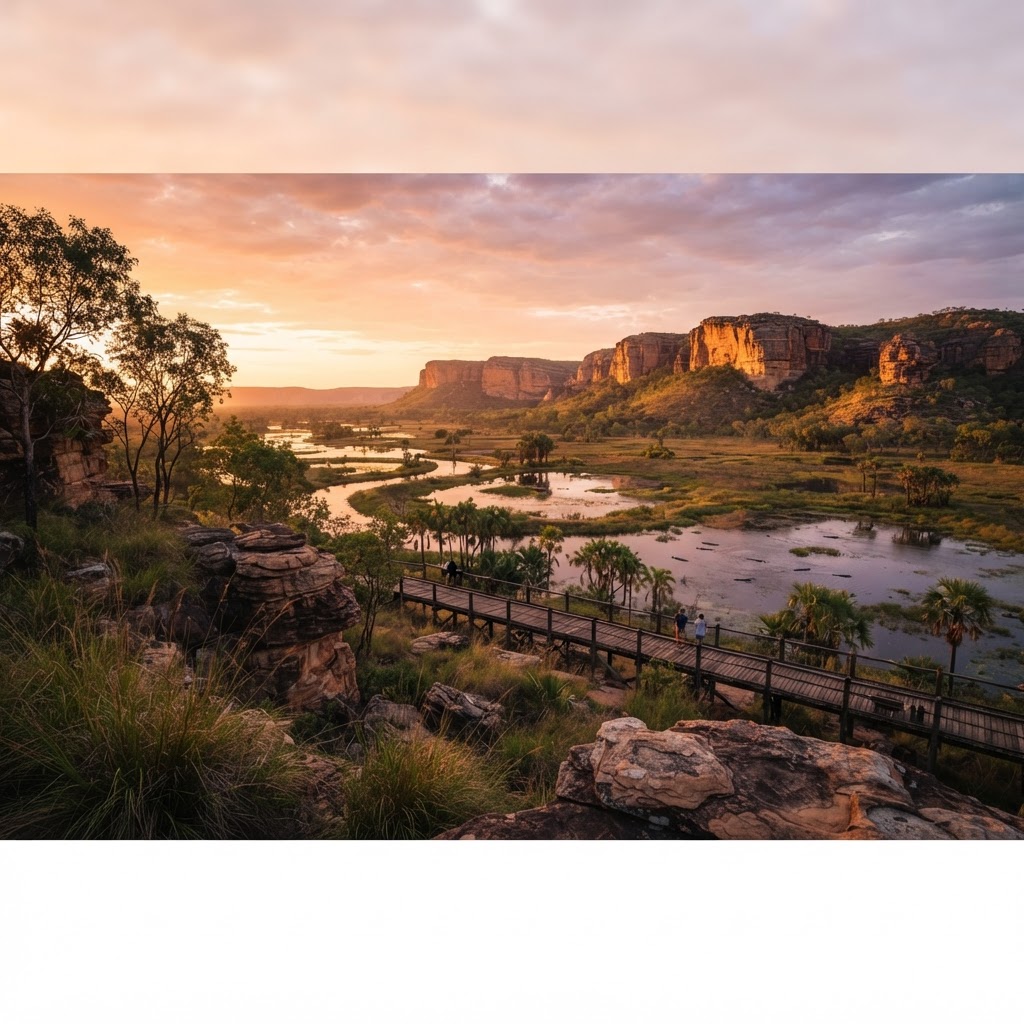
Darwin and Kakadu form the dual heart of Australia's Top End. Darwin serves as a compact, multicultural harbour outpost where Southeast Asian night markets meet frontier pub life, while Kakadu National Park, located three hours southeast, holds 20,000 square kilometres of dual-World Heritage floodplains, Aboriginal rock art galleries dating back tens of thousands of years, and tidal rivers thick with saltwater crocodiles.
6 to 7 days
Best time
June through early August for open 4WD access, minimal humidity, and croc-safe road travel.
Build your own trip with these prebuilt itineraries
Each one is a tested, day-by-day plan for Darwin & Kakadu — start here, then make it yours.
9 Days Top End Indigenous Heritage & Wildlife in Darwin/Kakadu
In-depth, slow-paced immersion focusing on ancient First Nations rock art, cultural tours, and world-class wetland birdwatching
7 Days Kakadu & Top End 4WD Adventure in Darwin/Kakadu
Rugged outdoor exploration tracking unsealed trails, deep gorges, remote billabongs, and Jim Jim Falls in a high-clearance 4WD
5 Days in Darwin & Kakadu Highlights in Darwin/Kakadu
First-time overview balancing Darwin waterfront culture, sunset markets, and sealed-road Kakadu rock art and wetland cruises
Go for one of the most culturally grounded wilderness landscapes on earth. Kakadu lets you examine 65,000-year-old rock art sites alongside Bininj/Mungguy heritage, cruise billabongs teeming with apex predators at sunrise, and transition into Darwin's balmy, breezy dry-season food scene with fresh barramundi and laksa by the Timor Sea.
Where to stay
Getting there
Getting around
Food & drink
What it costs
Things to do
Book tours & tickets in Darwin & KakaduSkip it if
Skip this region if you cannot handle tropical heat and humidity, if you require a classic sand-and-surf beach holiday where you can swim freely in the ocean, or if you prefer dense, walkable metropolitan European-style cities over wilderness driving.
When to go
The Top End operates on monsoonal extremes rather than standard seasons. Visiting during peak dry season (June–August) guarantees all park tracks, rock art shelters, and swimming holes are graded and clear of wet-season floodwaters, but car rental rates spike and campsite spaces tighten. Come in May or September only if you are willing to trade uncomfortably building heat (the 'build-up') for fewer tourist caravans on the Arnhem Highway.
Peak (June–August)
Daytime temperatures sit reliably around 31°C with cooler, rain-free nights down to 18°C. Every unsealed track to Jim Jim Falls and Maguk generally opens by July, but 4WD rental inventory books out six months ahead.
Shoulder (April–May & September–October)
April and May bring dramatic post-monsoon greenery and roaring falls, but major unsealed tracks may still be submerged. September and October bring fierce humidity and temperatures pushing 38°C ('the build-up'), concentrating huge flocks of birds and salties around shrinking billabongs.
Low (November–March)
The true wet season brings monsoonal deluges, lightning storms, and widespread road washouts. Kakadu's waterfalls can only be viewed via scenic flight from Jabiru, and open-air walking in the midday heat is physically draining.
Neighborhoods
Where you stay shapes the trip. Here's how to think about it.
Darwin Waterfront & CBD
Harbour breeze, modern sea-wall dining, safe swimming lagoons, and easy pedestrian access to the Mitchell Street pub corridor.
Best for:First-timers, families wanting stinger-free swimming, and travelers without an early car rental.
Don't miss:The man-made Darwin Waterfront Recreation Lagoon (fully netted against marine stingers and crocs) followed by local wild-caught barramundi at Snapper Rocks.
Fannie Bay & Parap
Leafy tropical residential streets, mid-century elevated houses, Saturday morning laksa rituals, and immediate access to coastal reserve sunsets.
Best for:Food-focused travelers, returning visitors, and those who prefer a quiet tropical neighborhood over CBD concrete.
Don't miss:Mary's Laksa stall at the Saturday Parap Village Market; join the queue by 8:30 AM before the heat and broth sell out.
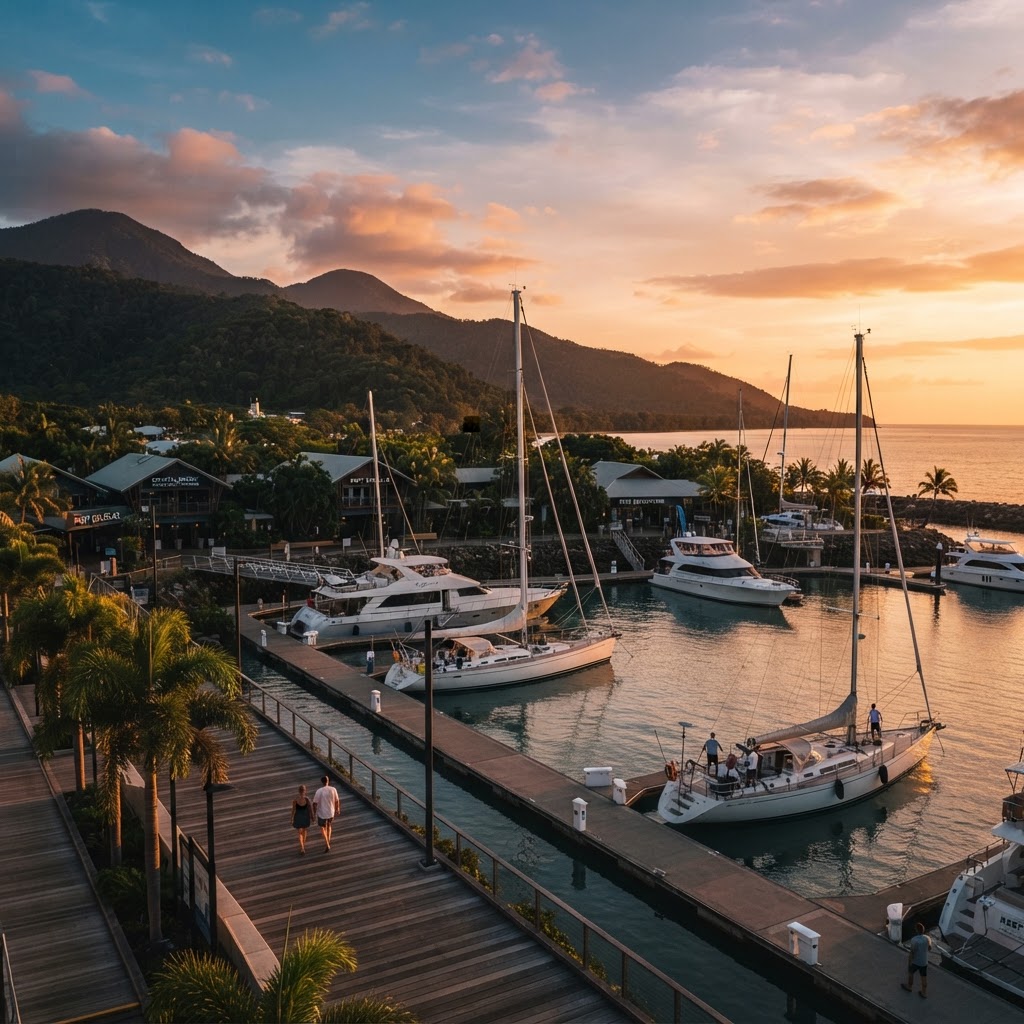
Cullen Bay Marina
Marina boardwalk lined with yachts, charter boat departures, and casual fish-and-chip turf where locals gather on the grassy lawn for dusk.
Best for:Couples, sunset seekers, and anyone heading out on a bluewater fishing charter.
Don't miss:Taking a takeaway paper parcel of grilled coral trout from La Beach out onto the grass of Cullen Bay to watch the sunset over the Timor Sea.
Jabiru (Kakadu Central Hub)
Frontier service town and former uranium-mining outpost inside the park, functioning as the primary logistical base for central billabongs.
Best for:Road-trippers wanting brick-and-mortar hotel comforts, air conditioning, and a central base to access northern and central Kakadu sites.
Don't miss:The Bowali Visitor Centre for mandatory road-condition reports from park rangers before setting off toward unsealed tracks.
Cooinda (Kakadu Wetlands Hub)
Isolated river-basin outpost deep in South Alligator country, surrounded by paperbark swamps, active birdlife, and crocodile-heavy channels.
Best for:Photographers, wildlife watchers, and campervan road-trippers wanting to be on the water at first light.
Don't miss:The 6:45 AM sunrise Yellow Water Cruise; you must sleep in Cooinda the night before to make the dawn departure without a dangerous pre-dawn drive on unlit highways.
Destination intelligence
Updated 9/14/2026The structured record we plan every Darwin & Kakadu itinerary from.
Walkability
Low. Central Darwin and the Waterfront precinct are compact and pedestrian-friendly, but visiting markets, outer coastal points, and Kakadu's vast landscapes requires private motor transport.
Transit quality
Basic. Darwin's public bus network services suburbs and city interchanges adequately, but no passenger rail or public transport exists connecting Darwin to Kakadu or between national park sites.
Car needed
Yes. A rental vehicle (preferably a high-clearance 4WD if exploring beyond the sealed Arnhem and Kakadu Highways) is essential to explore Kakadu and the Top End independently.
Ideal duration
6 to 7 days
Minimum useful
4 days
Peak season
June through August (Dry season: warm sunny days around 31°C, crisp cooler nights, zero rain, lower humidity, all park tracks and billabongs open).
Shoulder season
April–May and September–October (The transition months: hotter days, building humidity or drying tracks, smaller crowds, and dramatic shifting skies).
Low season
November through March (Wet season: oppressive humidity, tropical monsoons, road closures, and localized flooding, but roaring waterfalls and active wildlife).
Best for
Common mistakes
- Attempting Kakadu as a single-day trip from Darwin (spending 6+ hours driving on a sealed highway leaves little time on Country).
- Ignoring croc-safety signage: never swim in unmanaged natural waterways, rivers, or ocean beaches anywhere in the Top End.
- Visiting during peak wet season (January to March) without expecting unsealed roads, Jim Jim Falls, and key river crossings to be completely impassable.
- Renting a 2WD passenger car if you intend to explore unsealed interior tracks like Jim Jim Falls or Maguk, which mandate high-clearance 4WD vehicles.
Best nearby
See what a trip to Australia actually costs. Travel Budget Co.
How to plan it
- Anchor your Darwin days around Thursday or Sunday to catch the Mindil Beach Sunset Markets; visiting Darwin mid-week misses the core open-air community rhythm.
- Sleep in Cooinda rather than Jabiru if your priority is the sunrise Yellow Water Cruise; driving from Jabiru to Cooinda before dawn involves dodging wandering brumbies and buffalo in pitch black.
- Time your Ubirr visit specifically for 90 minutes before sunset; the hike up to the Nadab lookout is brutal in midday heat, but the late-afternoon light across the floodplains is the park's quintessential visual.
- Pair your Top End trip with Litchfield National Park on the return leg from Kakadu; Litchfield's spring-fed waterfalls (Florence Falls, Buley Rockhole) offer reliable, croc-monitored freshwater swimming that Kakadu rarely provides.
- Never plan highway drives after dusk between Darwin and Kakadu; black cows, wild horses, and water buffalo frequently stand on the unlit bitumen to escape highway-edge mosquitoes.
Questions
More in Australia
Readymade itineraries
Start from a tested template — then make it yours.
Ready to book
Lock in your Darwin & Kakadu trip
Everything in one place. We may earn a small commission — it never costs you more.
Plan a trip to Darwin & Kakadu
Pick a length and we'll build a day-by-day plan around how you travel — neighborhoods clustered, budget-aware, and editable.
Get better at planning trips like this
Occasional notes on planning smarter — no spam, unsubscribe anytime.
Plan a trip to Darwin & Kakadu
Turn this guide into a day-by-day plan built around your pace, your group, and your budget.
Build my Darwin & Kakadu trip