Panama
Bocas del Toro
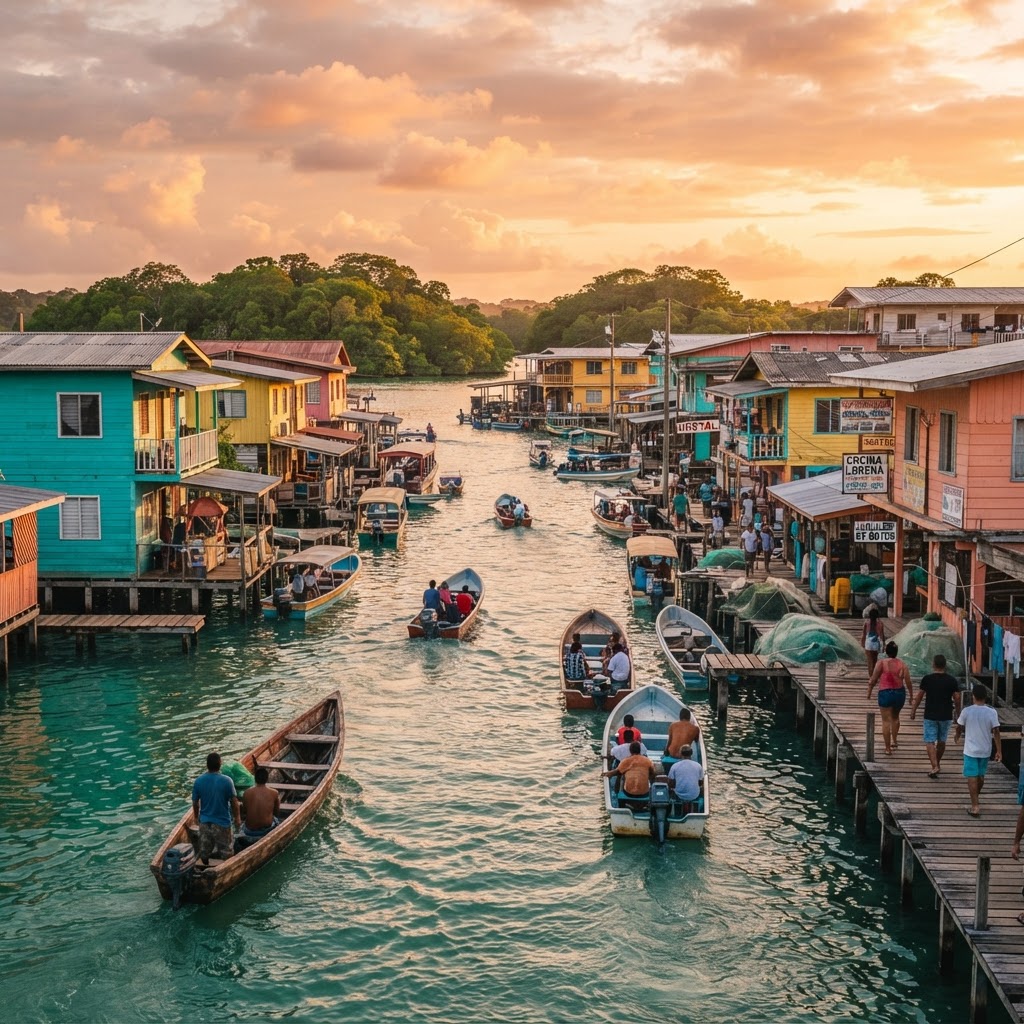
A ragged Caribbean archipelago where mangrove boat commutes replace paved roads
Plan & book
Sort your Bocas del Toro trip in one place.
We point you to the booking tools we'd actually use — live prices, no markup. Or let us build the day-by-day plan around you first, then book.
Bocas del Toro is Panama's rugged, unpolished Caribbean outpost. Rather than manicured all-inclusive resorts, you find timber stilt houses hovering over turquoise swells, outboard water taxis darting between dense mangrove keys, and dense rainforest humming with poison dart frogs. Spanning six principal islands and hundreds of coral cays, life here revolves entirely around the tide, surf breaks, and boat fuel.
5 to 6 days
Best time
February to March for dry sunny days and peak surf, or September to October for glassy, mirror-flat diving conditions.
Build your own trip with these prebuilt itineraries
Each one is a tested, day-by-day plan for Bocas del Toro — start here, then make it yours.
6 Days in Bocas: The Complete Archipelago Circuit in Bocas del Toro
A balanced first-time exploration dividing nights between bustling Isla Colón and the wild, remote beaches of Isla Bastimentos
7 Days in Bocas: Off-Grid Nature & Eco-Lodges in Bocas del Toro
Slow, sustainable travel focused on solar-powered overwater bungalows, marine biodiversity, dolphin watching, and tranquil outer keys
4 Days in Bocas: Surf, Waves & Town Life in Bocas del Toro
Surfing Caribbean reef breaks, beach biking, and enjoying the lively nightlife of Bocas Town and Isla Carenero
Go for the rare, visceral blend of untamed Neo-tropical rainforest dropping directly into Caribbean coral reef. It offers world-class reef breaks for surfers, boat-access-only jungle lodges, and unvarnished Afro-Antillean maritime culture without the hyper-commercialized gloss of standard resort towns.
Where to stay
Getting there
Getting around
Food & drink
What it costs
Things to do
Book tours & tickets in Bocas del ToroSkip it if
Skip Bocas del Toro if you rely on predictable air conditioning, manicured pavements, punctuality, and traditional 5-star hotel luxury. If you get boat sick easily or get frustrated by sudden equatorial downpours and erratic utility grids, you will struggle here.
When to go
Bocas is tropical rainforest, meaning rain can fall any week of the year. The traditional dry season (January–March) brings reliable sun and world-class surf breaks but peaks in hotel rates and harbor congestion; the September–October shoulder window flips the sea into a dead-calm swimming pool with empty beaches and slashed rates.
Peak (January to March, plus holiday weekends)
Crisp sunny weather and prime surf conditions across reef breaks. Expect packed water taxis, bustling Bocas Town bars, and higher lodge minimums.
Shoulder (April to May & September to October)
September and October feature the calmest waters of the year with virtually no ocean swell—ideal for boat tours and snorkeling, with zero crowds.
Low (June to August & December)
Heavy tropical squalls and choppier seas. Great for budget travel, but expect rain showers that can disrupt open-skiff crossings and snorkel visibility.
Neighborhoods
Where you stay shapes the trip. Here's how to think about it.
Bocas Town (Isla Colón)
Rambling clapboard waterfront hub rattling with outboard pangas, delivery trucks, and late-night reggaeton.
Best for:First-timers, bar hoppers, and travelers who want walkable access to tour operators, ATMs, and diverse dining.
Don't miss:Dinner at El Último Refugio, perched directly over the water away from the noisy main strip of Calle 3.
Playa Bluff (Isla Colón)
Miles of pounding amber sand backed by dense jungle, dirt roads, and breezy, eco-conscious open-air retreats.
Best for:Couples and surfers seeking total quiet, heavy shorebreak barrels, and rainforest sounds instead of town commotion.
Don't miss:Renting a cruiser bike or hailing a 4x4 truck taxi to sip passionfruit cocktails at Bluff Beach Bar while watching the shorebreak.
Isla Carenero
Laid-back, pedestrian-only sand fringe sit-in just a two-minute panga hop across the harbor from Bocas Town.
Best for:Travelers who want quick proximity to town restaurants without having to sleep inside the actual noise basin.
Don't miss:A long afternoon meal of whole fried snapper at Bibi's on the Beach, watching surfers carve the point break.
Old Bank (Isla Bastimentos)
Vibrant, unvarnished Afro-Antillean village where English patois echoes along a paved sidewalk perched above the swell.
Best for:Cultural explorers and independent wanderers comfortable with rustic timber guesthouses and genuine community rhythm.
Don't miss:Hiking the jungle ridge path up to Up in the Hill for organic cacao brownies and homemade passion fruit juice.
Red Frog Beach (Isla Bastimentos)
Thick coastal rainforest opening onto a broad, surf-pounded Caribbean beach anchored by low-key eco-lodges.
Best for:Families, nature lovers, and travelers who want comfortable resort infrastructure tucked directly beside hiking trails.
Don't miss:Taking the mangrove boardwalk trail from the bay dock to the ocean side to spot miniature red strawberry poison dart frogs.
Isla Solarte & Mangrove Outliers
Secluded off-grid overwater bungalows, quiet reef drop-offs, and dense mangrove channels alive with marine life.
Best for:Snorkelers, kayakers, and couples wanting deep immersion with zero roads, relying strictly on solar power and rainwater.
Don't miss:Paddling a kayak along the perimeter reef directly from your lodge deck to Hospital Point for drift snorkeling.
Destination intelligence
Updated 9/14/2026The structured record we plan every Bocas del Toro itinerary from.
Walkability
Low overall across the archipelago. Bocas Town itself is dense and walkable, but all travel between beaches, reef breaks, and islands requires outboard water taxis or bikes.
Transit quality
Fair. Completely reliant on an informal, cash-only network of private and communal water taxis and pick-up trucks.
Car needed
No. A rental car is useless in the archipelago; leave your vehicle in David or take regional flights directly to Isla Colón.
Ideal duration
5 to 6 days
Minimum useful
3 days
Peak season
January to March, plus major Panamanian holidays (Carnaval in February and Fiestas Patrias in November). Weather is at its driest and sunniest.
Shoulder season
April to May and September to October. September and October are especially prized by locals for flat, glassy waters and minimal crowds.
Low season
June through August and December. Characterized by higher rainfall and rougher Caribbean swell.
Best for
Common mistakes
- Staying entirely on Isla Colón and assuming Bocas Town represents the whole archipelago.
- Renting a car on the mainland: vehicles cannot reasonably cross, and parking in Almirante is stressful and unnecessary.
- Buying boat tickets from unauthorized street touts outside official Almirante dock offices.
- Failing to carry enough US dollar cash; ATMs on Isla Colón frequently run out of money or experience power cuts, and outer-island lodges rarely take cards without steep fees.
- Touching or lifting cushion sea stars out of the water at Starfish Beach for photographs, which fatally suffocates them.
Best nearby
See what a trip to Panama actually costs. Travel Budget Co.
How to plan it
- Split your stay: spend 2 nights in Bocas Town or Carenero for easy dining and water taxi access, then move 3 nights to an off-grid overwater bungalow on Solarte or Bastimentos.
- Carry at least $200-$300 in physical small-denomination US cash before flying in; the few ATMs in Bocas Town frequently run dry or suffer power outages during storms.
- Don't try to cram Starfish Beach (Playa Estrella) and Cayo Zapatilla into the same day—they sit on completely opposite sides of the archipelago and result in hours of choppy skiff transit.
- Coordinate domestic flights with a minimum 3-hour buffer if transferring from Tocumen International (PTY) to Marcos A. Gelabert Albrook Airport (PAC) across Panama City.
- Book overwater lodges on remote cays 3 to 6 months in advance for peak season (January–March), as boutique properties often have fewer than 6 bungalows.
Questions
Readymade itineraries
Start from a tested template — then make it yours.
Ready to book
Lock in your Bocas del Toro trip
Everything in one place. We may earn a small commission — it never costs you more.
Plan a trip to Bocas del Toro
Pick a length and we'll build a day-by-day plan around how you travel — neighborhoods clustered, budget-aware, and editable.
Get better at planning trips like this
Occasional notes on planning smarter — no spam, unsubscribe anytime.
Plan a trip to Bocas del Toro
Turn this guide into a day-by-day plan built around your pace, your group, and your budget.
Build my Bocas del Toro trip